On this page
Chapter 10 of NCERT's new Class 7 book, Exploring Society: India and Beyond, Part I (code gees1, First Edition April 2025, Reprint 2026-27), closes the book's Governance and Democracy theme. CBSE publishes no separate 2026-27 curriculum for Classes 6 to 8; these classes follow the NCERT book, so this chapter is assessed by the school.
What is a constitution, and why does India need one?
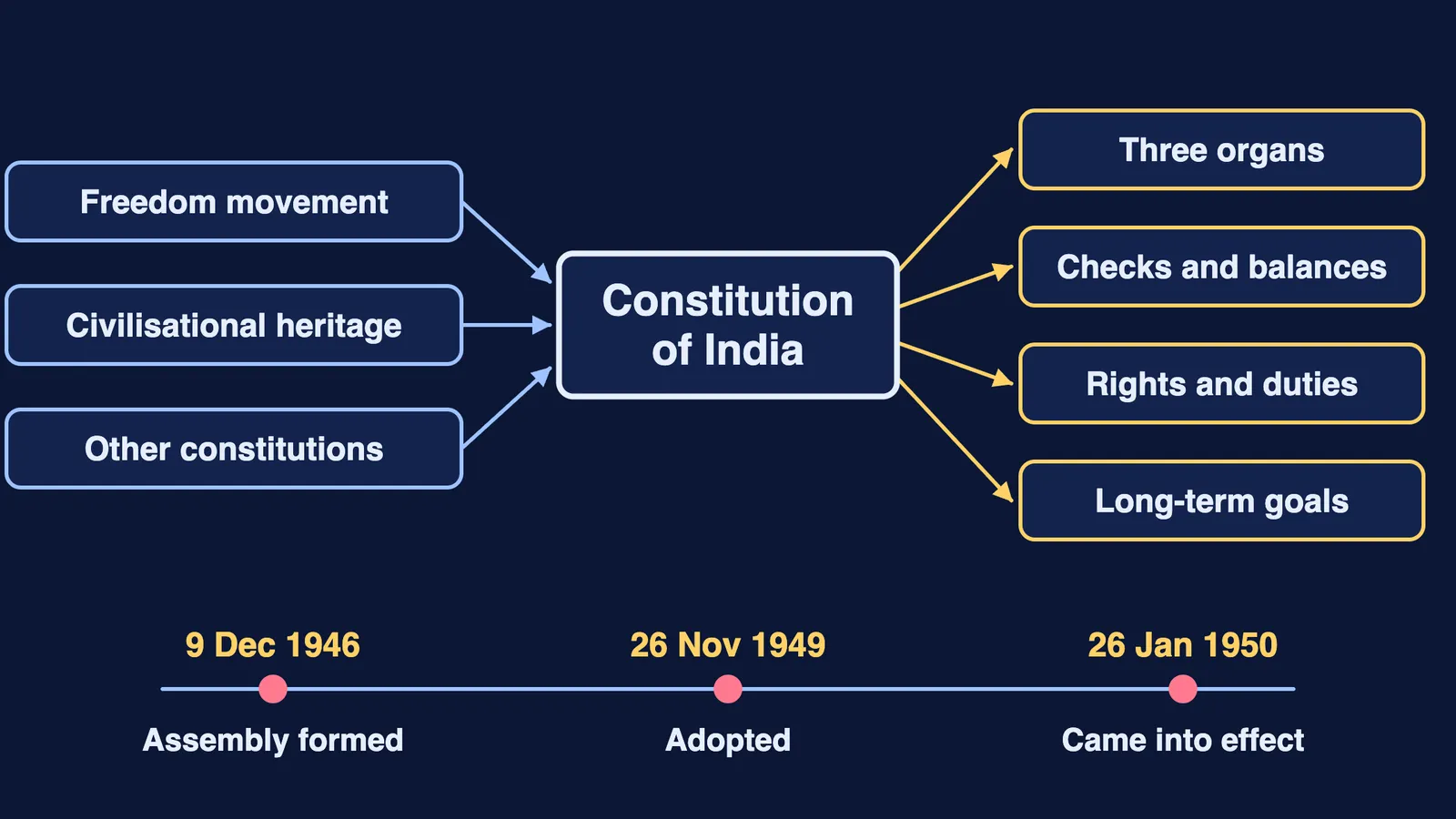
The chapter describes a constitution as the document setting down the core laws and principles a nation runs on. It covers four things:
the legislature, executive and judiciary, and their jobs;
checks and balances among those organs, for fairness and accountability;
the rights and duties of citizens;
the nation's long-term goals.
The book compares it to a game's rulebook that settles disputes. Many constitutions, India's included, also state values such as equality, justice, fraternity and freedom.
India's now has 25 parts and 12 schedules (22 and 8 in 1950); the book calls it the world's largest written constitution.
How was the Indian Constitution made?
A Constituent Assembly was set up on 9 December 1946. It began with 389 members, reduced to 299 after Partition, and 15 of them were women. Provincial legislative assemblies elected the members. Dr. Rajendra Prasad chaired the Assembly; Dr. B.R. Ambedkar headed the Drafting Committee that prepared the first text.
The Assembly adopted the Constitution on 26 November 1949, and it came into effect on 26 January 1950, the day we mark as Republic Day. The original sits in Parliament in a glass case filled with helium, a gas that does not react with paper or ink.
The book names three influences:
The freedom movement: ideals such as equality, justice and freedom, plus answers on voting, separation of powers and amendment.
India's civilisational heritage: for example accepting that people can hold different points of view, and the idea of the world as one family; the book links the stress on people's duties to the Fundamental Duties.
Other countries' constitutions: liberty, equality and fraternity from France, the Directive Principles from Ireland, and the idea of an independent judiciary from the USA.
What are the Constitution's key features?
Beyond the three organs and three tiers (central, state, local), the chapter highlights:
Fundamental Rights, such as equality before law (Article 14) and the right to education (Article 21-A). The book says you can go to court if these are denied.
Directive Principles of State Policy, goals the government should work towards, such as public health and nutrition (Article 47). They guide the government, but you cannot go to court to enforce them.
Fundamental Duties, such as protecting the natural environment, expected of every citizen.
The Constitution is a living document: changes, called amendments, are debated in Parliament first. For example, Fundamental Duties were added in 1976, and the 73rd Amendment brought in Panchayati Raj in 1992. In 2004 the Supreme Court held that flying the national flag is part of freedom of expression.
Worked example: right, principle or duty?
A town's public library refuses a membership card to a girl only because of her religion. Fundamental Right (equality): the book says such rights can be taken to court.
A state starts free midday meals in its schools. Directive Principle: the government is working towards nutrition and public health.
Residents of a colony clean up a lake and stop dumping plastic in it. Fundamental Duty: protecting the environment.
A father makes sure his 9-year-old daughter attends school. Fundamental Duty of a parent; the child's own entitlement is the right to education.
What does the Preamble say?
The book calls the Preamble the essence of the Constitution's guiding values. It opens with "We, the people of India", meaning the Constitution was made by the people's representatives, not handed down by a king or any outside power. It describes India as sovereign, socialist, secular, democratic and a republic, and sets out justice, liberty, equality and fraternity. The book notes that "socialist", "secular" and "integrity" were added by the 42nd Amendment in 1976.
How does Chapter 10 connect to the rest of the book?
It builds on Chapter 9's types of government and Grade 6 ideas such as Panchayati Raj. See the older Class 7 guide On Equality, how a state government works, and our Class 8 guide to the features of the Indian Constitution.
Practice questions (mark values are our suggestion):
Give two dates linked to the making of the Constitution and what happened on each. (2 marks)
Name the three influences on the Constitution, with one example of each. (3 marks)
A town council plans a public health scheme. Is this a Fundamental Right or a Directive Principle? Give one reason. (2 marks)
Why is the Constitution called a living document? Use one example. (3 marks)
Why does the Preamble begin with "We, the people of India"? What does it tell us about who made the Constitution? (3 marks)
Want to check which of these you can already answer? Fermi's AI tutor works out what you already know and builds a plan for the session.