

On this page
NCERT's *On Equality* opens the Class 7 book *Social and Political Life*. Its idea: the Constitution recognises every person as equal, but daily life in India does not always match that promise (NCERT, Chapter 1).
One check first. From the 2025-26 session, NCERT replaced three Class 7 books, *Social and Political Life* among them, with one, *Exploring Society: India and Beyond*, The Wire reported. If your school uses it, compare contents pages with our guide on how to check the deleted NCERT syllabus before buying a guide.
What does the Constitution promise in On Equality?
The chapter lists four provisions that recognise equality (NCERT, Chapter 1):
Everyone is equal before the law: “every person, from the President of the country to Kanta, a domestic worker, has to obey the same laws.”
No one can be discriminated against on the basis of religion, race, caste, place of birth or whether they are female or male.
Everyone can use public places: playgrounds, hotels, shops, markets, public wells, roads and bathing ghats.
Untouchability has been abolished.
Each promise rests on an Article; this wording is from the Constitution of India (Ministry of Law and Justice):
Article 14: “The State shall not deny to any person equality before the law or the equal protection of the laws within the territory of India.”
Article 15(1): “The State shall not discriminate against any citizen on grounds only of religion, race, caste, sex, place of birth or any of them.” Clause (2) covers shops, hotels, wells, roads and bathing ghats.
Article 17: “‘Untouchability’ is abolished and its practice in any form is forbidden.”
More in our guide to the features of the Indian Constitution for Class 8.
What is universal adult franchise in Class 7?
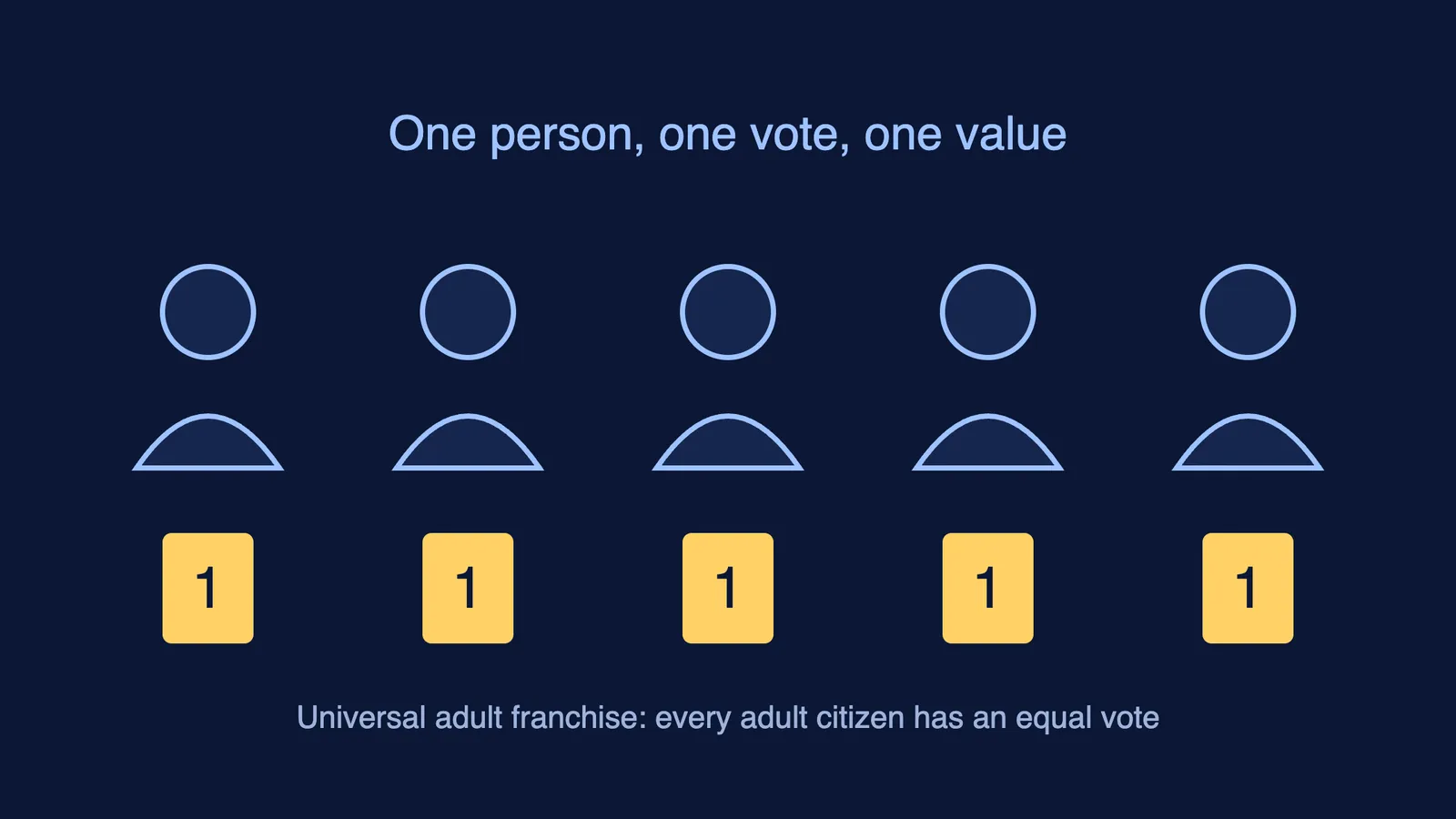
Universal adult franchise means that all adult citizens, those aged 18 and above, have the right to vote irrespective of their social or economic backgrounds, in the chapter's glossary (NCERT, Chapter 1).
The rule is Article 326: every citizen who is at least eighteen years old, and not disqualified by law, is entitled “to be registered as a voter” (Constitution of India). The age used to be 21. The footnote to Article 326 records that the Sixty-first Amendment Act, 1988 changed it to 18, with effect from 28 March 1989.
What forms of inequality does the chapter describe?
The chapter says people still treat others unequally on the basis of caste, religion, disability, economic status and because they are women, because “attitudes change very slowly” (NCERT, Chapter 1). It also notes the gap between schools the rich and the poor attend.
The key word is dignity, which the glossary defines as “thinking of oneself and other persons as worthy of respect.” The chapter also looks abroad: Rosa Parks refused to give up her bus seat to a white man on 1 December 1955, and, as the chapter puts it, the US Civil Rights Act of 1964 prohibited discrimination on the basis of race, religion or national origin.
How does the government try to make equality real?
The chapter names two ways: laws, and schemes for communities that were treated unequally for several centuries (NCERT, Chapter 1). Its main example is the midday meal, a cooked lunch in government elementary schools. Tamil Nadu was the first state to introduce it, and in 2001 the Supreme Court asked all state governments to begin it within six months. The benefits it lists:
More poor children enrol and attend school regularly.
Mothers no longer have to interrupt work to feed children at home.
Children of all castes eat together, and in quite a few places Dalit women are employed to cook the meal, which helps reduce caste prejudice.
Children who are not hungry can concentrate in class.
How do you write the exercise answers?
Use three parts: Point (one sentence that answers), Proof (the Article or law) and Picture (an example from the chapter or your own area).
Worked example, Exercise 3: what do you understand by the term “all persons are equal before the law”?
Point: Everyone, rich or poor, must obey the same laws and gets their equal protection.
Proof: Article 14 says the State shall not deny any person equality before the law.
Picture: The President and Kanta, a domestic worker, are bound by the same laws. In a democracy this matters because no one is above the rules.
A four-step revision plan:
Write the four promises from memory, then check them.
Match each to Article 14, 15 or 17, and add Article 326 for the vote.
List three midday meal benefits and two ways Article 15 addresses inequality.
Say one exercise answer aloud as Point, Proof, Picture.
In Class 9 the same ideas return in what democracy is and why we choose it. If science or maths homework is waiting too, Fermi's AI tutor can work out what you already know and build a plan for the session, so you start with a clear next step.


