On this page
The Basic Unit of Life is Chapter 1 of Unit IV, Cells and Organisms, in the CBSE Class XI Biotechnology (045) curriculum for 2026-27. We found no official PDF of CBSE's prescribed A Text Book of Biotechnology on cbseacademic.nic.in, so this guide follows the curriculum's topic list (cell structure and components, organisation of life) and uses Chapter 2, Cellular Organelles, of the NCERT Biotechnology Class XI book (Reprint 2026-27) as reference, as the curriculum allows.
How many marks is The Basic Unit of Life in Class 11 Biotechnology?
The 2026-27 curriculum gives Unit IV, Cells and Organisms, 25 of the 70 theory marks. Those 25 marks are shared with Chapter 2, Cell Growth and Development, and CBSE prints no separate figure for this chapter. Cell counting is one of the seven Class XI practicals.
How is this different from Cell: The Unit of Life in core Biology?
If you take Biology, our Cell: The Unit of Life Class 11 guide covers cell theory, cell sizes and the prokaryote and eukaryote comparison. The Biotechnology reference chapter walks through the cell one organelle at a time. From the NCERT reference chapter, these parts deserve extra time:
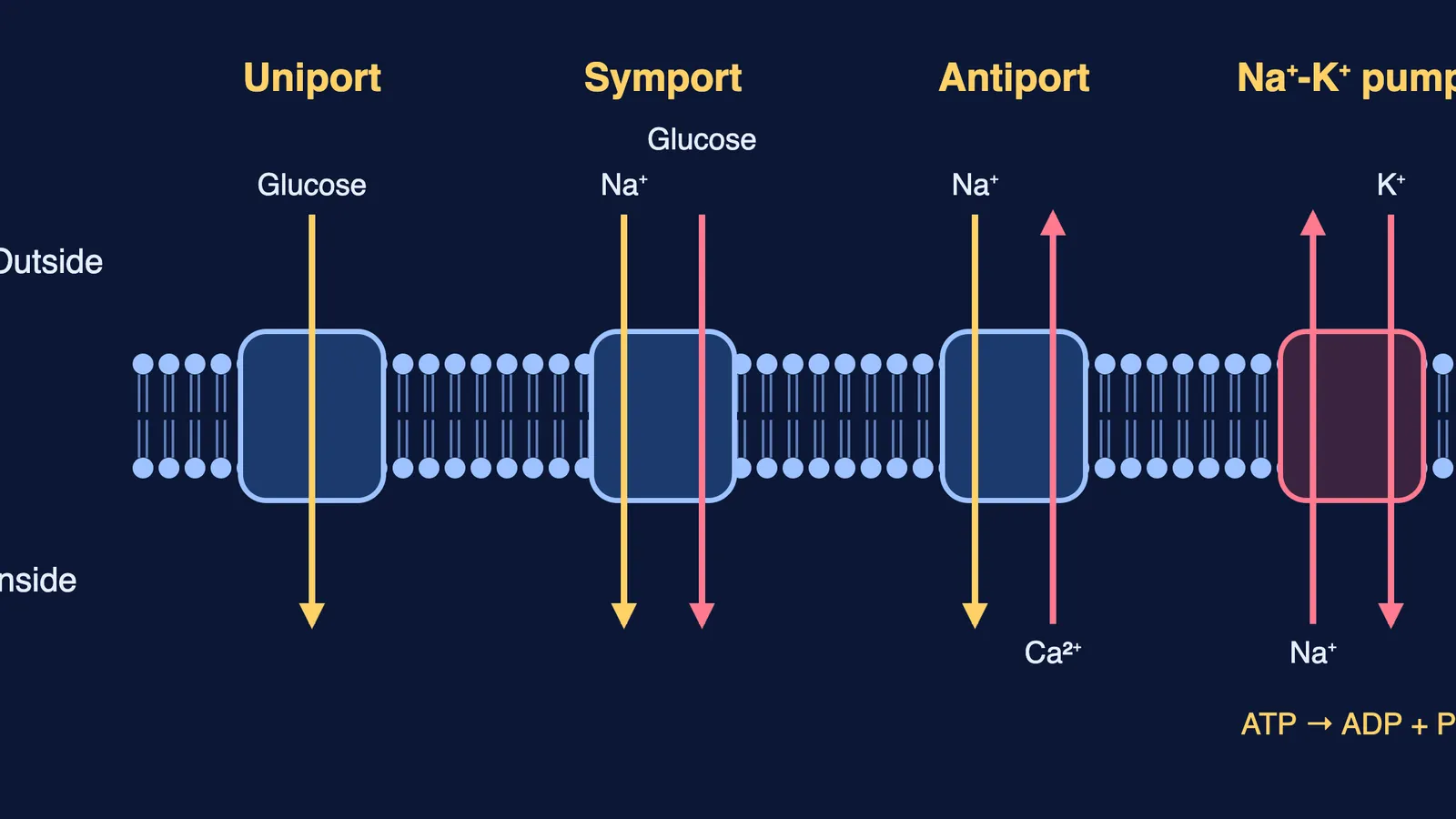
Moving things across the membrane: passive movement runs down a gradient; facilitated movement uses carrier or channel proteins such as aquaporins; active transport runs against the gradient, as in the ATP-driven Na⁺-K⁺ pump.
Coupled transport: symport carries two molecules the same way (Na⁺ with glucose), antiport carries them in opposite directions (the Na⁺-Ca²⁺ antiporter), and uniport carries a single molecule such as glucose.
Bacterial walls: Gram-positive bacteria have a thick wall and a single membrane; Gram-negative bacteria have a thin wall with two membranes. Many commonly used antibiotics work by blocking the cross-links between peptidoglycan strands.
Protein sorting: proteins made on free ribosomes are used inside the cell, while those made on ribosomes bound to rough ER can pass through the Golgi and leave the cell. Palade's group traced this route in the 1960s.
Cytoskeleton widths: microtubules are 25 nm (tubulin), intermediate filaments 10 nm and actin filaments 6 nm.
Nucleus and chromosomes: nuclear pore complexes built from nucleoporins, the nuclear lamina under the inner membrane, and nucleosomes (DNA wound on histones). A human cell holds 46 chromosomes; Joe Hin Tjio settled that count in 1956, correcting the figure of 48 Theophilus Painter gave in 1923.
The curriculum also lists organisation of life, but the NCERT reference chapter has no section with that title. Its overview only ties the body's many tasks to cells, and each cell's jobs to its organelles.
How do you tell which kind of membrane transport is happening?
Ask: is the molecule going down or up its gradient, and is it travelling alone?
Take a cell with 140 mM Na⁺ outside and 10 mM inside, and 140 mM K⁺ inside and 5 mM outside. These are our own illustrative values, not NCERT's.
Na⁺ is 140 ÷ 10 = 14 times more concentrated outside, so Na⁺ entering the cell is moving down its gradient.
K⁺ is 140 ÷ 5 = 28 times more concentrated inside, so pushing more K⁺ in is uphill. That is active transport, and in the NCERT chapter the Na⁺-K⁺ pump does it by splitting ATP into ADP and Pi.
If glucose enters together with Na⁺ through one protein, both move the same way: symport. The energy comes from Na⁺ flowing down its gradient, not directly from ATP.
If Na⁺ comes in while Ca²⁺ goes out through one protein, that is antiport. The direction is our example; NCERT gives none.
Which questions should you practise?
Marks in brackets are our suggestion; question 3 uses our own values.
Glucose and Na⁺ enter a cell together through one carrier. Name this type of transport. (1 mark)
Assertion (A): most lipids are made on smooth ER rather than in the cytosol. Reason (R): lipids are hydrophobic. Are A and R both true, and does R explain A? (1 mark)
A cell holds 150 mM K⁺ inside and 6 mM outside. How many times more concentrated is K⁺ inside, and which mechanism moves more K⁺ in? (2 marks)
A bacterium has a thick peptidoglycan wall and only one membrane. Classify it by Gram stain and explain how an antibiotic that blocks cross-linking slows its growth. (3 marks)
An oilseed is germinating. Explain why its glyoxysomes become more active, and name the organelles that work with them to turn fat into sugar. (3 marks)
Describe the nuclear envelope and the nuclear pore complex, and explain how RNA made in the nucleus reaches the cytoplasm. (5 marks)
Answer to 3: 150 ÷ 6 = 25 times; the Na⁺-K⁺ pump, by ATP-driven active transport.
What should you read next?
Unit IV's next chapter, Cell Growth and Development, covers cell division; our Cell Cycle and Cell Division Class 11 guide covers the core Biology version. For where this leads in Class 12, read Biotechnology Principles and Processes Class 12.
Short on time this week? Fermi's AI tutor works out what you already know and builds a plan for the session.