On this page
Unit 4 answers one question: once a small business works, how does it grow? This guide covers each sub-topic the 2026-27 curriculum lists, with fictional examples. It is a study summary, not business or financial advice.
What does Unit 4 cover, and how many marks is it worth?
The CBSE Entrepreneurship (066) curriculum for 2026-27 lists franchising (concept, types, and advantages and limitations for franchisor and franchisee) and mergers and acquisitions (concept, reasons and types).
Units 3 and 4 share one 20-mark block, so CBSE prints no separate figure for Unit 4. Theory is worth 70 marks and project work 30.
The prescribed book is CBSE's own Entrepreneurship Class XII, revised edition 2014.pdf). Its Unit 4 also covers why mergers fail and the value chain; the 2026-27 curriculum does not list those, so we skip them.
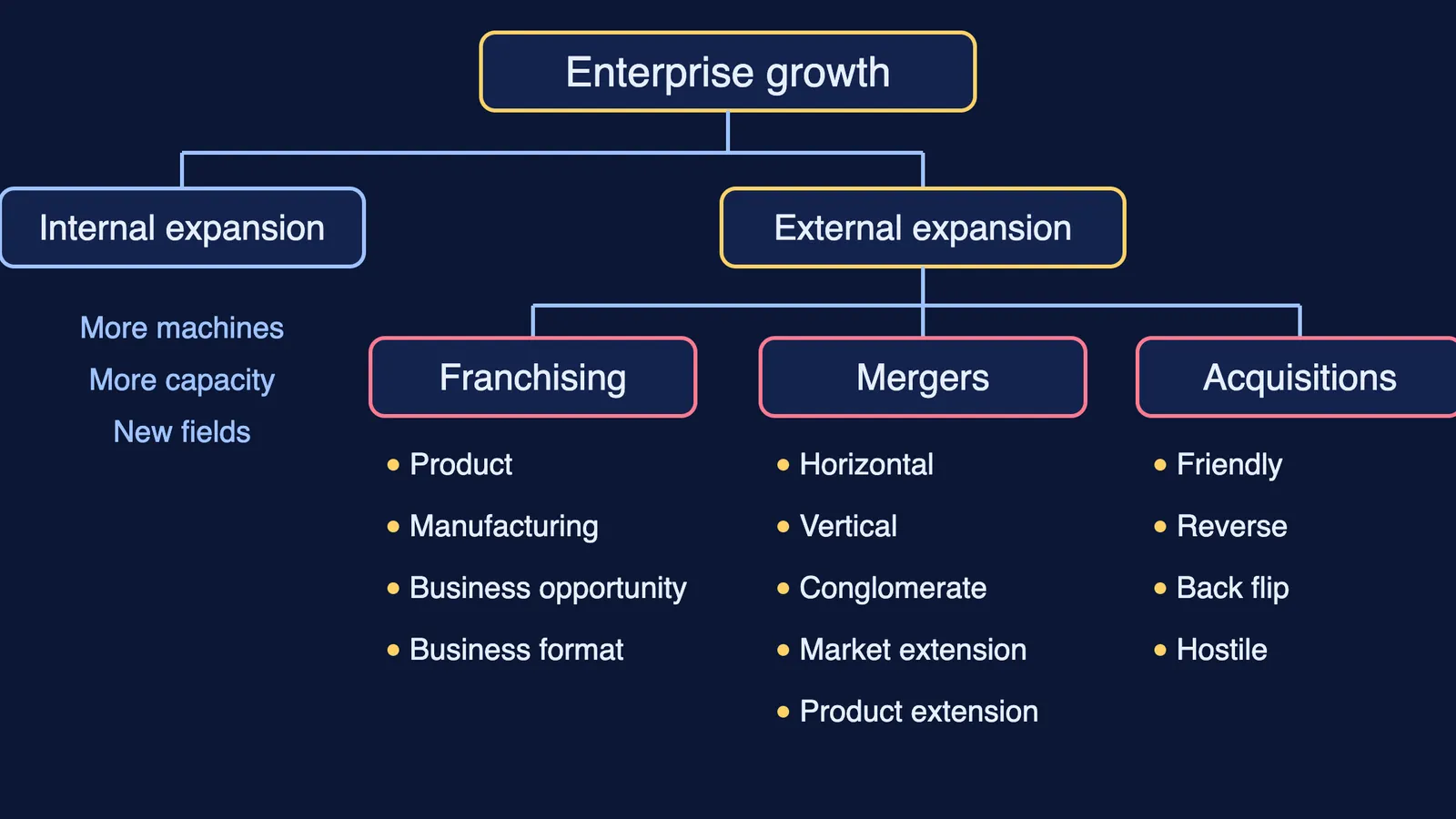
The book splits growth into internal expansion (more machines, more capacity, new fields) and external expansion, where firms combine. Unit 4 studies two external forms.
What is franchising, and what are its four types?
In the book's terms, franchising lets independent local operators sell a trademarked product or service, paying royalties to its owner and following the owner's standard procedures. The owner is the franchisor; the buyer is the franchisee. A franchise agreement binds them; the 2026-27 marking scheme lists its parts as contract explanation, operations manual, proprietary statements and ongoing site maintenance.
Product franchise: a retailer sells the maker's goods under the maker's name, paying a fee or buying minimum stock.
Manufacturing franchise: the franchisee makes and sells the product under the franchisor's name and trademark; bottlers, for instance, must use its ingredients.
Business opportunity venture: the owner distributes one company's products, and the company supplies the customers or accounts.
Business format franchise: a proven way of running the whole business, plus support, for a fee or royalty. The book calls it the most popular form.
What are the advantages and limitations of franchising?
The franchisee gets an accepted product, management training, start-up and capital help, the franchisor's market knowledge, and ready-made quality controls. The franchisor expands quickly with little capital of its own, keeps a lean head office, and saves through bulk buying and a shared advertising pool.
A franchisee loses freedom to innovate, keeps paying a share of revenue, can be stranded if the franchisor fails or is sold, and may not get promised services. A franchisor can struggle to find good franchisees, and one poorly run outlet hurts the whole system.
What are mergers and acquisitions, and how do their types differ?
A merger joins two companies into one larger company through a share swap or cash. In absorption, B merges into A and A survives (A + B = A); in amalgamation, both end and a new company forms (A + B = C). At least one company always stops existing on its own. An acquisition, or takeover, is one company buying most or all of another's ownership to control it.
Horizontal merger: same industry, often competitors.
Vertical merger: different stages of one supply chain, such as a carmaker and a parts supplier.
Conglomerate merger: unrelated businesses (pure or mixed).
Market extension merger: same products, different markets.
Product extension merger: related products, same market.
Acquisitions are friendly (both agree), reverse (a private company takes over a public one), back flip (the buyer becomes a subsidiary of its target) or hostile (against the target's wishes).
Why do enterprises merge or acquire?
The book gives seven reasons: synergy, new technology, higher profitability, gaining a competency the firm lacks, new markets, funds and tax benefits. The 2026-27 sample paper has a 5-mark acquisition case. Synergy means the combined firm is worth more than the two apart: V(AB) is greater than V(A) + V(B).
Practice questions in the 2026-27 paper style
Mark labels follow the sample paper types; questions are ours.
(1 mark) Dairies selling the same milk in Pune and in Nagpur combine. Name the merger type.
(2 marks) State two limitations of franchising for a franchisee.
(3 marks) P is worth Rs 12 lakh and Q Rs 9 lakh; merged, PQ is worth Rs 20 lakh. Is there synergy? Show working.
(5 marks) A fictional pickle brand wants 40 outlets in two years but has little capital. Explain three advantages franchising gives it as franchisor and one limitation it must plan for.
Answers: 1. market extension; 3. no, 20 lakh is Rs 1 lakh below 21 lakh.
For the wider subject, see our Class 12 Entrepreneurship subject guide, the Class 11 forms of business organisation comparison and a break-even comparison of two plans.
Not sure which unit to revise first? Fermi's AI tutor works out what you already know and builds a plan for the session.