On this page
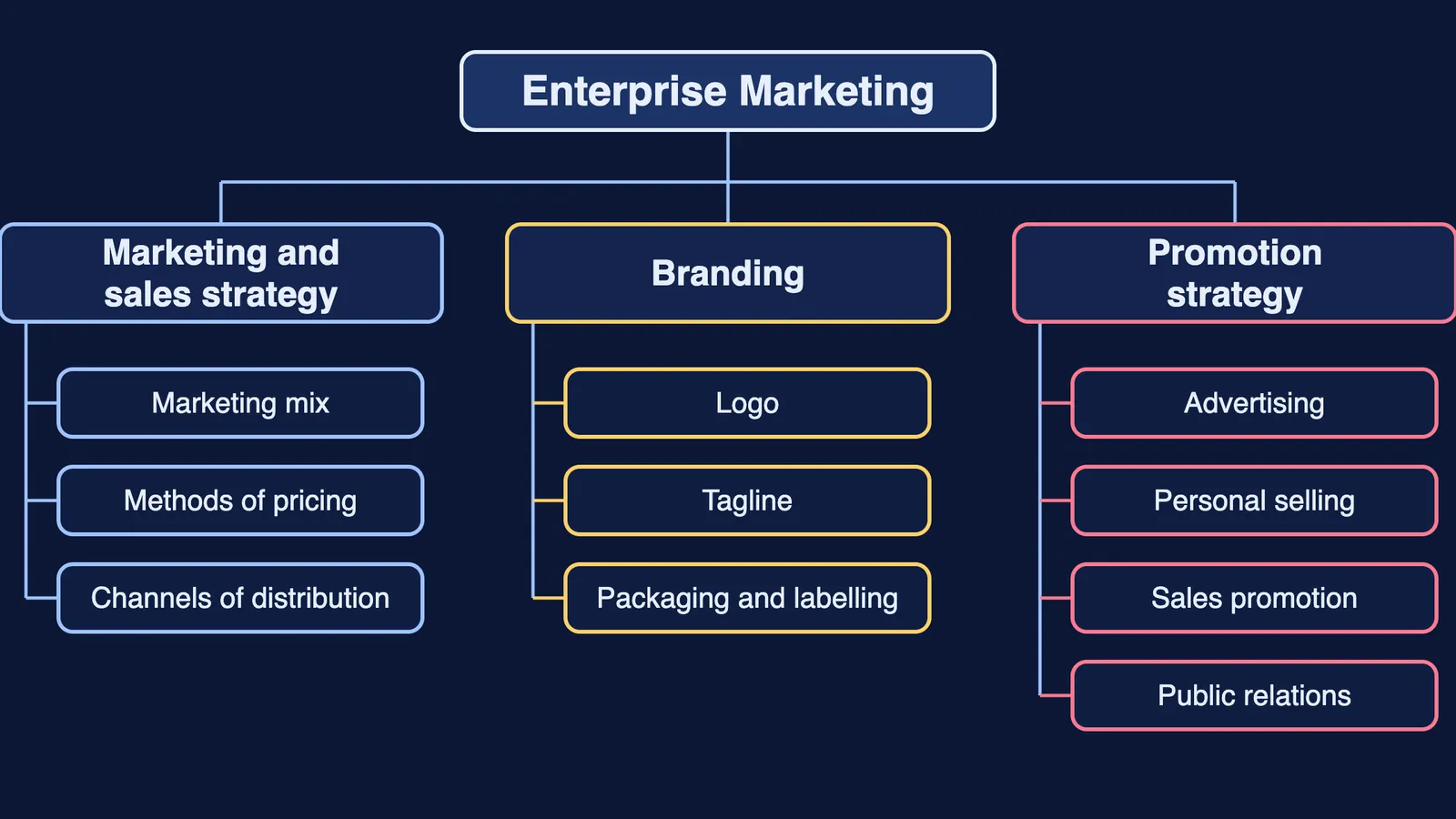
Enterprise Marketing is Unit 3 of CBSE Class 12 Entrepreneurship (code 066). The 2026-27 Entrepreneurship curriculum lists three contents for it: marketing and sales strategy; branding, logo and tagline; and promotion strategy. We could not find an official PDF of the CBSE Class XII textbook on cbseacademic, so this guide follows the curriculum's topic list and the 2026-27 sample paper.
How many marks is Enterprise Marketing in Class 12?
The 2026-27 curriculum prints 20 marks for Unit 3 and Unit 4 (Enterprise Growth Strategies) together, in one merged cell, so there is no separate figure for Unit 3. Theory is 70 marks and project work 30.
The 2026-27 sample paper has 34 questions worth 1, 2, 3 or 5 marks. Its marketing items cover advertising media, skimming pricing, taglines, below-the-line promotion, a pricing strategy and distribution channels.
What is marketing and sales strategy?
The curriculum asks you to discuss the marketing strategies a business uses and to explain the marketing mix. Its project checklist refers to the 4P's: product, price, place and promotion.
Product: the curriculum pairs branding with packaging and labelling; see the next section.
Price: the curriculum asks for several pricing methods. The 2026-27 marking scheme describes cost-plus pricing (work out the full cost of production, then add a fixed profit margin) and variable pricing (the same product sold at different prices by quantity or pack size). It links skimming to products buyers see as raising their status and to buyers who judge quality by price.
Place: the channel of distribution. A direct channel runs from producer to consumer; indirect ones add a retailer, wholesaler or agent. The marking scheme says perishable, fragile or technical goods need shorter channels, while made-to-order goods need direct contact with buyers.
Promotion: covered below.
The curriculum also asks for the concept and types of sales strategy; the 2026-27 papers do not define it, so use your textbook's definition.
What are branding, logo and tagline?
The curriculum lists branding, logo and tagline as one content, and asks you to understand branding, packaging and labelling. The sample paper treats a tagline as a line that carries a brand's message and helps buyers remember the brand. In the same assertion-reason item, the marking scheme marks as false the claim that a tagline is the brand's legal name.
On brand awareness, the sample paper's alternative to its advertising-media question credits regular, engaged use of social media. For definitions of brand, logo, packaging and label, use your textbook's wording.
Worked example: pricing a student venture
The Tote Club is a made-up venture run by two Class 12 students who sell printed cloth tote bags. Cost per bag: fabric ₹40, stitching ₹25, printing ₹10, label and packing ₹5, a total of ₹80.
Cost-plus price. With a 35% markup on cost, price = 80 × 1.35 = ₹108. Profit per bag = 108 − 80 = ₹28.
Margin on price. 28 ÷ 108 = 25.9% of the selling price.
An offer. At the school fair they offer two bags for ₹200, or ₹100 a bag. Profit falls to 100 − 80 = ₹20 a bag.
What the offer must achieve. Suppose they would sell 30 bags at full price: 30 × 28 = ₹840 profit. Earning ₹840 at ₹20 a bag needs 840 ÷ 20 = 42 bags.
So the offer needs 12 extra sales just to match full-price profit, and more than 12 to beat it.
What is a promotion strategy?
The curriculum names advertising (its objectives and modes), personal selling, sales promotion (and its techniques) and public relations.
Advertising: the sample paper's media options are outdoor, ambient, point of sale and window display.
Below-the-line promotion: the marking scheme credits it with direct, personal contact with customers, which helps a firm explain its product's features.
Personal selling, sales promotion and public relations: learn each concept from your textbook.
For the 4Ps from the Business Studies side, see the Class 12 marketing mix guide.
Practice questions for Unit 3
Mark labels follow the 2026-27 sample paper's question types; the questions are ours.
(1 mark) A spice seller prices a 250 g pack at ₹60 and a 1 kg pack at ₹200. Which pricing strategy is this? (A) Skimming (B) Cost-plus (C) Variable (D) Penetration
(2 marks) A candle maker's full cost is ₹60 a candle. Find the cost-plus price at a 25% markup and the profit per candle.
(3 marks) Distinguish between a logo and a tagline, with one made-up example of each for a bakery.
(5 marks) A student team opens a stationery refill counter at school. Suggest one use of each promotion tool, and say which to start with and why.
Answers: 1 is (C). For 2, 60 × 1.25 = ₹75, so profit is ₹15.
For how this unit fits the project and the rest of the course, read what the Class 12 Entrepreneurship subject covers.
Short on time this week? Fermi's AI tutor works out what you already know and builds a plan for the session.