On this page
What makes someone an entrepreneur? This guide covers Unit 2 of Class 11 Entrepreneurship from the CBSE 2026-27 Entrepreneurship curriculum and CBSE's own Class XI Entrepreneurship book. It is a study summary, not business or financial advice.
How many marks is An Entrepreneur worth?
The 2026-27 curriculum prints one figure of 15 marks for Units 1 and 2 together, out of 70 theory marks, with no separate figure for Unit 2. Project work adds 30 marks.
It lists five topics, from why be an entrepreneur to the intrapreneur, and names the competencies to build: need for achievement, motivation, ethics, opportunity seeking, passion and independence.
Why be an entrepreneur rather than an employee?
The curriculum wants you to understand the motivation; the book's closest material sorts entrepreneurs by what drives them:
Spontaneous: driven from within, to prove their own excellence; no outside push needed.
Induced: drawn in by government support such as finance and incentives, or pushed by events such as losing a job.
Motivated: keen to use their technical or professional skill, and spurred on once buyers accept the product.
It also contrasts entrepreneur and employee on six points, including status, risk and rewards. The entrepreneur owns the enterprise, carries its risk and earns an uncertain profit; the employee serves it for a fixed salary.
In numbers: Meera (fictional) runs an after-school snack stall for four weeks and pays her classmate Arjun a fixed ₹500 a week to help. After paying him, her weekly profit is ₹900, a loss of ₹200, ₹1,500, then ₹600.
Meera: 900 − 200 + 1,500 + 600 = ₹2,800, an average of ₹700 a week, with a loss in week 2 she could not foresee.
Arjun: 4 × 500 = ₹2,000, certain from day one.
Meera ends ₹800 ahead, her uncertain reward for bearing risk; a worse month could erase it.
What are the types of entrepreneurs?
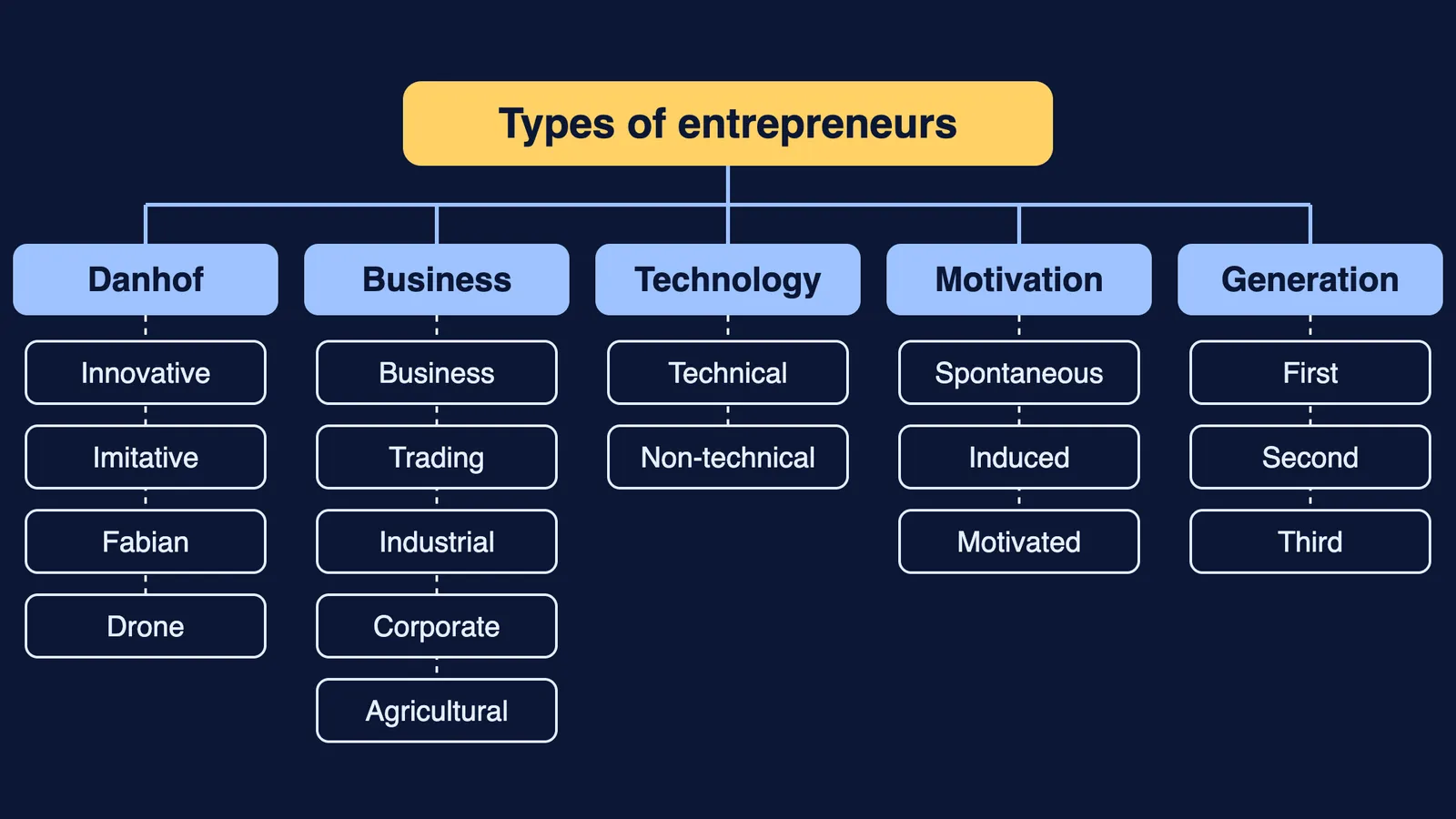
The book follows C. Danhof's four types:
Innovative: bring in new products, methods or markets.
Imitative: copy or adapt others' innovations; they organise more than create.
Fabian: very cautious; they change only when standing still would cost them their position.
Drone: refuse to change their methods even while making losses.
It also groups entrepreneurs by type of business (business, trading, industrial, corporate, agricultural), use of technology (technical, non-technical), motivation (above) and generation (first, second, third), plus professional entrepreneurs, who build businesses to sell.
Which competencies, values and attitudes does an entrepreneur need?
The book treats a competency as a defined set of behaviours that helps spot, assess and develop how a person acts. It groups them as entrepreneurial, enterprise launching and enterprise management competencies. The first group includes initiative, risk taking, problem solving, leadership, persistence, information seeking and systematic planning.
Values, in Milton Rokeach's definition, are beliefs that steer what we do and how we judge. The four core values are innovation and creativity, independence (self-reliance), respect for work, and a quest for outstanding performance. The book's ethics examples include quality goods in the correct quantity, correct wages and no child labour. Our guide to social responsibility of business and ethics in Class 11 overlaps here.
Attitudes are how a person feels about something. They affect behaviour, are invisible, are acquired and are pervasive, and come from direct experience, group associations and influential others.
Motivation is the process that pushes an entrepreneur to put in high effort towards a goal: an unmet need creates tension, tension creates a drive, and reaching the goal eases it. The book covers Maslow's five levels of need and McClelland's three needs: achievement, affiliation and power.
What is an intrapreneur, and why do firms want one?
An intrapreneur is an employee who acts like an entrepreneur inside an organisation, using its resources, while the firm carries the risk. The book credits management consultant Gifford Pinchot with coining the term in the 1980s, and gives the main reason firms encourage intrapreneurs: it keeps talented staff who might otherwise leave to pursue their ideas alone.
Kavya (fictional) launches a millet-snack range for the bakery chain she works for, on its budget: an intrapreneur. If she opened her own bakery with her savings, she would be an entrepreneur.
Practice questions on An Entrepreneur
The mark values are our suggestion, and the questions are our own.
(1 mark) A shopkeeper keeps a billing method that loses him money every month and refuses to try another. Which of Danhof's types is he?
(3 marks) Name the three groups of competencies, with one fictional example each.
(3 marks) Using two sources of attitudes, explain how a student might come to see business positively.
(5 marks) A software company lets an employee build a new feature on company time and money. Is she an entrepreneur or an intrapreneur? Give four differences and say why firms encourage this.
Answer to 1: Drone. For 4, look for ownership, risk, reward and resources.
See our overview of Entrepreneurship as a Class 12 subject.
Not sure where to start tonight? Fermi's AI tutor works out what you already know and builds a plan for the session.