On this page
How does an entrepreneur get what a venture needs? This guide follows the 2026-27 topic list with fictional examples and our own questions. It is a study summary, not business or financial advice.
What does Unit 7 cover, and how many marks is it worth?
The CBSE Entrepreneurship (066) curriculum for 2026-27 lists two sub-topics for Unit 7: the types of resources (physical, human, financial and intangible), and the selection and utilization of human resources and professionals such as accountants, lawyers, auditors and board members.
Units 6 and 7 share one 20-mark block; CBSE prints no separate figure for Unit 7. The theory paper is 70 marks; project work carries 30.
The prescribed book is CBSE's own Entrepreneurship Class XI, third edition 2013. Its Unit 7 treats material resources separately; the curriculum groups them with physical ones. Class 12 has a different unit on capital markets, angel investors and venture capital, covered in our Class 12 Resource Mobilization guide.
What is resource mobilization?
The book calls a resource any means, tangible or not, that an organisation needs to reach its goals. Resource mobilization is getting them from whoever provides them: the right type, at the right time and price, then put to good use.
It is wider than raising money: the book adds building contacts and networks and winning help in kind. The entrepreneur must mobilise, organise and manage resources well, because they are always scarce. Needs depend on the nature and size of the activity, the product and the type of business.
What are the four types of resources?
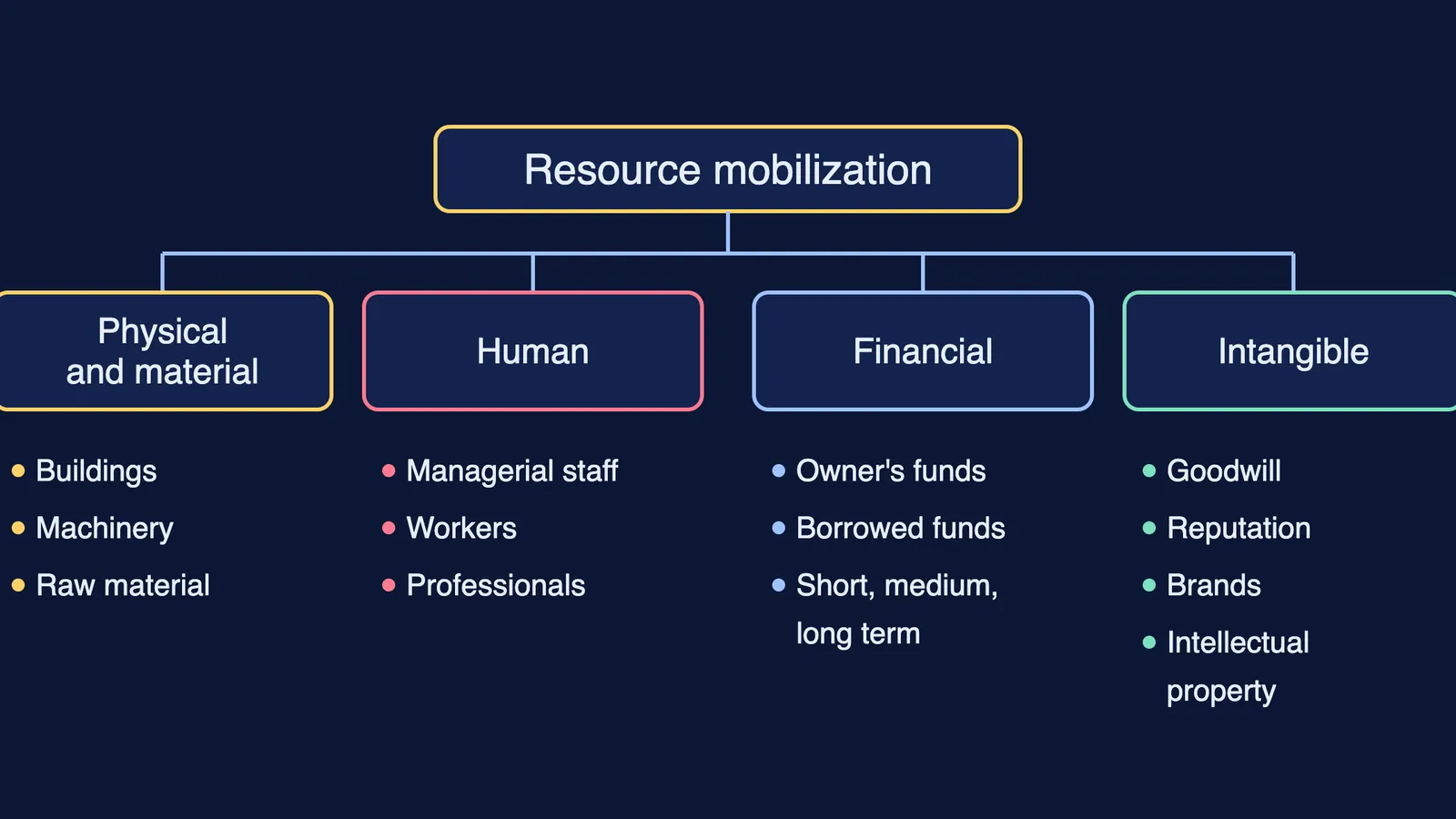
Physical (and material): buildings, plant, machinery, tools, technology and raw material. The first decision is the place, which affects capital cost, transport, wages, utilities and access to markets. The book warns against outdated or worn-out machinery.
Human: the people, which the book calls the most important asset.
Financial: the "lifeblood" of an enterprise. The entrepreneur decides how much is needed, for what term (short: up to 1 year; medium: 1 to 5 years; long: 5 years or more), and the mix of owner's funds (equity, preference capital, margin money) and borrowed funds (debentures, bank and institutional loans, private lenders), secured or unsecured.
Intangible: unseen assets that help a business earn above-normal profit: goodwill, reputation, brands and intellectual property such as patents and trademarks.
Owner's and borrowed funds are compared further in our Class 11 Business Studies guide to sources of business finance.
How does an entrepreneur select and use human resources?
The book starts with two questions. What kind of people? That means the qualifications, skills and experience each job needs. How many? That depends on the total work, what one person can do in a set time, expected absenteeism and labour turnover, current staff and growth plans.
It groups people into managerial staff (the "brain box" that sets policy), non-managerial staff (unskilled to highly skilled workers) and professionals and others. In a small unit, the entrepreneur is the most important human resource, being both employer and employee.
Good selection, in the book's list, covers careful recruitment, cost-effective training, induction, periodic appraisal, feedback, proper pay and motivation, a say in management, and following employee-welfare laws. The aim is the right person in the right job at the right time.
Why hire accountants, lawyers, auditors and board members?
Small firms usually cannot keep chartered accountants, auditors, bankers or lawyers on the payroll, so the book suggests bringing them in when needed. Benefits it lists include less waste, saved time and money, proven expertise, focus on core work, lower risk and savings on extra fixed investment in in-house facilities.
They can be engaged on a contractual, third-party, lease, captive-unit, part-time or regular basis. The choice rests on skill, knowledge, reputation, ethics, creativity and price; fees may be per project or hourly.
The book's manning table puts the board of directors at the top managerial level but gives no separate selection steps for board members.
Practice questions (our own)
Mark labels are our suggestion.
(1 mark) A loan repaid over 3 years to modernise a machine is which term of finance?
(1 mark) Customers trust a café's name. Which type of resource is this?
(3 marks) State three factors that decide how many workers a fictional tailoring unit needs.
(4 marks) Explain four benefits to a fictional bookshop of hiring an outside auditor.
(6 marks) Ravi, a fictional shop owner, needs Rs 1,50,000 for a cycle-repair shop and puts in Rs 45,000. Find the borrowed amount and his share as a percentage, then name one physical, one human and one intangible resource he needs.
Answers: 1. medium term; 2. intangible (reputation or brand); 5. Rs 1,05,000 borrowed, owner's share 30%.
Choosing subjects? See our Class 12 Entrepreneurship subject guide.
Planning this week's revision? Fermi's AI tutor works out what you already know and builds a plan for the session.