On this page
This guide follows CBSE's own Entrepreneurship Class XII textbook.pdf) (revised edition 2014), which the curriculum prescribes. It is a study summary, not business or financial advice.
What does Unit 2 cover in the 2026-27 syllabus?
The CBSE Entrepreneurship (066) curriculum for 2026-27 lists for Unit 2: forms of business organisation (sole proprietorship, partnership, company), the business plan's concept and format, and six component plans.
Units 1 and 2 together carry 30 of the 70 theory marks; CBSE prints one shared figure, not a mark for each unit. Project work adds 30 marks, and one of its two projects is a business plan. See how the Class 12 Entrepreneurship subject works.
Which form of business organisation suits a new venture?
Unit 2 covers three forms:
Sole proprietorship: one person owns, funds and runs it, keeps all profit and has unlimited liability. Owner and business are legally one, and it is easy to start and close.
Partnership: two or more people agree, by a written or oral agreement, to run a business together and share its profits and losses. The book also quotes the definition in the Indian Partnership Act, 1932. Each partner can act for all (mutual agency), liability is usually unlimited, and partners owe each other good faith. Our partnership fundamentals guide shows the accounting side.
Company: an artificial person created by law, separate from its members, with limited liability.
A private company needs at least two members, restricts share transfers and cannot invite the public to buy shares; its name ends in "Pvt. Ltd.". A public company needs at least seven members, can invite the public, and ends in "Ltd.".
Why is a private company often preferred? The book says that, despite its restrictions, it enjoys several privileges under company law, starting with needing only two members. The book was written under the Companies Act, 1956 and predates the Companies Act, 2013, so we leave out its legal limits and figures.
What is a business plan, and what formats does it take?
A business plan is the entrepreneur's written road map: the internal and external factors in starting the venture, its goals and how to reach them. Lenders and investors use it to judge feasibility, risk and repayment.
Four formats of one plan:
Elevator pitch: a three-minute summary.
Pitch deck with oral narrative: slides and talk to spark investor interest.
Written presentation: a detailed plan for outside stakeholders.
Internal operational plan: detail for managers.
What goes into each component plan?
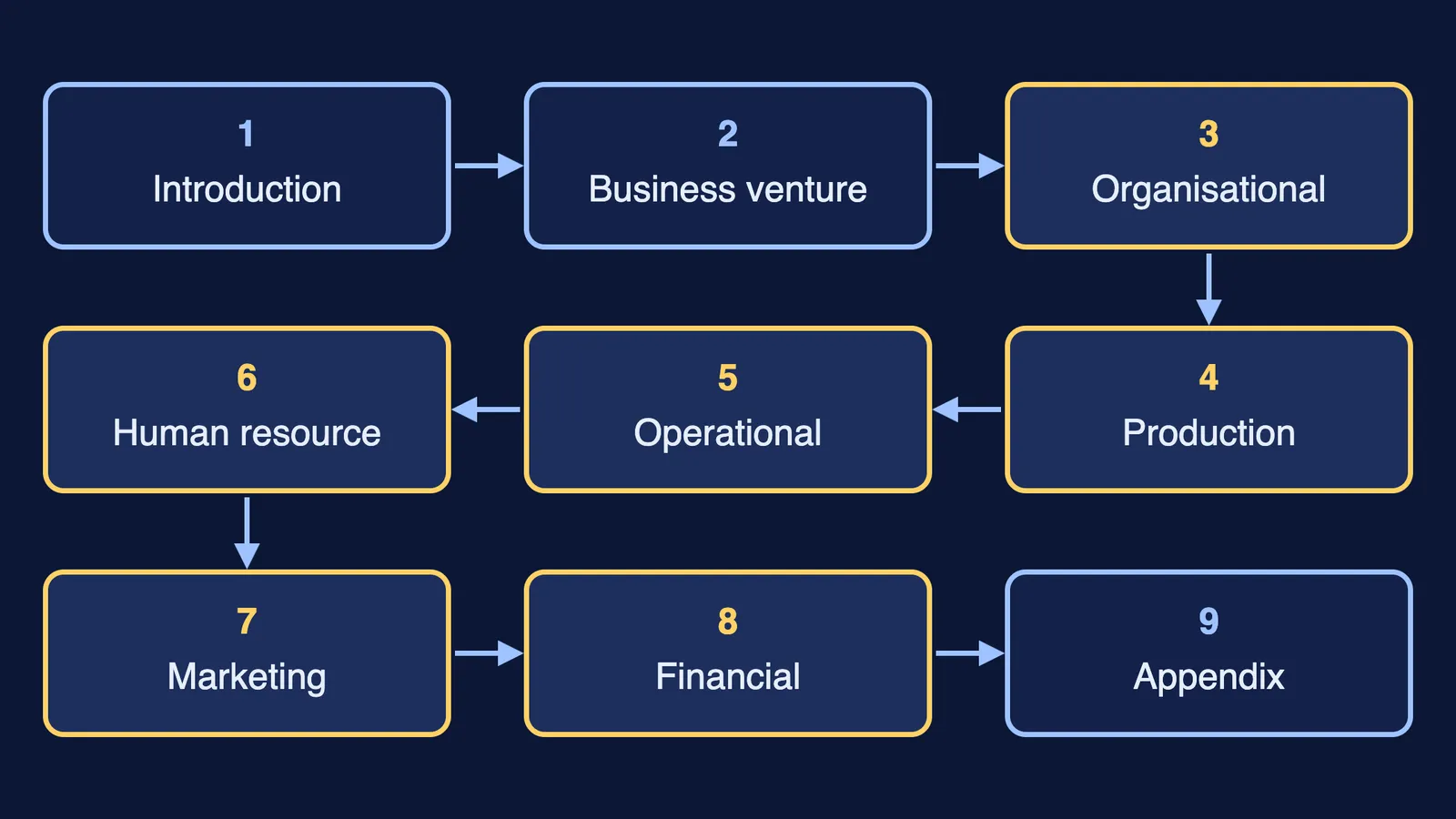
Organisational plan: form of ownership, members' stakes, authority, roles, voting rights and dispute settlement.
Production plan: depends on how much the venture makes itself. A trader or service firm drops it; an outsourcing venture names subcontractors, reasons, cost and time; full manufacturing covers layout, machines, raw materials, suppliers and cost.
Operational plan: if production says "plan your work", operations says "work your plan". Its elements are routing, scheduling, dispatching, follow-up, inspection and shipping.
Human resource (manpower) plan: what kind of people, how many, and how they will be recruited, selected and trained.
Marketing plan: pricing, promotion and distribution, around three questions: where have we been, where do we want to go, how do we get there.
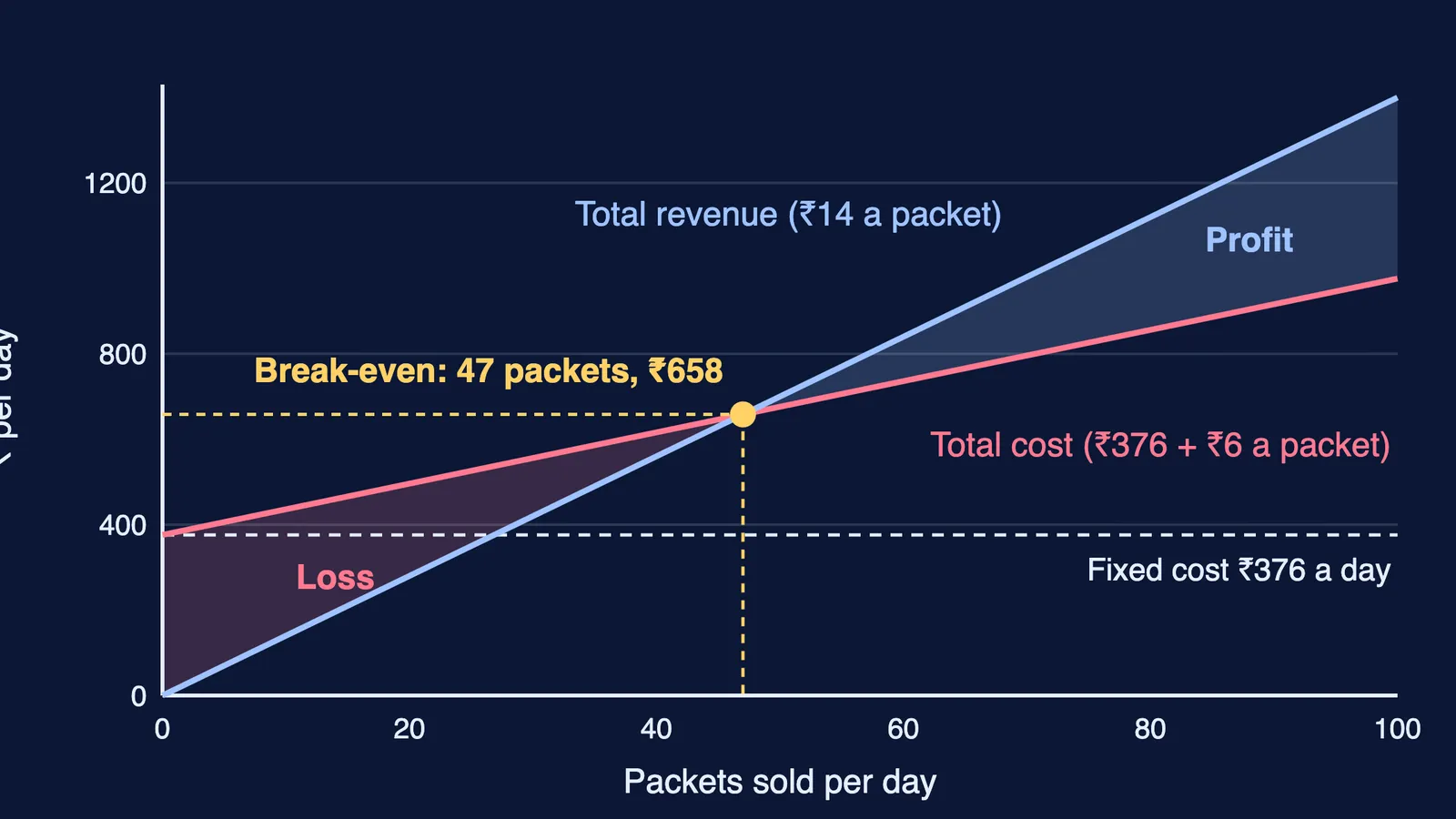
Financial plan: how much money is needed and where from. Parts: proforma investment and financing decisions, income statement, cash flow, balance sheet, break-even analysis, and economic and social variables.
How does the financial plan work for a small stall?
Worked example (our numbers, fictional stall). A student sandwich stall has fixed costs of ₹12,000 a month. Each sandwich sells for ₹40 and costs ₹25 to make.
Contribution per sandwich: 40 − 25 = ₹15
Break-even: 12,000 ÷ 15 = 800 sandwiches a month, or 800 × 40 = ₹32,000 of sales
Proforma income at 1,000 sandwiches: 40,000 − 25,000 − 12,000 = ₹3,000 profit
Now say 200 go to a canteen on credit. Cash in is 800 × 40 = ₹32,000, but cash out is 25,000 + 12,000 = ₹37,000, so the month's cash flow is −₹5,000 even though profit is +₹3,000. That gap is why proforma cash flow is separate from the income statement. More on equal-cost points: when two plans cost the same.
Practice questions in the 2026-27 format
Our own questions about fictional businesses, in the 2026-27 sample paper's mark types (1, 2, 3 and 5).
(1 mark) Fixing the date each job in a bakery starts and ends is: (a) routing (b) scheduling (c) dispatching (d) inspection
(2 marks) Meera runs a tailoring shop alone, and her savings are at risk if it fails. Name the form and the feature shown.
(3 marks) A phone-cover startup outsources all its manufacturing to a workshop. State three details its production plan must give.
(5 marks) A fictional juice cart has fixed costs of ₹9,000 a month, sells at ₹30 and pays ₹18 per glass. Find break-even and profit at 900 glasses; explain why profit and cash flow can differ.
Answers: 1 (b). 4: 9,000 ÷ 12 = 750 glasses; 900 × 12 − 9,000 = ₹1,800.
Got a science subject too? Fermi's AI tutor works out what you already know and builds a plan for the session.