

On this page
You are choosing between two mobile plans. One has a lower fixed charge; the other has a lower rate per unit. Which is cheaper depends on how much you use, and one exact usage makes them cost the same. Finding it takes a single linear equation.
When do two mobile plans cost the same?
Most simple plans have the shape cost = fixed charge + rate × usage. On a graph that is a straight line: the fixed charge is where the line starts on the cost axis, and the rate is its slope. If writing costs this way is new to you, our taxi fare walkthrough for Class 9 linear equations builds one from scratch.
Two plans give two lines. NCERT's Class 10 chapter Pair of Linear Equations in Two Variables lists the three things two lines can do: intersect at a single point (a unique solution), run parallel (no solution), or coincide (infinitely many solutions). For two plans, the intersection is the usage at which both bills are equal.
OpenStax College Algebra 2e calls the intersection of a cost line and a revenue line the break-even point, and the same algebra works for two cost lines.
How do you find the break-even usage?
These prices are made up to keep the arithmetic clean; swap in your real ones.
Plan A: ₹99 a month, plus ₹15 for every GB of data you use.
Plan B: ₹249 a month, plus ₹5 for every GB.
Let x be the number of GB you use in a month.
Write each cost: A = 99 + 15x and B = 249 + 5x.
Set them equal: 99 + 15x = 249 + 5x.
Collect x on one side: 15x − 5x = 249 − 99, so 10x = 150.
Solve: x = 15 GB.
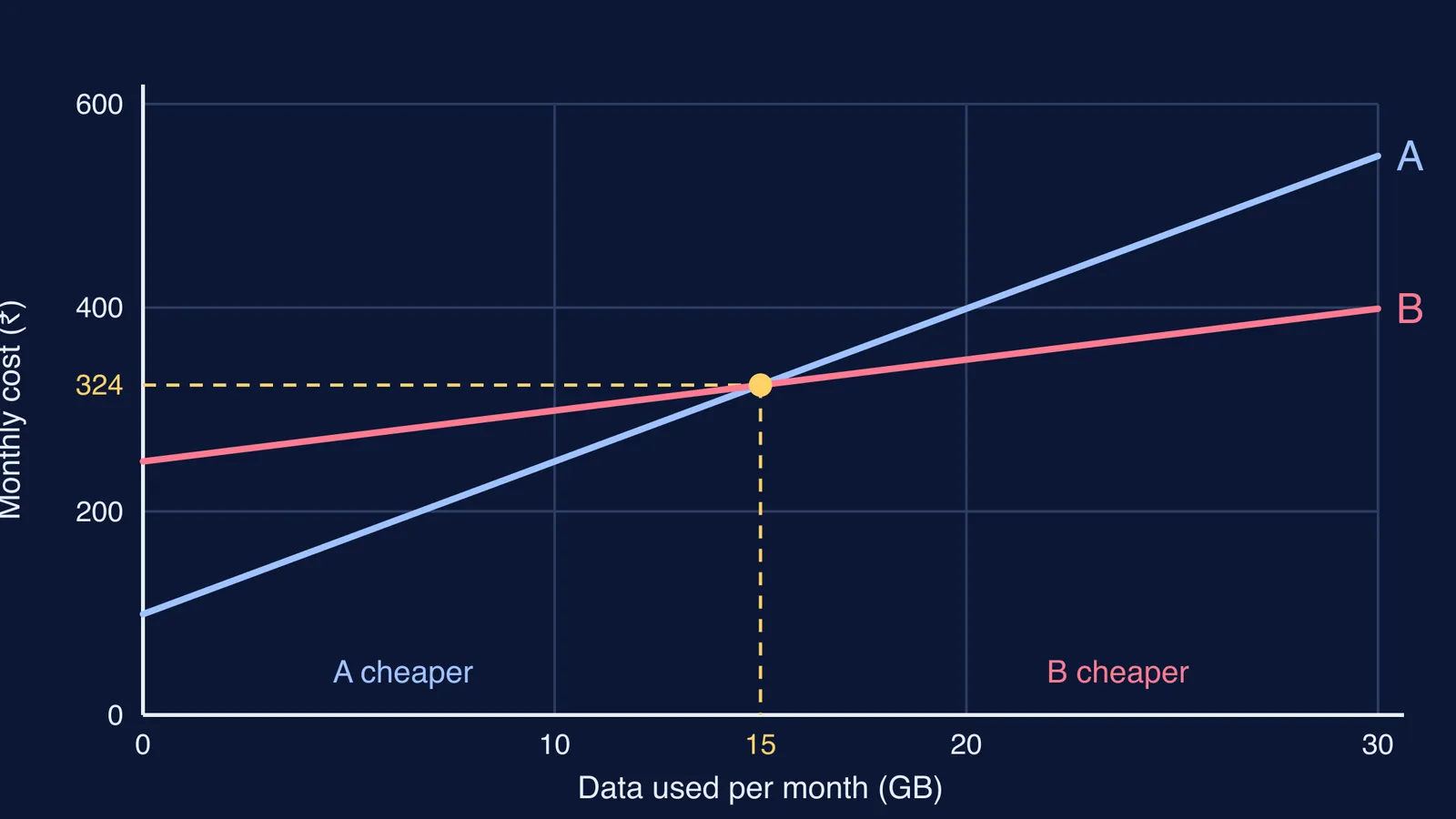
Check in both: A = 99 + 15 × 15 = ₹324 and B = 249 + 5 × 15 = ₹324. Same bill, so the break-even usage is 15 GB.
Step 3 has a plain meaning: Plan B costs ₹150 more up front but saves ₹10 per GB, so it takes 150 ÷ 10 = 15 GB to pay back the extra charge.
Which plan is cheaper on each side of the break-even point?
Test one usage on each side.
At 10 GB: A = ₹249 and B = ₹299, so Plan A is cheaper.
At 20 GB: A = ₹399 and B = ₹349, so Plan B is cheaper.
The general pattern: below the break-even usage, the plan with the lower fixed charge wins; above it, the plan with the lower rate per unit wins. On the graph, the steeper line (Plan A) starts lower and climbs above the flatter one after the crossing. Our post on reading a pair of linear equations from a graph shows how to sketch both lines quickly.
So the decision is about your own usage. If your last three months were 8, 11 and 9 GB, pick Plan A; if they were 18, 22 and 25 GB, Plan B. Near 15 GB the bills are almost identical, so other factors, such as coverage, may decide it.
What if the two cost lines never cross?
If both plans charge the same rate per unit, their lines have the same slope and run parallel. The NCERT chapter calls such a pair inconsistent: there is no solution, so there is no break-even. The algebra shows it at once: 99 + 15x = 149 + 15x simplifies to 99 = 149, which is false. The plan with the lower fixed charge is cheaper at every usage.
If the fixed charge and the rate both match, the lines coincide and the plans always cost the same. A plan with a free allowance or slabs is not one straight line, so solve it piece by piece; our post on piecewise linear slab billing walks through that case.
A checklist for any which-plan-is-cheaper question
Name the variable and its unit: GB per month, km per ride, visits per month.
Write each cost as fixed charge + rate × variable, over the same time period.
Set the two costs equal and solve.
Check the answer in both original equations.
Test one value on each side to see which plan wins where.
Compare the break-even with your real usage, not the usage you hope for.
Textbook word problems use the same structure: Exercise 3.3 of the NCERT chapter includes a lending library with a fixed charge plus a charge for each extra day.
If you can set up the equations but keep slipping on the algebra, the Fermi Problem Library has worked problems with a step-by-step solver that explains the reasoning rather than printing an answer. If slope and intercept themselves feel shaky, look them up in the Fermi Concept Library, where every concept in mathematics has its own lesson.


