On this page
The CBSE 2026-27 Accountancy curriculum prints Unit 1, Accounting for Partnership Firms, at 36 marks (CBSE Accountancy curriculum 2026-27). Fundamentals of partnership opens that unit, and the textbook chapter, NCERT Accountancy Part 1 chapter 1, is marked Reprint 2026-27 (NCERT chapter 1). Below: the syllabus, the no-deed rules, an original worked numerical and the errors that cost marks.
What is in the fundamentals of partnership syllabus for 2026-27?
The CBSE curriculum lists these topics first under Unit 1, before goodwill, reconstitution and dissolution:
Partnership: features and the partnership deed
Provisions of the Indian Partnership Act 1932 in the absence of a deed
Fixed vs fluctuating capital accounts
Profit and Loss Appropriation Account: division of profit among partners and guarantee of profits
Past adjustments relating to interest on capital, interest on drawings, salary and profit sharing ratio
It notes that interest on a partner's loan is a charge against profits. It names no method for interest on drawings; the NCERT chapter teaches the average period and product methods.
The 2026-27 sample paper tests a guarantee (1 mark), partners' salaries (3 marks) and, as one option of an either/or question, a past adjustment for an omitted commission (4 marks); the marking scheme gives the answers and working.
What happens if there is no partnership deed?
A partnership agreement can be oral; the deed is the written version. Where it is silent, the Indian Partnership Act 1932 applies (NCERT chapter 1):
Profits and losses are shared equally, whatever each partner's capital.
No interest is allowed on capital.
No interest is charged on drawings.
A partner's loan to the firm earns interest at 6% per annum.
No partner gets a salary or other remuneration for working in the firm.
Fixed or fluctuating capital: what is the difference?
Under the fixed capital method each partner has two accounts (NCERT chapter 1). The capital account changes only when capital is added or withdrawn and always shows a credit balance; profit share, interest, salary and drawings go to a current account, which can turn debit. Under the fluctuating method all of these go to one capital account, which may show a debit balance. If a question is silent, NCERT says use the fluctuating method.
How do you prepare a P&L Appropriation Account?
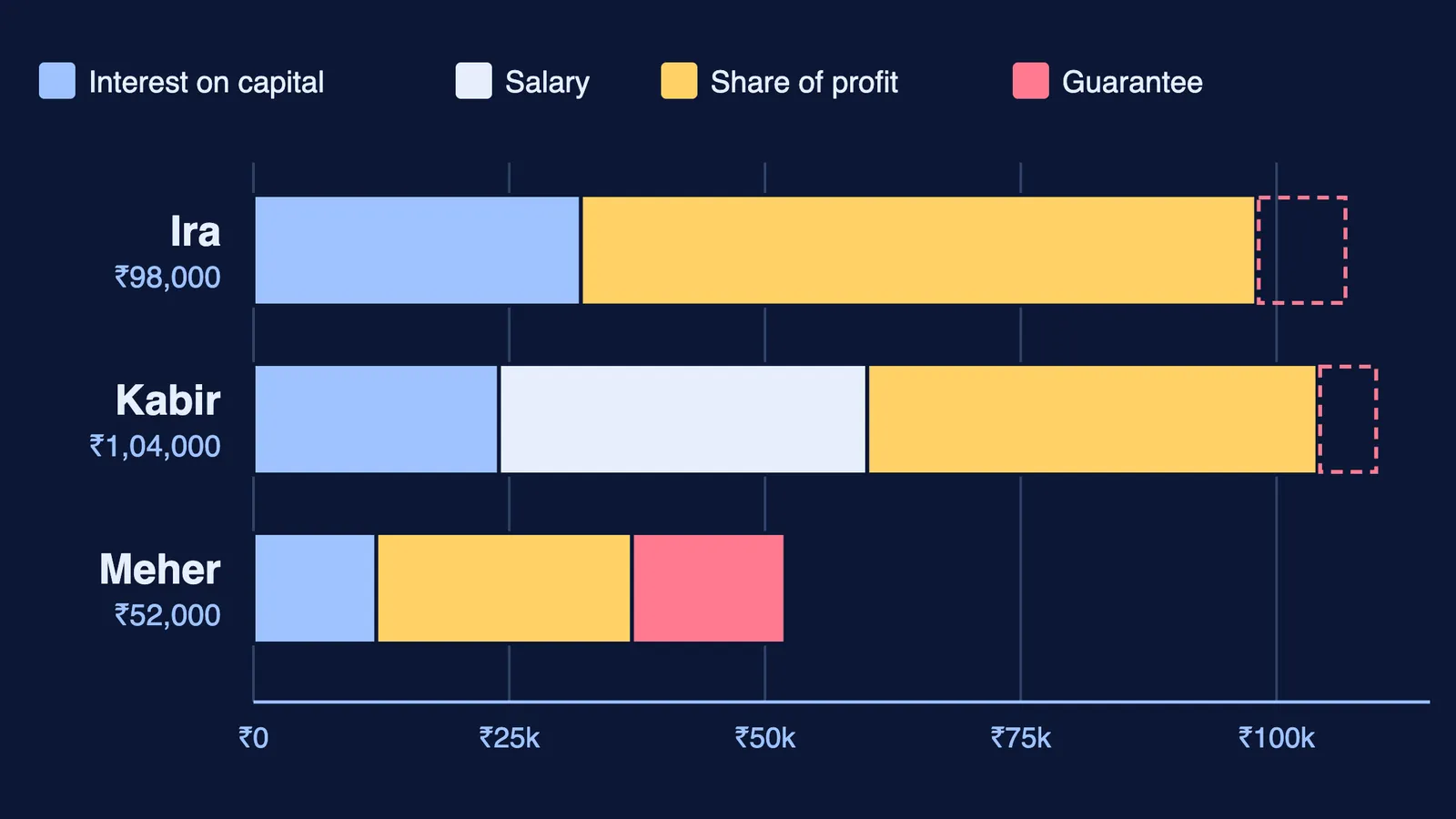
Ira, Kabir and Meher share profits 3:2:1. Their fixed capitals are ₹4,00,000, ₹3,00,000 and ₹1,50,000. The deed allows interest on capital at 8% p.a., a salary to Kabir of ₹3,000 a month, and interest on drawings at 10% p.a. Meher is guaranteed a minimum ₹40,000 as her share of profit; any deficiency is borne by Ira and Kabir in the ratio 3:2. During 2026-27, Ira drew ₹5,000 at the start of every month, Kabir drew ₹48,000 (dates not given) and Meher drew ₹20,000 on 1 October 2026. Net profit for the year ended 31 March 2027 was ₹2,47,350.
Interest on capital at 8%: Ira ₹32,000, Kabir ₹24,000, Meher ₹12,000. Total ₹68,000.
Kabir's salary: ₹3,000 × 12 = ₹36,000.
Interest on drawings for Ira: ₹60,000 × 10% × 6.5/12 = ₹3,250 (start of each month: 6½ months).
Interest on drawings for Kabir: ₹48,000 × 10% × 6/12 = ₹2,400 (no dates: 6 months).
Interest on drawings for Meher: ₹20,000 × 10% × 6/12 = ₹1,000 (1 October to 31 March). Total ₹6,650.
Divisible profit: ₹2,47,350 + ₹6,650 − ₹68,000 − ₹36,000 = ₹1,50,000.
Shares at 3:2:1: Ira ₹75,000, Kabir ₹50,000, Meher ₹25,000.
Guarantee: Meher is ₹15,000 short. Ira bears ₹9,000 and Kabir ₹6,000, giving Ira ₹66,000, Kabir ₹44,000 and Meher ₹40,000.
The drawing periods follow the NCERT chapter; the 2026-27 marking scheme answer to Q2 (₹4,000 on ₹80,000 of undated drawings at 10%) also implies 6 months.
What are the common mistakes in partnership questions?
Loan interest in the wrong account. The CBSE curriculum makes it a charge against profits, so it belongs in the Profit and Loss Account.
Interest on drawings without a deed clause. If the deed is silent, none is charged (NCERT chapter 1).
The wrong period. NCERT uses 6½ months for monthly drawings at the start, 5½ at the end, 6 in the middle.
Salary in a loss year. The marking scheme allows none in a loss year and splits a profit too small for salaries in their ratio.
Full interest on capital from a small profit. NCERT allows it only up to the available profit, in the ratio of interest due, and none in a loss year.
The wrong partner bearing the guarantee. The agreed ratio applies; a sole guarantor bears all of it.
Reopening last year's accounts. NCERT corrects past adjustments through a Profit and Loss Adjustment Account or directly in capital accounts.
Working through the chapter alone? Fermi's AI tutor can work out what you already know and build a plan for the session, so you sit down to a clear next step.
Next, read how goodwill is valued by average profit, super profit and capitalisation and what changes in the books when a new partner is admitted.