
On this page
Admitting a partner ends the old agreement, so six things must be settled: the new ratio, the sacrificing ratio, goodwill, revaluation, reserves and capitals. Get the order right and a 6-mark question becomes routine.
What does the 2026-27 syllabus say about admission of a partner?
The CBSE Accountancy curriculum for 2026-27 keeps admission of a partner inside Unit 1, Accounting for Partnership Firms, which carries 36 of the 80 theory marks. It lists the effect on the profit sharing ratio, goodwill (as per AS 26), revaluation of assets and reassessment of liabilities, reserves and accumulated profits and losses, adjustment of capital accounts, and preparing the capital accounts, current accounts and balance sheet.
The textbook is Chapter 2 of NCERT Accountancy Part 1, Reconstitution of a Partnership Firm: Admission of a Partner, marked Reprint 2026-27. The 2026-27 sample paper has a 6-mark admission question (Q25 A), and the marking scheme shows its full solution.
How do you find the new ratio and the sacrificing ratio?
The sacrificing ratio is the ratio in which old partners give up their share of profit to the incoming partner, and each partner's sacrifice equals old share minus new share (NCERT Chapter 2).
If the question does not say how the new partner takes the share, NCERT assumes it comes in the old ratio, so the sacrificing ratio equals the old ratio. If the new ratio is given, do not assume: subtract.
Write every old and new share over one common denominator.
Subtract new from old for each old partner.
Check that the sacrifices add up to the new partner's share.
For how the original ratio is set, see our guide to the partnership profit sharing ratio.
How is goodwill treated when a new partner joins?
The new partner pays the old partners for the profit share they give up. This premium for goodwill is credited to the old partners in their sacrificing ratio, not their old ratio (NCERT Chapter 2).
Premium brought in cash: Bank A/c Dr., To Premium for Goodwill A/c; then Premium for Goodwill A/c Dr., To sacrificing partners' capital accounts.
Premium not brought in: the new partner's current account is debited and the sacrificing partners' capital accounts are credited.
Goodwill already in the books: write it off to the old partners in the old ratio first.
Under AS 26, internally generated goodwill is not recognised as an asset, so it must not stay in the balance sheet; if it is raised, it is written off in the same year (NCERT Chapter 2).
What happens to reserves, revaluation and capital?
These belong to the old firm, so they go to the old partners in the old ratio (NCERT Chapter 2).
Reserves and accumulated profits: credited to old partners' capital accounts; a debit balance of Profit and Loss is debited to them.
Revaluation: gains are credited to the Revaluation Account, losses debited; the balance goes to old partners.
Capital adjustment: if capitals must match the new ratio, the new partner's capital gives the firm's total; others bring in shortfalls or withdraw excess.
Worked example: Meera, Kabir and Tara
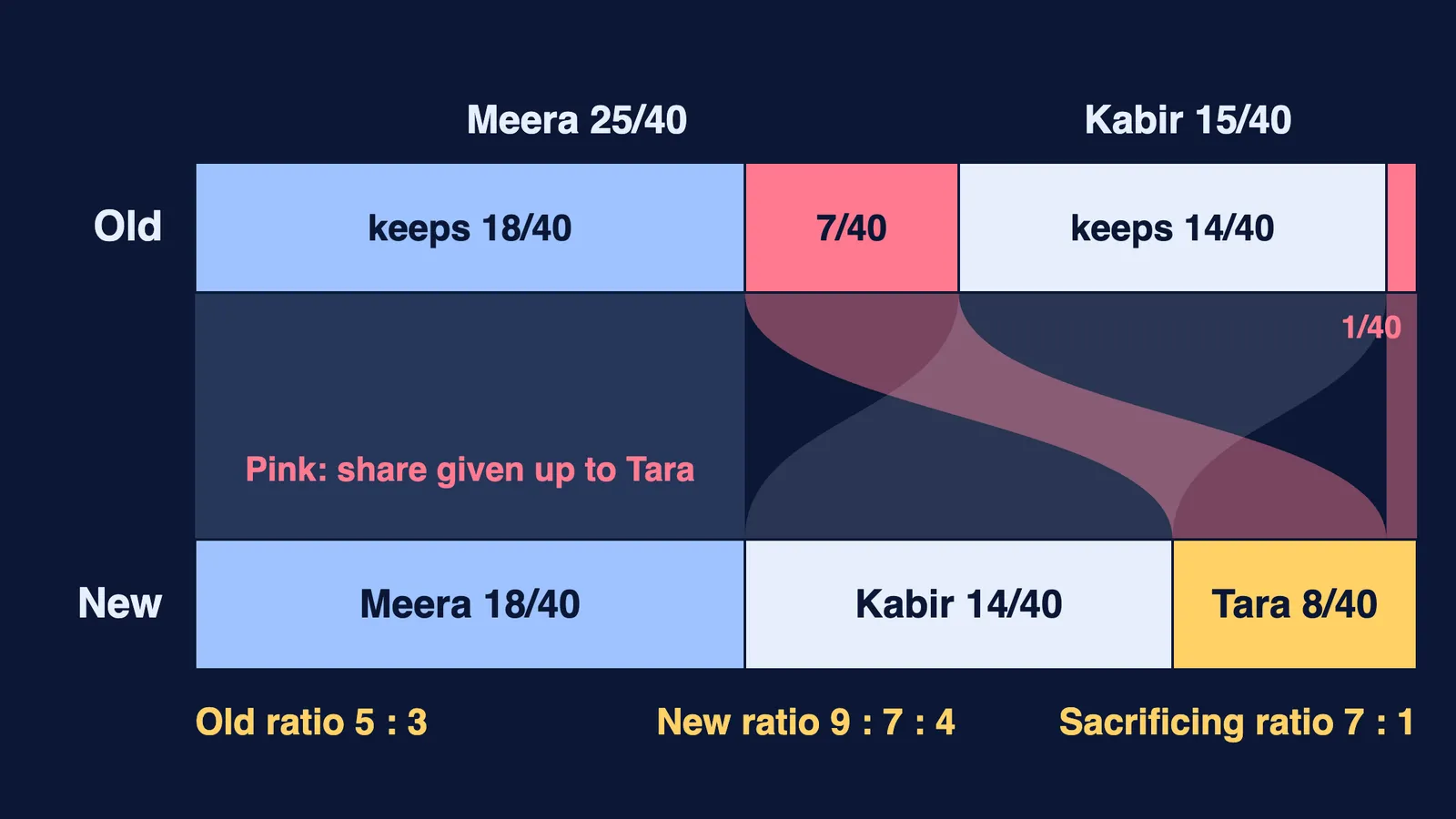
Meera and Kabir share profits 5:3. They admit Tara for a 1/5 share and agree a new ratio of 9:7:4. Goodwill is valued at ₹2,40,000. Tara brings ₹1,50,000 as capital and her premium in cash. There is a general reserve of ₹24,000 and a revaluation profit of ₹16,000. Old capitals are Meera ₹2,00,000 and Kabir ₹1,20,000.
Step 1: shares in 40ths. Old: Meera 25/40, Kabir 15/40. New: Meera 18/40, Kabir 14/40, Tara 8/40.
Step 2: sacrifice. Meera 25/40 − 18/40 = 7/40. Kabir 15/40 − 14/40 = 1/40. Total 8/40 = 1/5, Tara's share. Sacrificing ratio 7:1.
Step 3: premium. Tara's share of goodwill = ₹2,40,000 × 1/5 = ₹48,000, credited 7:1: Meera ₹42,000, Kabir ₹6,000.
Bank A/c Dr. ₹1,98,000, To Tara's Capital A/c ₹1,50,000, To Premium for Goodwill A/c ₹48,000
Premium for Goodwill A/c Dr. ₹48,000, To Meera's Capital A/c ₹42,000, To Kabir's Capital A/c ₹6,000
Step 4: reserve and revaluation, old ratio 5:3. Reserve: Meera ₹15,000, Kabir ₹9,000. Revaluation: Meera ₹10,000, Kabir ₹6,000.
Step 5: capitals. Adjusted capitals are Meera ₹2,67,000 and Kabir ₹1,41,000. If capitals must follow the new ratio, Tara's ₹1,50,000 for 4/20 implies a total of ₹7,50,000. Meera needs ₹3,37,500 (brings in ₹70,500) and Kabir ₹2,62,500 (brings in ₹1,21,500).
Which mistakes cost marks most often?
Crediting the premium in the old ratio. Here that gives Meera ₹30,000 and Kabir ₹18,000 instead of ₹42,000 and ₹6,000.
Giving the new partner a share of reserves or revaluation profit.
Raising goodwill to full value and leaving it in the balance sheet, against AS 26.
Forgetting to write off goodwill already in the books before crediting the premium.
Adjusting capitals before goodwill, reserves and revaluation are posted.
Next, revise Part B with our cash flow statement format guide and ratio analysis formulas. If you also take maths or science, Fermi's AI tutor works out what you already know and builds a plan for the session; it covers STEM subjects, not accountancy.