On this page
The arithmetic in a Class 12 cash flow statement is simple. The usual slips are a wrong sign or an item in the wrong section. Here is the format, the rule behind each line, and a solved example you can check line by line.
What is a cash flow statement in Class 12?
A cash flow statement shows the inflows and outflows of cash and cash equivalents of a company during a period, classified into operating, investing and financing activities (NCERT Class 12 Accountancy, chapter 6).
Cash equivalents are short-term, highly liquid investments that can be turned into a known amount of cash with little risk of a change in value. NCERT says an investment normally qualifies only when it has a short maturity of, say, three months or less from the date of acquisition (NCERT, section 6.3).
The CBSE Accountancy curriculum for 2026-27 gives the cash flow statement unit 8 marks in Part B and asks for the indirect method only, as per AS 3 (Revised). It also says bank overdraft and cash credit are treated as short-term borrowings, and current investments as marketable securities unless the question says otherwise.
Which activities go under operating, investing and financing?
For an ordinary trading or manufacturing company, NCERT's chapter follows AS 3 and sorts cash flows like this:
Operating: cash from selling goods and services; cash paid to suppliers, employees and for income tax.
Investing: buying and selling fixed assets and long-term investments; interest and dividend received.
Financing: issuing or redeeming shares and debentures; raising or repaying loans; interest and dividend paid.
A transaction that uses no cash, such as buying machinery by issuing shares, is left out of the statement altogether.
How do you find cash from operating activities by the indirect method?
Start from net profit before tax and extraordinary items, not profit after tax, and adjust it in three steps (NCERT, section 6.6.1):
Add back non-cash expenses such as depreciation and goodwill written off.
Add back non-operating expenses such as interest on debentures or loss on sale of fixed assets; subtract non-operating income such as profit on sale of assets or dividend received.
Adjust working capital: subtract an increase in current assets or a decrease in current liabilities; add a decrease in current assets or an increase in current liabilities.
Then subtract income tax actually paid to reach net cash from operating activities.
Solved example: cash flow statement by the indirect method
This is a practice question we wrote, set out in the NCERT proforma. Asha Traders Ltd, year ended 31 March 2026, all figures in Rs:
Surplus (Statement of Profit and Loss balance) rose from 40,000 to 1,00,000 after an interim dividend of 20,000 was paid.
Provision for tax rose from 15,000 to 25,000; tax provided this year was 30,000.
Machinery (net) rose from 3,00,000 to 3,85,000 after depreciation of 25,000; machinery with a book value of 40,000 was sold for 32,000.
Share capital rose from 4,00,000 to 5,00,000 through shares issued for cash at par. 10% debentures fell from 1,20,000 to 80,000, redeemed at par at year end; interest paid was 12,000.
Trade receivables went from 50,000 to 65,000; inventories from 60,000 to 52,000; trade payables from 35,000 to 42,000; outstanding expenses from 6,000 to 4,000.
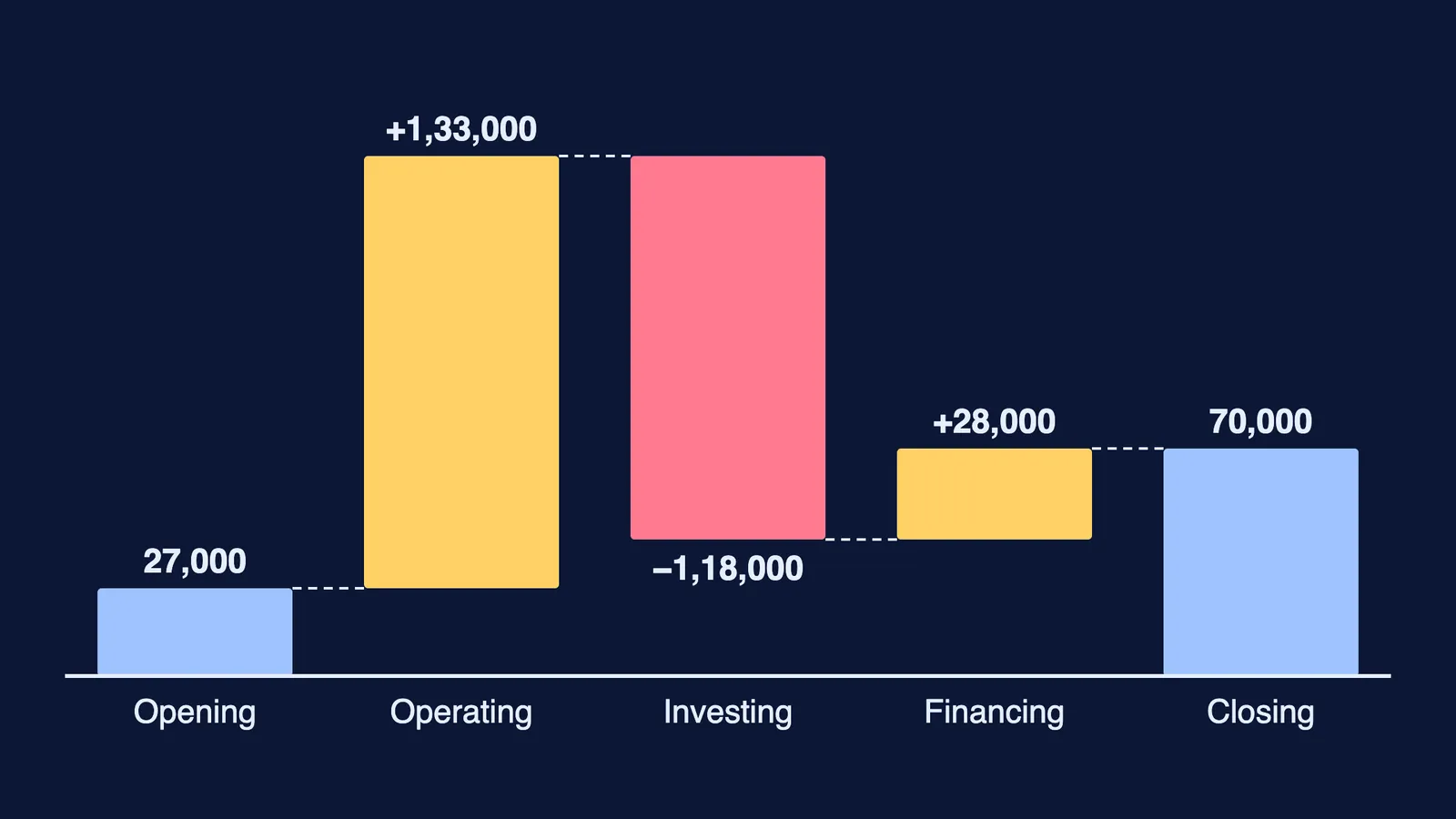
Opening cash and cash equivalents were 27,000.
Working notes
Net profit before tax = 60,000 (rise in surplus) + 20,000 (interim dividend) + 30,000 (tax provided) = 1,10,000.
Tax paid = 15,000 + 30,000 - 25,000 = 20,000.
Machinery bought = 3,85,000 + 25,000 + 40,000 - 3,00,000 = 1,50,000. Loss on sale = 40,000 - 32,000 = 8,000.
A. Cash flows from operating activities
Net profit before tax 1,10,000; add depreciation 25,000, loss on sale of machinery 8,000 and interest on debentures 12,000
Operating profit before working capital changes: 1,55,000
Less increase in trade receivables (15,000); add decrease in inventories 8,000; add increase in trade payables 7,000; less decrease in outstanding expenses (2,000)
Cash generated from operations: 1,53,000; less income tax paid (20,000)
Net cash from operating activities: 1,33,000
B. Cash flows from investing activities
Purchase of machinery (1,50,000); sale of machinery 32,000
Net cash used in investing activities: (1,18,000)
C. Cash flows from financing activities
Issue of shares 1,00,000; redemption of debentures (40,000); interest on debentures paid (12,000); interim dividend paid (20,000)
Net cash from financing activities: 28,000
Net increase in cash and cash equivalents = 1,33,000 - 1,18,000 + 28,000 = 43,000, so the closing balance is 27,000 + 43,000 = 70,000.
What mistakes cost marks in the cash flow question?
Starting from profit after tax instead of profit before tax.
Putting interest paid under operating activities; for a non-financial company it is a financing outflow (NCERT, section 6.5.4).
Showing tax provided instead of tax paid.
Treating a bank overdraft as cash; the CBSE curriculum treats it as a short-term borrowing.
Skipping working notes. They show the examiner where each figure came from, which is why a 20-minute board answer writing drill is worth the time.
If journal entries still feel shaky, start with checking journal entries against the golden rules. For the longer questions in the paper, see how to answer case-based questions in CBSE board exams.
Saying why each sign goes the way it does, before you write it, helps you catch these errors. For your STEM subjects, Fermi's AI tutor works in a similar way: it notices where you are stuck, decides whether to explain, ask or show, and checks understanding as it goes.
Your next step: cover the solution, rework Asha Traders from the data alone, and match each line.