

On this page
How do you divide profit when capital stays constant?
When two or more people start a business and leave their capital untouched for the entire financial year, splitting profit is straightforward. The distribution obeys direct proportionality in mathematics): profit earned is directly proportional to capital invested. If Partner A invests ₹60,000 and Partner B invests ₹40,000 for 12 months, the profit-sharing ratio simplifies to 60,000 : 40,000, or 3 : 2. If the partnership records an annual net profit of ₹50,000, Partner A receives 3/5 (₹30,000) and Partner B receives 2/5 (₹20,000).
This simple setup assumes both time and operational commitments are identical. In school mathematics and examinations, mastering these proportional splits builds on foundational ratio and proportion methods. However, real ventures rarely remain static: partners invest unequal sums, join midway, or withdraw funds as circumstances change.
How do you split profit when partners join or leave midway?
When investment periods differ, distributing profit solely by capital is unfair. A partner whose funds remained active for twelve months took greater market risk than someone joining late. Under standard partnership accounting principles, commercial arithmetic resolves this using the compound partnership rule:
Profit Share = Capital × Time
Multiplying each deposit by its duration converts it into equivalent single-month capital, establishing the true ratio of contribution.
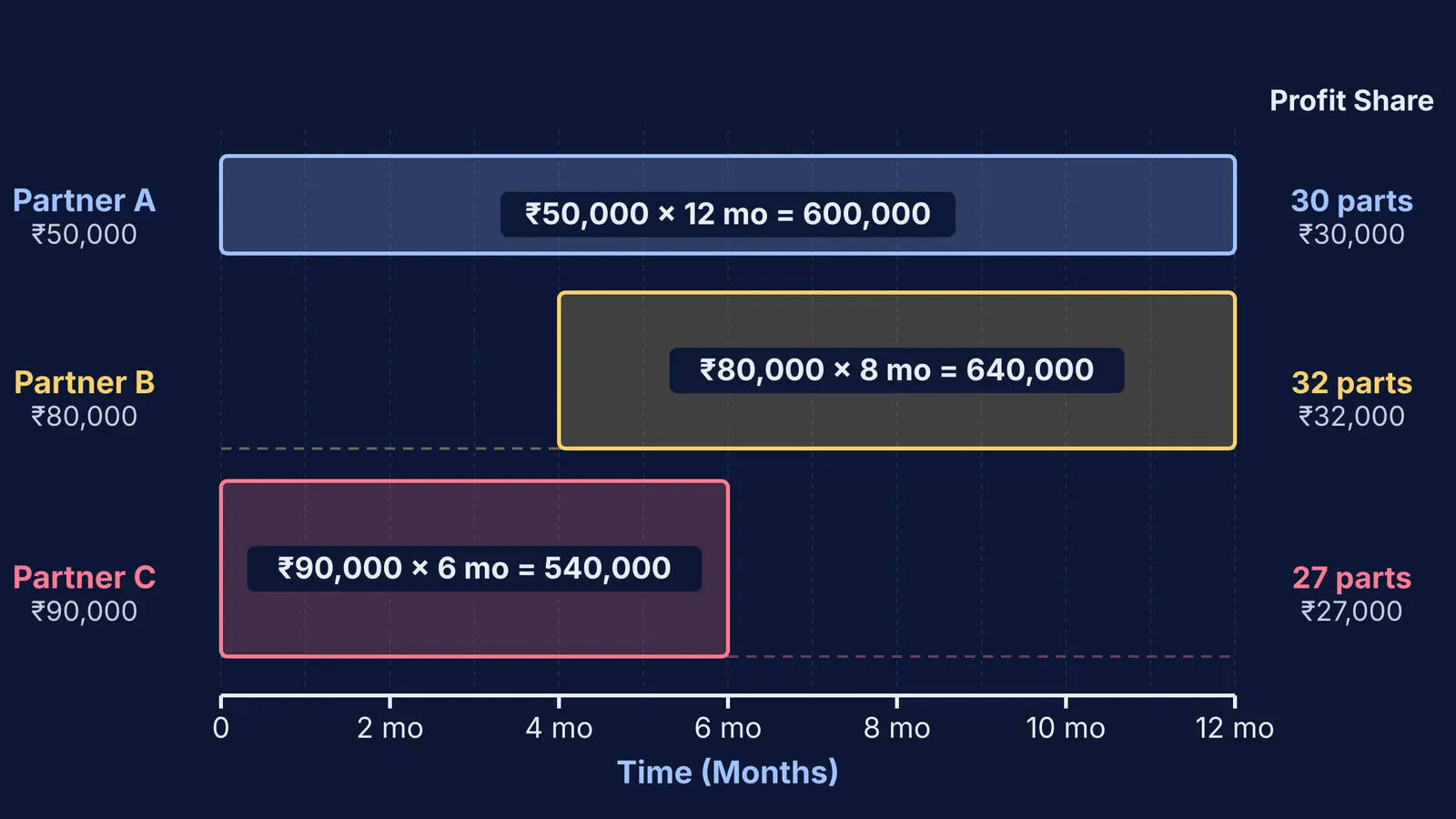
Consider a three-partner firm dividing an annual net profit of ₹89,000:
Partner A invests ₹50,000 on 1 January for the full 12 months.
Partner B joins on 1 May with ₹80,000 for the remaining 8 months.
Partner C invests ₹90,000 on 1 January but leaves on 30 June after 6 months.
Calculate each partner's capital-time product:
Partner A: ₹50,000 × 12 months = 600,000 units
Partner B: ₹80,000 × 8 months = 640,000 units
Partner C: ₹90,000 × 6 months = 540,000 units
Dividing each figure by 20,000 simplifies the ratio to 30 : 32 : 27, giving 89 total parts (30 + 32 + 27). Each part equals ₹1,000 (₹89,000 ÷ 89):
Partner A: 30 × ₹1,000 = ₹30,000
Partner B: 32 × ₹1,000 = ₹32,000
Partner C: 27 × ₹1,000 = ₹27,000
Partner B receives the largest share, despite joining four months late, because their larger capital produced a greater capital-time product than Partner A's full year.
This systematic product calculation applies equally when partners make recurring deposits or partial withdrawals, matching direct and inverse proportion rules. The Fermi Problem Library has worked problems with a step-by-step solver that explains the reasoning rather than printing an answer, helping students master multi-stage arithmetic without getting lost in the algebra.
What does the law say if there is no partnership agreement?
When partners operate without a formal deed, statutory rules take over. Under Section 13(b) of the Indian Partnership Act, 1932, partners share profits and losses equally, regardless of capital contributed. A partner supplying 90% of the capital receives the same share as one contributing 10%, unless their agreement specifies otherwise.
The statute also regulates remuneration and advances. Under Section 13(a) of the Indian Partnership Act, 1932, no partner is entitled to a salary for taking part in the business without an explicit agreement. Under Section 13(d) of the Indian Partnership Act, 1932, any advance beyond subscribed capital earns statutory interest at 6% per annum.
These clauses underline why a written agreement is essential. The Fermi Concept Library covers every concept in mathematics, each with its own lesson and its place in the map, helping learners understand proportional splits before committing capital.
How do you account for partner salaries before splitting profit?
In many partnerships, one member works full-time while others act as silent investors. Splitting profit purely by capital ignores the market value of managerial labor.
According to OpenStax Principles of Financial Accounting, partnerships resolve this imbalance through a two-stage allocation:
Deduct agreed salary allowances and interest on capital from total profit as an appropriation of income.
Distribute residual profit among all partners according to their agreed capital-time ratio.
For example, if a firm earns ₹1,50,000 in net profit, the deed might allocate a ₹30,000 management salary to the working partner first. The remaining ₹1,20,000 is then split using the capital × time ratio.
Breaking compound word problems into structured phases mirrors how students learn translating word problems into algebraic equations. When a student struggles to organize these steps, Fermi's AI tutor works out what they already know, builds a plan for the session, and teaches through it — writing on a board and checking understanding as it goes.


