
On this page
Goodwill comes up whenever a partnership firm is reconstituted. This guide covers what it is, the three valuation methods CBSE lists for 2026-27, an original worked numerical and the slips that cost marks.
Is goodwill in the CBSE Class 12 Accountancy syllabus for 2026-27?
Yes. The CBSE Accountancy curriculum for 2026-27 lists goodwill's meaning, nature, the factors affecting it and three valuation methods (average profit, super profit and capitalisation) under Unit 1, Accounting for Partnership Firms. The same document prints Unit 1 at 36 marks of the 80-mark theory paper.
The CBSE sample question paper for 2026-27 tests it directly. Question 20 (3 marks) asks for goodwill at 3 years' purchase of five years' average profits, after three adjustments to those profits, and Question 6 (1 mark) values goodwill on a partner's death.
NCERT covers it in Chapter 2, Admission of a Partner, of Accountancy Part 1: Partnership Accounts; the current book is marked Reprint 2026-27.
What is goodwill, and what affects its value?
In NCERT's terms, goodwill is what a firm's reputation is worth because it is expected to earn more than normal profits in future (NCERT Chapter 2). It is an intangible asset.
Goodwill exists only when a firm earns super profits; a firm earning only normal profits, or making losses, has no goodwill, according to the same chapter.
NCERT lists five factors: nature of business, location, efficiency of management, market situation (little competition helps) and special advantages such as licences, patents and long-term contracts. In a partnership, goodwill is valued on a change in profit-sharing ratio, admission, retirement or death of a partner, dissolution with sale as a going concern, and amalgamation.
How do you value goodwill by each method?
The formulas, from NCERT Chapter 2:
Average profits method: Goodwill = Average profit × Number of years' purchase. Use a weighted average only when the question asks for it.
Super profits method: Normal profit = Capital employed × Normal rate of return ÷ 100. Super profit = Average profit − Normal profit. Goodwill = Super profit × Number of years' purchase.
Capitalisation of average profits: Goodwill = (Average profit × 100 ÷ Normal rate of return) − Net assets, where net assets are total assets (excluding goodwill and fictitious assets) minus outside liabilities.
Capitalisation of super profits: Goodwill = Super profit × 100 ÷ Normal rate of return. NCERT notes this gives exactly the same answer as capitalising average profits.
Worked example: one firm, four answers
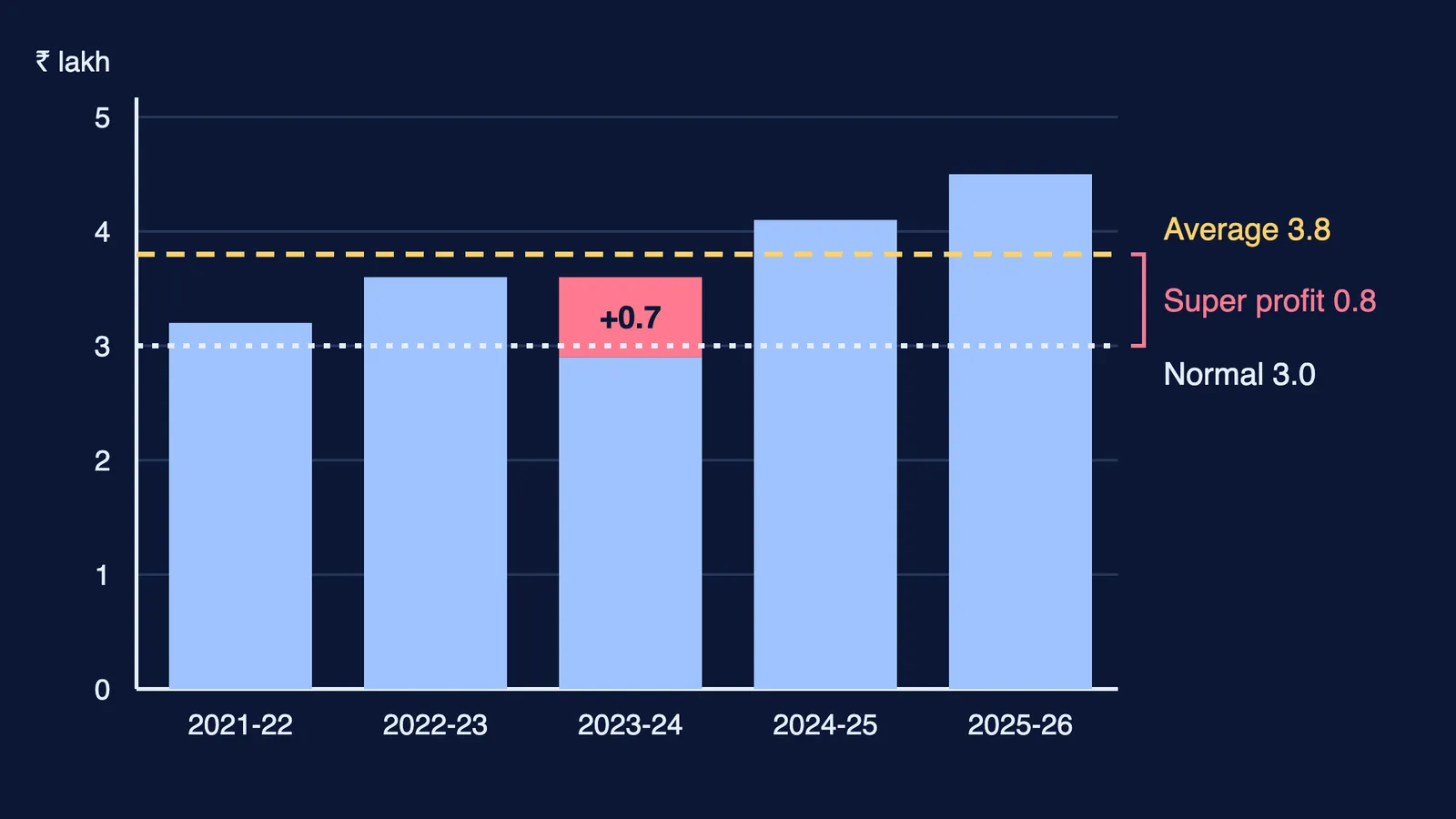
Riya and Dev are partners. Their profits for the last five years were: 2021-22 ₹3,20,000; 2022-23 ₹3,60,000; 2023-24 ₹2,90,000; 2024-25 ₹4,10,000; 2025-26 ₹4,50,000. The 2023-24 profit is after an abnormal loss of ₹70,000 when a flood damaged uninsured stock. Total assets (excluding goodwill) are ₹36,50,000, outside liabilities ₹6,50,000, the normal rate of return 10% and goodwill is valued at 3 years' purchase where needed.
Step 1: adjust and average. Add back the abnormal loss: 2023-24 becomes ₹2,90,000 + ₹70,000 = ₹3,60,000. Adjusted total = ₹19,00,000. Average profit = ₹19,00,000 ÷ 5 = ₹3,80,000.
Step 2: normal and super profit. Capital employed = ₹36,50,000 − ₹6,50,000 = ₹30,00,000. Normal profit = ₹30,00,000 × 10 ÷ 100 = ₹3,00,000. Super profit = ₹3,80,000 − ₹3,00,000 = ₹80,000.
Step 3: goodwill by each method.
Average profits: ₹3,80,000 × 3 = ₹11,40,000.
Super profits: ₹80,000 × 3 = ₹2,40,000.
Capitalisation of average profits: ₹3,80,000 × 100 ÷ 10 = ₹38,00,000; minus net assets ₹30,00,000 = ₹8,00,000.
Capitalisation of super profits: ₹80,000 × 100 ÷ 10 = ₹8,00,000.
The figures differ because each method measures something different, which is why NCERT says partners agree the method. In the exam, use only the method the question names.
What are the common mistakes in goodwill numericals?
Skipping the adjustments. Add back abnormal losses and remove abnormal gains before averaging, as the marking scheme does in Question 20. Without the add-back above, the average-profit answer falls to ₹10,98,000.
Getting a loss year's sign wrong. A loss is subtracted when you total the years; the 2026-27 marking scheme does this for the ₹(1,00,000) year in Question 20.
Counting goodwill in capital employed. Exclude goodwill and fictitious assets.
Using a weighted average when it is not asked. NCERT says to use it only if specified.
Mixing years' purchase with capitalisation. Use years' purchase or 100 ÷ normal rate, never both.
Forcing a positive answer. If average profit is at or below normal profit, there is no super profit and no goodwill under that method.
What happens after you value goodwill?
Valuation is half the question. The curriculum says goodwill is then adjusted through partners' capital or current accounts, and treated as per AS 26 on admission, retirement or death. Revise how shares are worked out in our guide to dividing profit in a partnership.
If you lose marks without knowing which step went wrong, Fermi's AI tutor works out what you already know and builds a plan for the session, so you sit down to a clear next step.
For Part B, see our ratio analysis formulas for Class 12 and the cash flow statement format with a solved example.