

On this page
Ratio analysis is where Class 12 Accountancy stops recording numbers and starts reading them. Here is every ratio on the CBSE list, then one company worked through all of them.
Which ratios are in the CBSE Class 12 syllabus?
The CBSE Accountancy curriculum for 2026-27 puts accounting ratios in the Analysis of Financial Statements unit, worth 12 marks for students who choose it over Computerised Accounting. It lists 18 ratios in four families: liquidity, solvency, activity (turnover) and profitability. Practise net profit ratio both before and after tax, as the curriculum asks.
What are the ratio analysis formulas for Class 12?
All formulas are from Chapter 5, Accounting Ratios, of NCERT Accountancy Part II, the prescribed textbook.
Liquidity ratios (2):
Current ratio = Current assets ÷ Current liabilities
Quick ratio = Quick assets ÷ Current liabilities; quick assets leave out inventories, prepaid expenses and advance tax
Solvency ratios (5):
Debt to equity = Long-term debts ÷ Shareholders' funds
Debt to capital employed = Long-term debts ÷ Capital employed
Proprietary ratio = Shareholders' funds ÷ Capital employed or Total assets (NCERT shows both)
Total assets to debt = Total assets ÷ Long-term debts
Interest coverage = Profit before interest and tax ÷ Interest on long-term debts
Activity ratios (6):
Inventory turnover = Cost of revenue from operations ÷ Average inventory
Trade receivables turnover = Net credit revenue from operations ÷ Average trade receivables
Trade payables turnover = Net credit purchases ÷ Average trade payables
Net assets, fixed asset and working capital turnover = Revenue from operations ÷ Capital employed, Net fixed assets and Working capital
Collection or payment period = Days in the year (365) ÷ the matching turnover ratio
Profitability ratios (5):
Gross profit ratio = Gross profit ÷ Revenue from operations × 100
Operating ratio = (Cost of revenue from operations + Operating expenses) ÷ Revenue from operations × 100
Operating profit ratio = 100 − Operating ratio
Net profit ratio = Net profit ÷ Revenue from operations × 100
Return on investment = Profit before interest and tax ÷ Capital employed × 100
How do you solve a ratio analysis question?
Neel Fabrics Ltd is invented; the method follows the NCERT chapter. Amounts in rupees.
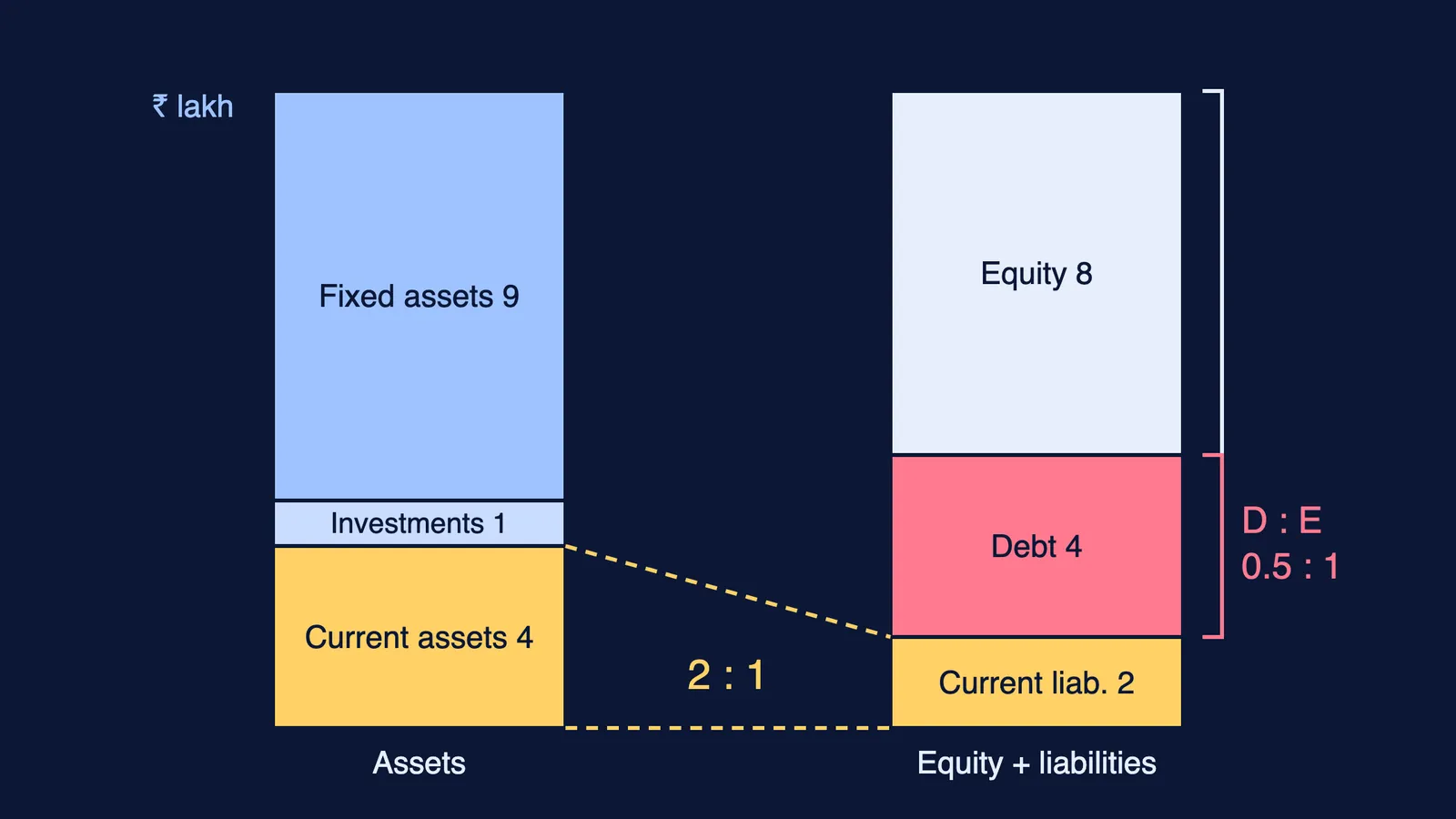
Balance sheet: shareholders' funds 8,00,000; 10% debentures 4,00,000; current liabilities 2,00,000; fixed assets 9,00,000; investments 1,00,000; current assets 4,00,000 (inventories 1,20,000, trade receivables 1,60,000, cash 1,00,000, prepaid expenses 20,000). Both sides total 14,00,000.
For the year: revenue from operations 24,00,000 (credit 20,00,000); cost of revenue from operations 18,00,000; operating expenses 3,00,000; debenture interest 40,000; tax 65,000; credit purchases 15,00,000. Opening inventory 80,000; opening receivables 2,40,000; trade payables 1,00,000 opening, 1,50,000 closing.
Current ratio = 4,00,000 ÷ 2,00,000 = 2 : 1
Quick ratio = (4,00,000 − 1,40,000) ÷ 2,00,000 = 1.3 : 1
Debt to equity = 4,00,000 ÷ 8,00,000 = 0.5 : 1
Debt to capital employed = 4,00,000 ÷ 12,00,000 = 0.33 : 1
Proprietary ratio = 8,00,000 ÷ 14,00,000 = 0.57 : 1 (on total assets)
Total assets to debt = 14,00,000 ÷ 4,00,000 = 3.5 : 1
Interest coverage = (24,00,000 − 21,00,000) ÷ 40,000 = 7.5 times
Inventory turnover = 18,00,000 ÷ 1,00,000 = 18 times
Receivables turnover = 20,00,000 ÷ 2,00,000 = 10 times; collection period 36.5 days
Payables turnover = 15,00,000 ÷ 1,25,000 = 12 times; payment period about 30 days
Net assets, fixed asset and working capital turnover = 2, 2.67 and 12 times
Gross profit ratio = 6,00,000 ÷ 24,00,000 × 100 = 25%
Operating ratio = 21,00,000 ÷ 24,00,000 × 100 = 87.5%, so operating profit ratio = 12.5%
Net profit ratio = 2,60,000 ÷ 24,00,000 × 100 = 10.83% before tax; 1,95,000 ÷ 24,00,000 × 100 = 8.13% after tax
Return on investment = 3,00,000 ÷ 12,00,000 × 100 = 25%
How do you interpret ratio answers in the exam?
The NCERT chapter says a current ratio of 2 : 1 is normally safe, advocates a quick ratio of 1 : 1, and considers a debt to equity ratio of 2 : 1 safe, though that varies by industry. Neel Fabrics is at or on the safe side of all three. NCERT also warns that there are no universally accepted standard levels, so say what you are comparing against.
Set out every answer as formula, substitution, result and unit (: 1, times, % or days). Our guide to writing numericals for full step marks carries over, and a minute-per-mark plan for the exam hall stops one ratio question eating your time.
Fermi teaches STEM rather than accountancy, but if ratio and percentage arithmetic slows you down, the Fermi Concept Library has a lesson for every concept in mathematics.
Next step: cover the answers, rework all fifteen lines and mark yourself.


