On this page
Unit 1 opens Class 11 Entrepreneurship: what entrepreneurship is, what an entrepreneur does, and why an economy needs enterprises. This guide follows the 2026-27 topic list with fictional examples and our own questions. It is a study summary, not business or financial advice.
What does Unit 1 cover, and how many marks is it worth?
The CBSE Entrepreneurship (066) curriculum for 2026-27 lists six sub-topics: the concept, functions and need of entrepreneurship; its myths; advantages and limitations; the process; the Indian scenario; and "why entrepreneurship for you".
Units 1 and 2 share one 15-mark block, so CBSE prints no separate figure for Unit 1. The Class 11 theory paper is 70 marks in 3 hours, and project work carries 30.
The prescribed book is CBSE's own Entrepreneurship Class XI, third edition 2013. Its Unit 1 has no separate sections titled "Why Entrepreneurship for You" or "The Indian Scenario", so for those two we use the curriculum's learning outcomes and what the book says about India's economy.
What is entrepreneurship, and how is it different from an entrepreneur?
The book separates three linked words:
Entrepreneur: the person who spots an opportunity, gathers the resources to use it and carries the risk.
Entrepreneurship: the process, or the set of activities that person carries out.
Enterprise: the outcome, the business that supplies goods or services and creates jobs.
The word comes from the French *entreprendre*, meaning "to undertake". The book's summing-up definition treats entrepreneurship as systematic innovation: a deliberate, organised search for change, together with a careful study of the economic and social openings that change may bring.
What are the four functions of an entrepreneur?
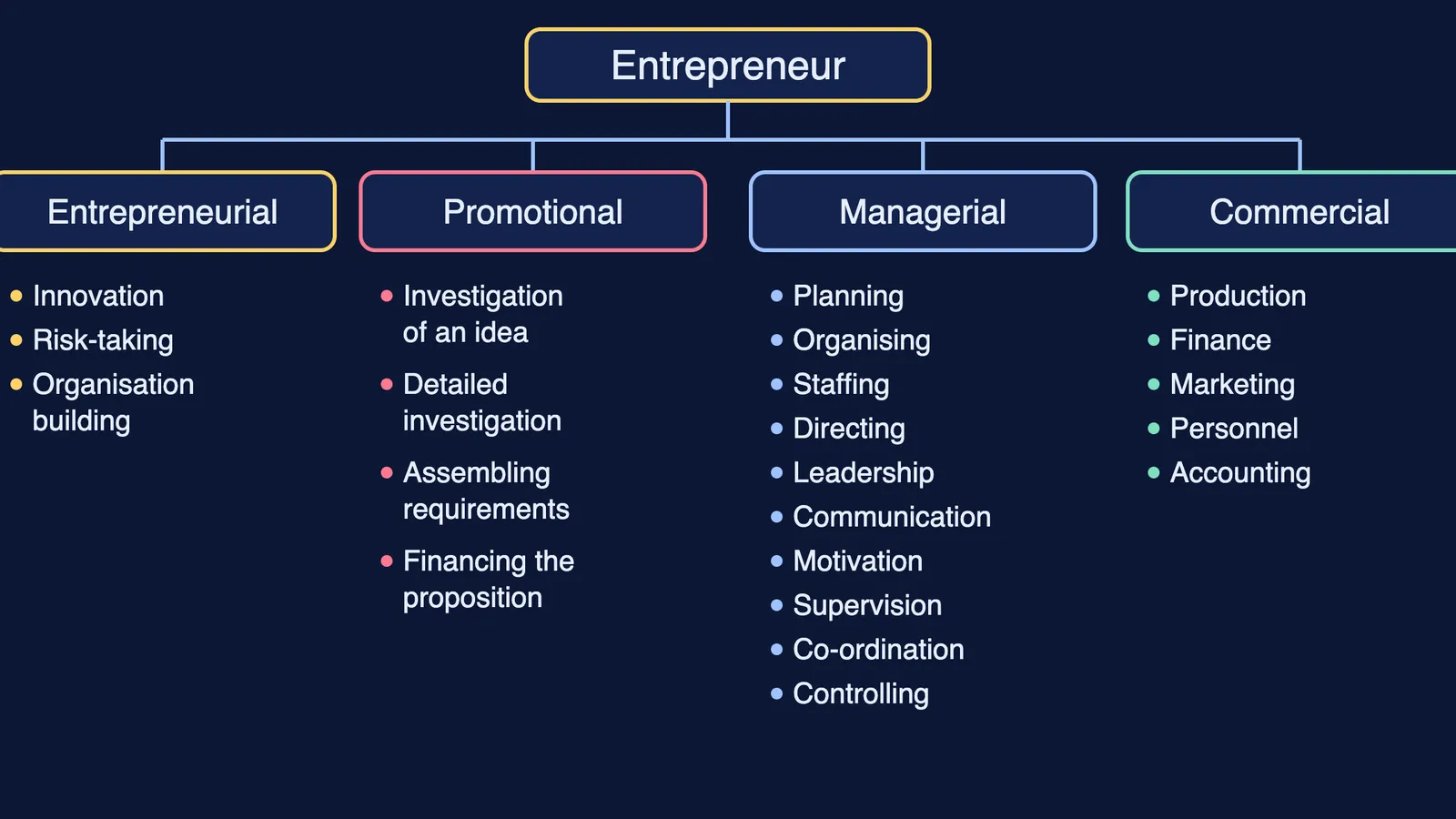
The book groups the functions into four sets.
Entrepreneurial: innovation (the basic function), risk-taking and organisation building.
Promotional: investigating an idea, detailed investigation of demand and inputs, assembling the requirements and financing the proposition.
Managerial: planning, organising, staffing, directing, supervision, co-ordination and controlling, plus leadership, communication and motivation.
Commercial: production, finance, marketing, personnel and accounting.
A common slip: the book puts financing the proposition under promotional functions, not managerial or commercial ones.
Why does an economy need entrepreneurship, and why might it suit you?
The book lists six needs: entrepreneurship is a life-line of a nation, provides innovation, drives change and inclusive growth, raises profits by cutting costs, creates employment and brings social benefits such as better products at lower cost.
On the Indian scenario, the book (third edition, 2013) gives its view of India as a mixed economy in which the government and private entrepreneurs are equally important. In the book's account, the private role grew after the 1991 liberalisation, and more entrepreneurs emerged as the economy progressed, though it says more still needs to be done.
"Why entrepreneurship for you" is about your own path. The curriculum's outcome is that you can assess how entrepreneurship might shape your career.
What are the myths, advantages and limitations of entrepreneurship?
The book lists seven myths, each of which it rejects:
Starting a business is easy.
A new business needs a lot of money.
Start-ups cannot use debt.
Banks do not lend to start-ups.
Most founders pick attractive industries.
Growth depends more on talent than on the industry chosen.
Most enterprises succeed financially.
Advantages: excitement, originality, independence, a salary that matches your effort, and freedom to follow your own ideas.
Limitations: no regular pay cheque, fewer benefits, an unpredictable schedule, every decision resting on you, and staff with less experience than you.
What are the steps in the process of entrepreneurship?
The book gives eight steps:
Self-discovery
Identifying opportunities
Generating and evaluating ideas
Planning
Raising start-up capital
Start-up
Growth
Harvest
Picture a fictional tiffin service. Its founder notices she enjoys cooking (1), sees that hostel students lack home food (2), shortlists three menu ideas and keeps one (3), writes a plan (4), finds funds (5), takes first orders (6), adds a second kitchen (7) and later sells the business (8).
Practice questions (mark labels are our suggestion):
(1 mark) To which function group does deciding the capital structure belong?
(3 marks) Using a fictional bicycle-repair shop, distinguish entrepreneur, entrepreneurship and enterprise.
(4 marks) A friend says, "You need lots of money, and banks never lend to new ventures." Identify the two myths in this remark and explain why the book rejects each.
(6 marks) A fictional student plans a plant-nursery stall. Take her through all eight stages of the process, giving one action for each stage.
Answer to 1: promotional (financing the proposition).
Taking the subject further? See our Class 12 Entrepreneurship subject guide, the Class 11 Business Studies guide to small business and enterprises and, ahead of Unit 6's arithmetic, a break-even comparison of two plans.
Short on time this week? Fermi's AI tutor works out what you already know and builds a plan for the session.