On this page
Unit 6 of Class 11 Entrepreneurship asks three questions: what is one sale, what does it cost, and how many sales cover your bills? Examples use our own figures for a fictional student-run popcorn stall. This is a study summary, not business or financial advice.
What does Unit 6 cover, and how many marks is it worth?
The CBSE Entrepreneurship (066) curriculum for 2026-27 lists three contents for Unit 6:
the unit of sale, and its price and cost (one product or service)
start-up, variable and fixed costs
break-even for one product or service
In the Class XI marks table Unit 6 and Unit 7 (Resource Mobilization) share one 20-mark cell, so Unit 6 has no separate figure. Theory carries 70 marks and project work 30; the question paper design puts 30 theory marks (43%) on applying ideas, so expect sums.
The prescribed book is CBSE's Entrepreneurship Class XI, third edition 2013. Its Unit 6 also covers a cash register, cash inflow and outflow, the income statement, cash flow projections and taxes; the 2026-27 curriculum does not list those for this unit.
What do unit of sale, unit price and cost per unit mean?
Unit of sale is the measure you bill a customer in: a kilogram, a litre, a piece, an hour.
Unit cost is the variable cost of producing, storing and selling one unit of sale: raw material, packing, commission and similar items. Count wastage too.
Unit price is what the customer pays for one unit of sale. It must be above unit cost.
Gross margin per unit = unit price − unit cost.
What is the difference between start-up, fixed and variable costs?
The book splits costs into start-up and operational, and operational into fixed and variable.
Start-up costs come before trading: assets such as machines or furniture, plus first stock until sales money arrives (the book calls that part working capital).
Fixed costs go on whether you sell or not: rent, salaries, insurance, advertising. They are fixed in nature, not always in amount.
Variable costs rise and fall in step with output: raw material, packing, freight, sales commission, piece-rate wages.
The same item can change type: paper is a fixed cost for an office but a variable cost for a printer.
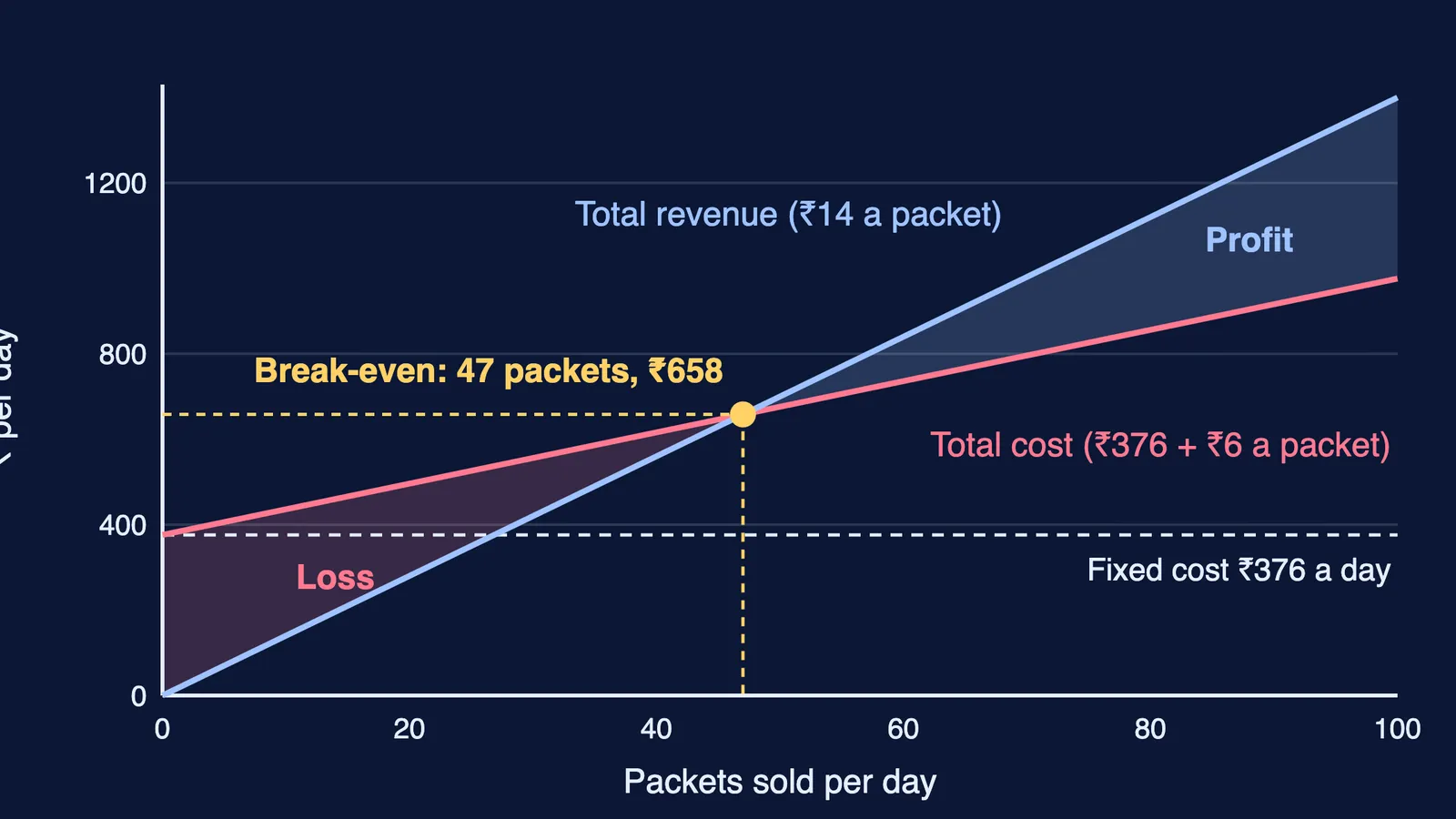
For the stall: the popcorn machine (Rs 12,100) and cart (Rs 4,700) plus first stock (Rs 1,600) make start-up costs of Rs 18,400. Recovering the Rs 16,800 of equipment over 600 trading days (24 months of 25 days) costs Rs 28 a day. Daily fixed costs: helper Rs 260, space fee Rs 78, recovery Rs 28, phone Rs 10; total Rs 376.
How do you calculate the break-even point for one product?
The break-even point is the sales level at which total revenue equals total expenses: no profit, no loss. The book's formula:
Break-even volume (per period) = fixed cost (per period) ÷ gross margin per unit
For the stall: 376 ÷ 8 = 47 packets a day. Check: revenue 47 × 14 = Rs 658; costs 47 × 6 + 376 = Rs 658.
At 30 packets the stall loses Rs 136 (240 − 376); at 80 it makes Rs 264 (640 − 376).
For a profit target, add it to the fixed cost: sales target = (fixed cost + target profit) ÷ gross margin per unit. To earn Rs 400 a day: (376 + 400) ÷ 8 = 97 packets.
For the algebra of crossing lines, see our break-even guide using two mobile plans.
Practice questions for Unit 6
Mark values are our suggestion.
(1 mark) What is the unit of sale for a fictional photocopy shop?
(3 marks) Classify as start-up, fixed or variable for a fictional bakery: buying an oven, monthly shop rent, flour.
(3 marks) A fictional candle maker's batch costs Rs 462 and yields 42 good candles; each box costs Rs 2. Find unit cost and gross margin at Rs 32 a candle.
(4 marks) The candle maker's fixed costs are Rs 5,700 a month. Find the monthly break-even and the sales needed for Rs 3,800 profit.
(4 marks) Explain why electricity can be a fixed cost for a tuition centre but a variable cost for an ice factory.
Answers: 1. one page copied; 2. start-up, fixed, variable; 3. Rs 13 and Rs 19; 4. 300 candles and 500 candles.
Multi-product break-even, EOQ and ROI follow in our Class 12 Business Arithmetic guide; see also our guide to taking Entrepreneurship in Class 12.
Stuck on where to start revising? Fermi's AI tutor works out what you already know and builds a plan for the session.