On this page
Unit 4 of CBSE Class 11 Entrepreneurship treats entrepreneurs as people who solve other people's problems. This guide follows the 2026-27 curriculum and CBSE's Class XI book, with fictional examples and our own numbers. It is a study summary, not business or financial advice.
What does Unit 4 cover, and how many marks is it worth?
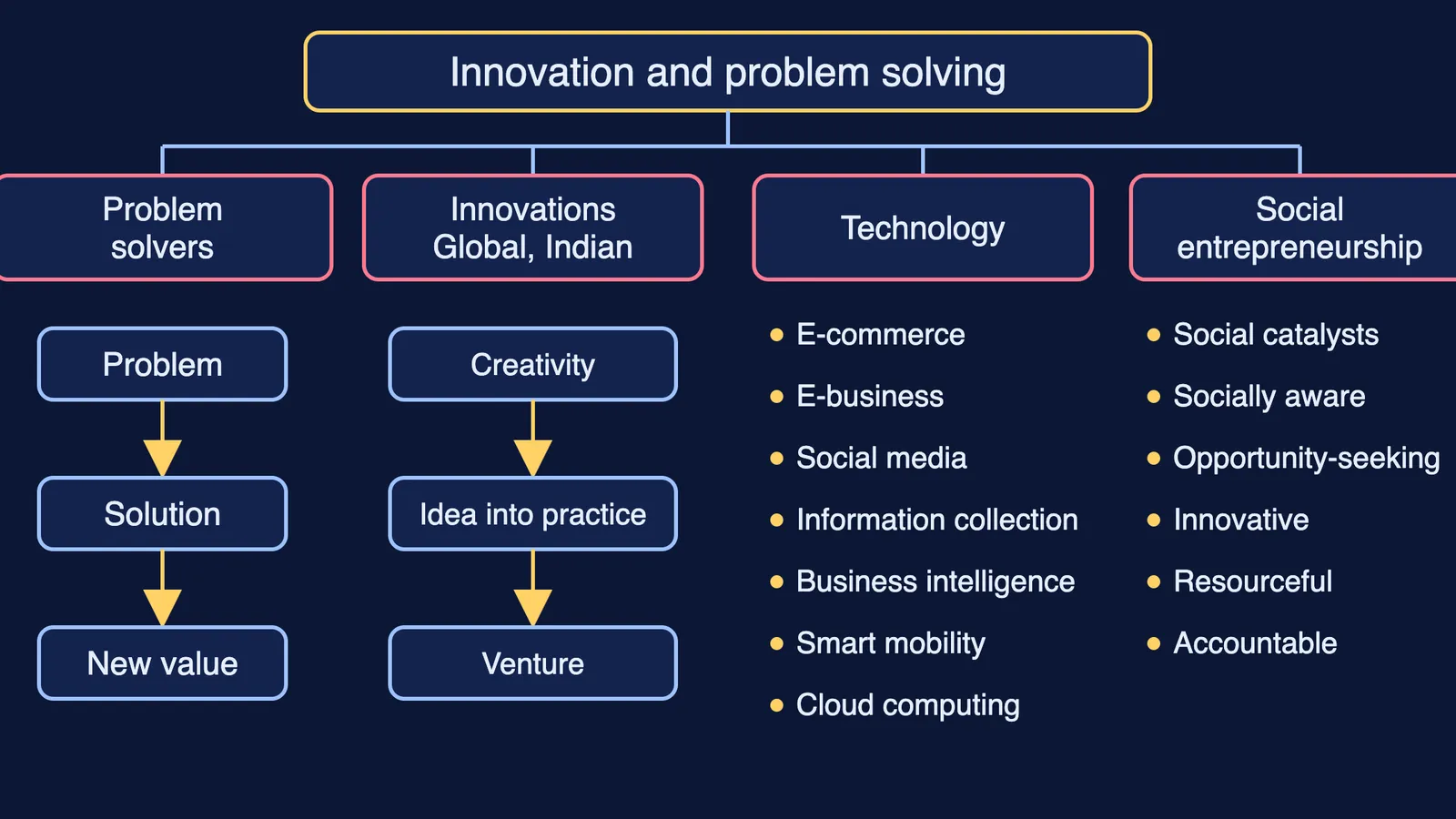
The CBSE Entrepreneurship (066) curriculum for 2026-27 lists four sub-topics: entrepreneurs as problem solvers; innovations and entrepreneurial ventures, global and Indian; the role of technology, meaning e-commerce and social media; and the concept of social entrepreneurship.
Units 3 and 4 share one 20-mark block, so CBSE prints no separate figure for Unit 4. Theory is worth 70 marks and project work 30. The question paper design gives 30 theory marks (43%) to applying ideas, so practise each idea on a new example.
The prescribed book is CBSE's Entrepreneurship Class XI, third edition 2013. Its Unit 4 also covers risk, barriers, incubators and government support, which the 2026-27 curriculum does not list here. The book's definitions of e-commerce sit in its Unit 5.
Why are entrepreneurs called problem solvers?
The book's argument has three steps. An entrepreneur acts to fix a problem for someone else; fixing it creates new value; and the more or bigger problems a venture fixes, the more profit it can make. Risk comes with it.
Its opening story follows Japanese fishing boats chasing fresh-tasting fish: bigger boats, then freezers, then tanks, each fix raising a new problem.
Which innovations led to entrepreneurial ventures?
The book treats creativity, joined to the ability to make an idea work, as the entrepreneur's mark. Its global examples are mostly accidental discoveries: penicillin (Alexander Fleming, from a discarded, contaminated dish), the pacemaker (John Hopps, during hypothermia research), the microwave oven (Percy Spencer, during radar work), X-rays (Wilhelm Roentgen) and potato chips (chef George Crum). The lesson: keep experimenting. It also tells how KFC began by feeding hungry travellers.
For India, the book describes Verghese Kurien's dairy co-operative work at Anand, which led to the National Dairy Development Board in 1965 and to Operation Flood, and Ela Bhatt's Self-Employed Women's Association (SEWA), whose garment workers formed their own co-operative in 1972.
How do e-commerce and social media create new kinds of business?
In the book, e-business is the wider idea: running industry, trade and commerce over computer networks. E-commerce is the narrower part: a firm buying and selling with customers and suppliers over the internet.
The book lists eight roles of e-business, including quick replies to customers, wider markets reaching rural areas, shorter distribution channels with fewer middlemen, lower payment risk and easier product launches. Its Unit 4 adds information collection, business intelligence, smart mobility and cloud computing, and says social media lets firms listen to customers. Its forecasts date from 2013, so learn the concepts, not the figures.
What is social entrepreneurship?
The book cites J. Gregory Dees, for whom social entrepreneurship pairs a social mission's passion with business-like discipline, innovation and determination. For Martin and Osberg, a social entrepreneur seeks large-scale benefit for neglected groups that lack the money or influence to secure it alone.
The key difference: an entrepreneur's end goal is wealth, while a social entrepreneur treats wealth as a means to social good. The book's global case is Muhammad Yunus and Grameen Bank microcredit. Its six traits are being accountable, innovative, resourceful, opportunity-seeking and socially aware, and acting as social catalysts.
Practice questions for Unit 4
Mark values are our suggestion.
(1 mark) What is created when an entrepreneur solves a customer's problem?
(3 marks) A fictional bakery takes orders and payments online and keeps its accounts online. Which part is e-commerce, and which is only e-business? Why?
(3 marks) A fictional weaver sells a shawl to a trader for Rs 900, and a shop sells it for Rs 1,400. Selling online at Rs 1,250 with Rs 150 delivery, how much more does the weaver keep, and how much does the buyer save?
(4 marks) Fictional Asha runs a tiffin service for profit; Ravi uses his tiffin profits to fund free meals for elderly people. Who is the social entrepreneur, and which two traits does he show?
(6 marks) Fictional village farmers sell tomatoes cheaply because they spoil. Draw a three-row problem and solution table for a venture that helps.
Answers: 1. new value; 2. orders and payments are e-commerce, accounts only e-business; 3. Rs 200 more, and the buyer saves Rs 150; 4. Ravi: profit is his means, not his goal.
See also our Class 12 Entrepreneurship subject guide, three Indian examples of frugal innovation and the Class 11 Business Studies guide to small business.
Short on time this week? Fermi's AI tutor works out what you already know and builds a plan for the session.