

On this page
What does the Class 12 Entrepreneurship syllabus cover?
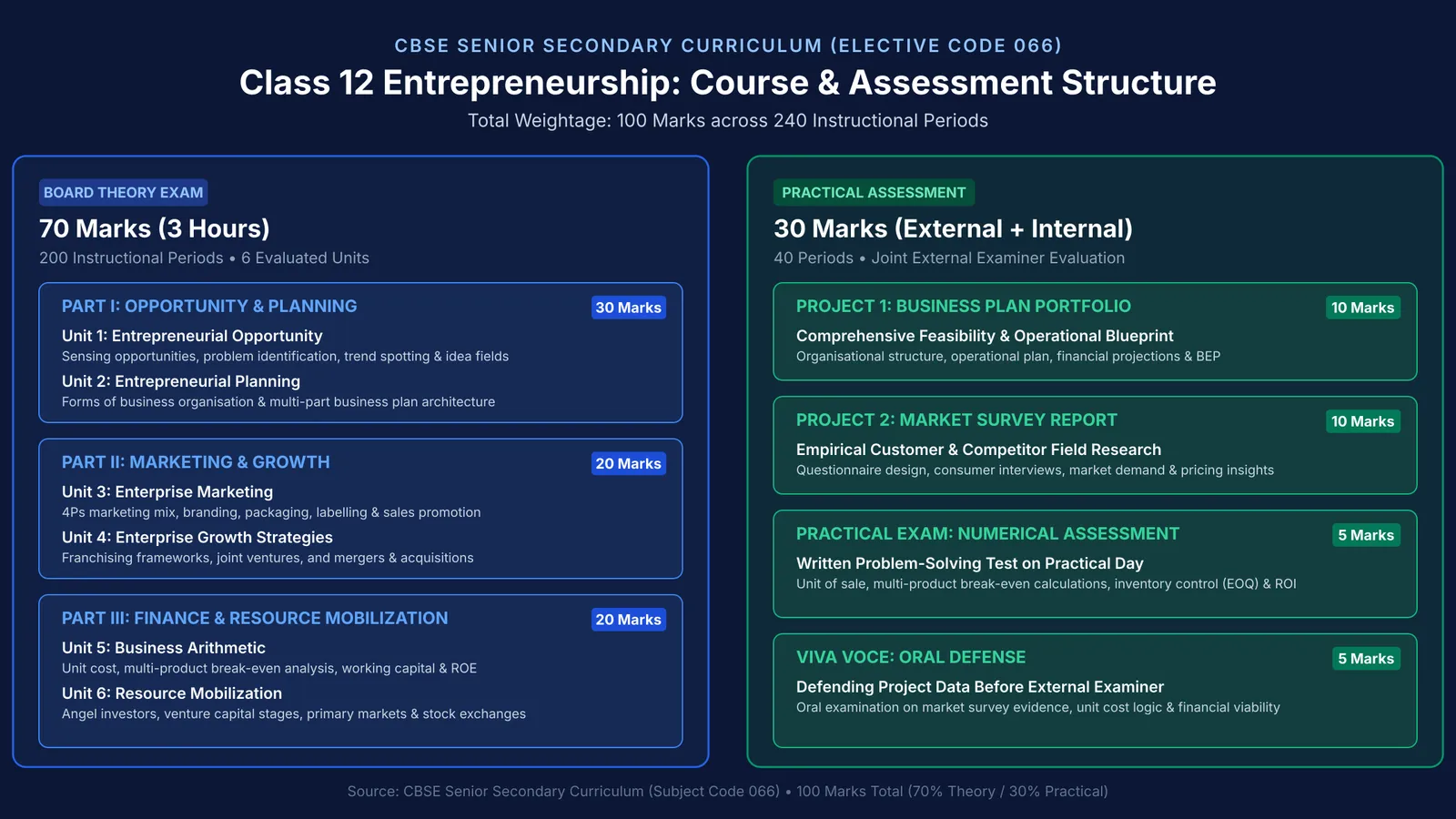
When high school students evaluate senior secondary commerce electives, subjects often feel entirely theoretical. The Central Board of Secondary Education offers Entrepreneurship (Subject Code 066) as an academic elective designed to turn business ideas into operational practice. Outlined in the official CBSE Senior Secondary Curriculum, the course spans 240 instructional periods divided between a 70-mark board theory paper and a 30-mark practical assessment.
The theory curriculum covers six focused units across the academic year:
Unit 1: Entrepreneurial Opportunity (environmental scanning, problem identification, idea fields, and trend spotting)
Unit 2: Entrepreneurial Planning (forms of business organisation, legal formalities, and multi-part business plan architecture)
Unit 3: Enterprise Marketing (the 4Ps marketing mix, branding strategies, sales promotion, and customer relationships)
Unit 4: Enterprise Growth Strategies (franchising frameworks, joint ventures, and mergers and acquisitions)
Unit 5: Business Arithmetic (unit costs, multi-product break-even analysis, inventory control, and return on equity)
Unit 6: Resource Mobilization (angel investment, venture capital stages, primary markets, and stock exchanges)
Rather than asking you to memorise corporate history, the syllabus emphasizes applied reasoning. In Unit 1 and Unit 2, which together account for 30 marks of the theory paper according to the CBSE Senior Secondary Curriculum, you learn how founders identify gaps in the market, assess commercial viability, and structure early business operations.
How does the 30-mark practical and project work operate?
The standout feature of Class 12 Entrepreneurship is its practical assessment. While most humanities and commerce subjects allocate 20 marks to internal assessment, Entrepreneurship dedicates a full 30 marks to practical work, evaluated jointly by an external board examiner and your subject teacher as specified in the CBSE Senior Secondary Curriculum.
The 30 practical marks follow a strict board rubric:
Market Survey project: 10 marks for field research surveying real consumers about product viability, target demographics, and pricing
Business Plan portfolio: 10 marks for creating an end-to-end operational, marketing, and financial blueprint for a new venture
Written numerical test: 5 marks for solving business arithmetic problems during the practical exam session
Viva voce: 5 marks for answering external examiner questions defending your survey data and business assumptions
Research shows that this style of applied instruction leaves lasting gains. In a meta-analysis by Martin, McNally, and Kay evaluating 42 independent samples covering 16,657 individuals, entrepreneurship education demonstrated a statistically significant positive correlation with entrepreneurship-related human capital assets (rw = 0.217). Tracking students over 16 years, a longitudinal study by Elert, Andersson, and Wennberg confirmed that secondary school enterprise programs significantly increased the probability of starting a venture and boosted long-term entrepreneurial income.
How does Entrepreneurship differ from Business Studies?
Families comparing subjects often wonder whether Entrepreneurship duplicates Business Studies (Subject Code 054). While both subjects introduce commercial principles, their perspectives differ fundamentally. Business Studies focuses on managing an established corporate organisation: delegation, departmental coordination, formal hierarchy, and established regulatory compliance. Entrepreneurship focuses on enterprise creation: sensing opportunity, raising early-stage capital, and building operations from scratch.
A second key difference is arithmetic rigor. Business Studies has almost no numerical computation. Entrepreneurship requires working quantitative problems in Unit 5, where you calculate unit cost, working capital, and break-even sales volume. If you enjoy data and want practical financial fluency, Entrepreneurship provides stronger analytical preparation. When deciding subjects during choosing a stream after Class 10, many students pair both subjects to balance managerial principles with venture building.
Which students benefit most from taking Entrepreneurship?
The elective is open to students across all three academic streams: Commerce, Science, and Humanities. It suits several distinct student pathways:
Future commerce and business undergraduates: Students targeting BBA, BMS, or integrated management programs like IPMAT find the syllabus mirrors first-year university business coursework.
Science students planning technology ventures: Combining physics, chemistry, or mathematics with Entrepreneurship helps aspiring engineers understand intellectual property, prototype budgeting, and venture capital. You can pair it alongside the CBSE Artificial Intelligence elective to build both technical and commercial foundations.
Social science and humanities students: Students interested in non-profit management, social enterprises, or design studios learn formal budgeting and organisational models.
How should you prepare for the board examination?
Success in the 70-mark theory exam outlined in the CBSE Senior Secondary Curriculum depends on mastering business arithmetic and structured case studies. For the numerical section, practice calculating the break-even point systematically. Consider this standard worked example:
Suppose a student venture manufactures recycled canvas bags:
Fixed costs (rent, tool depreciation): ₹30,000 per month
Variable cost per bag (fabric, stitching): ₹50
Selling price per bag: ₹100
Unit contribution margin: ₹100 − ₹50 = ₹50
Break-even volume: ₹30,000 / ₹50 = 600 bags
Break-even revenue: 600 × ₹100 = ₹60,000
If the firm sells fewer than 600 bags, it suffers a loss; every bag sold beyond 600 contributes ₹50 directly to profit. Practicing these formulas with the self-explanation technique ensures you understand how changes in fixed overhead or variable material expenses shift the break-even threshold. When multi-step arithmetic problems feel confusing, the Fermi Problem Library offers worked problems with a step-by-step solver that explains the reasoning rather than printing an answer. For broader revision across the six units, Fermi's AI tutor can work out what you already know and build a plan for the session, guiding you through case studies until each concept is clear.


