On this page
Business Arithmetic is Unit 5 of CBSE Class 12 Entrepreneurship. Every example below uses made-up figures for a fictional student-run canteen. This is a study summary, not business or financial advice.
What does Business Arithmetic cover in Class 12 Entrepreneurship?
The 2026-27 Entrepreneurship curriculum lists five contents for Unit 5:
unit of sale and unit cost for multiple products or services
break-even analysis for multiple products or services
computation of working capital
inventory control and EOQ
ROI (return on investment) and ROE (return on equity)
In the marks table for the 70-mark theory paper, Unit 5 and Unit 6 (Resource Mobilization) share one 20-mark cell; there is no separate figure for Unit 5.
The prescribed text is CBSE's own Entrepreneurship Class XII book (revised edition, 2014); its Unit 5 sets out the methods below. See also our guide to taking Entrepreneurship in Class 12.
How do you find unit price and break-even for several products?
With many items, the book picks a unit of sale, such as one customer. Unit price is total billing divided by units of sale; unit cost is variable cost (cost of goods sold) divided by the same number.
If the canteen bills 220 customers ₹19,140 in a day for goods costing ₹11,880, unit price = 19,140 ÷ 220 = ₹87, unit cost = 11,880 ÷ 220 = ₹54 and gross margin = ₹33 per customer.
For break-even with a fixed sales mix, the 2026-27 marking scheme uses a weighted average contribution margin per unit:
Sandwich: price ₹58, variable cost ₹31, contribution ₹27, mix 50%
Juice: price ₹46, variable cost ₹25, contribution ₹21, mix 30%
Muffin: price ₹38, variable cost ₹22, contribution ₹16, mix 20%
Weighted contribution = 27 × 0.5 + 21 × 0.3 + 16 × 0.2 = ₹23 per unit.
Break-even units = monthly fixed cost ₹52,900 ÷ 23 = 2,300.
By the mix: 1,150 sandwiches, 690 juices and 460 muffins.
Check: revenue ₹1,15,920 − variable cost ₹63,020 = ₹52,900, the fixed cost.
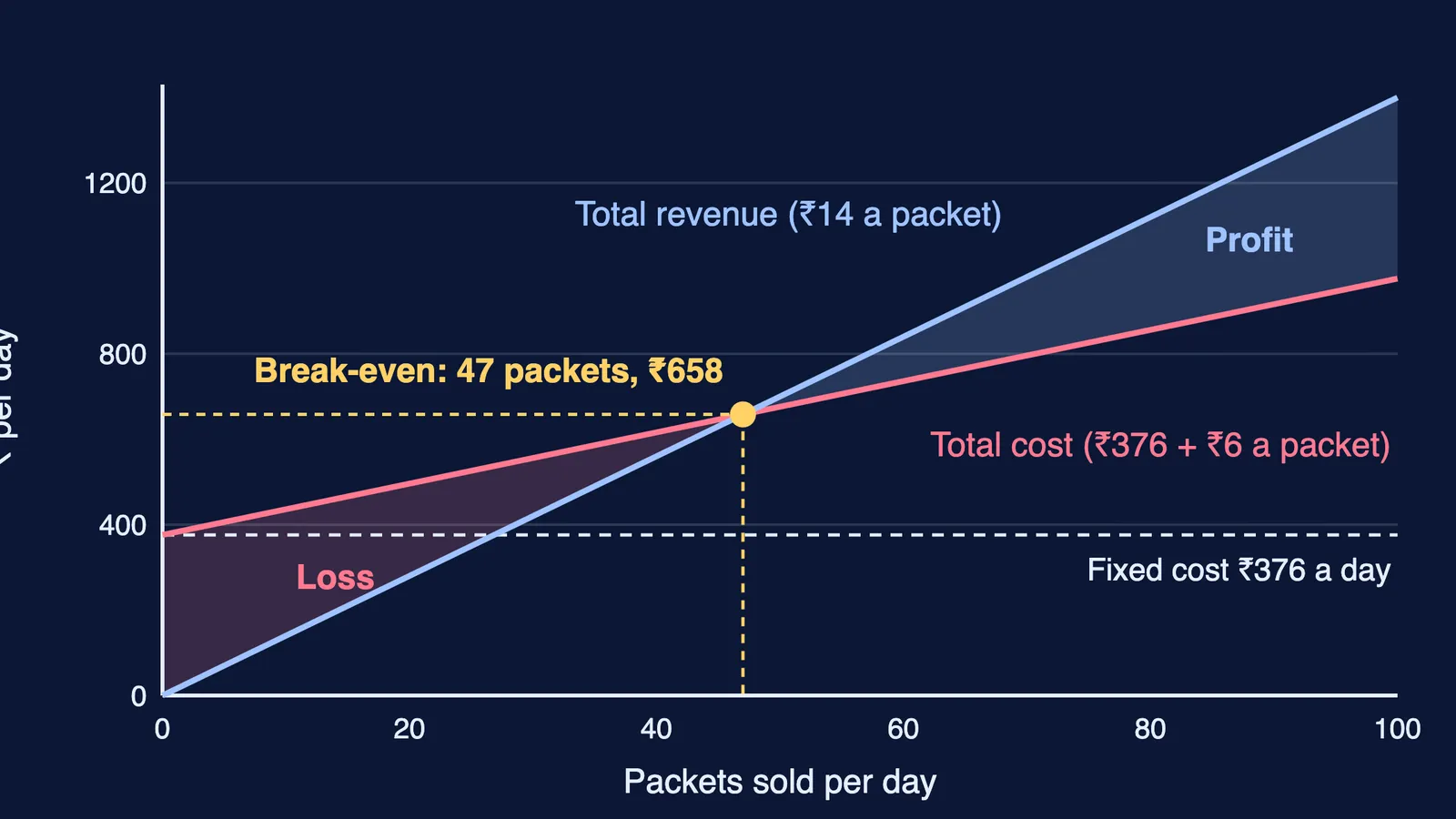
For the simplest case, see when two cost lines meet.
How do you compute working capital?
Working capital funds day-to-day operations. The marking scheme computes it as current assets minus current liabilities.
The canteen's cash (₹18,600), debtors (₹9,400) and stock (₹27,000) give current assets of ₹55,000. Creditors (₹21,500) and outstanding wages (₹4,300) give current liabilities of ₹25,800. Working capital = 55,000 − 25,800 = ₹29,200.
Our Schedule III financial statements guide shows where these items sit.
How is EOQ calculated?
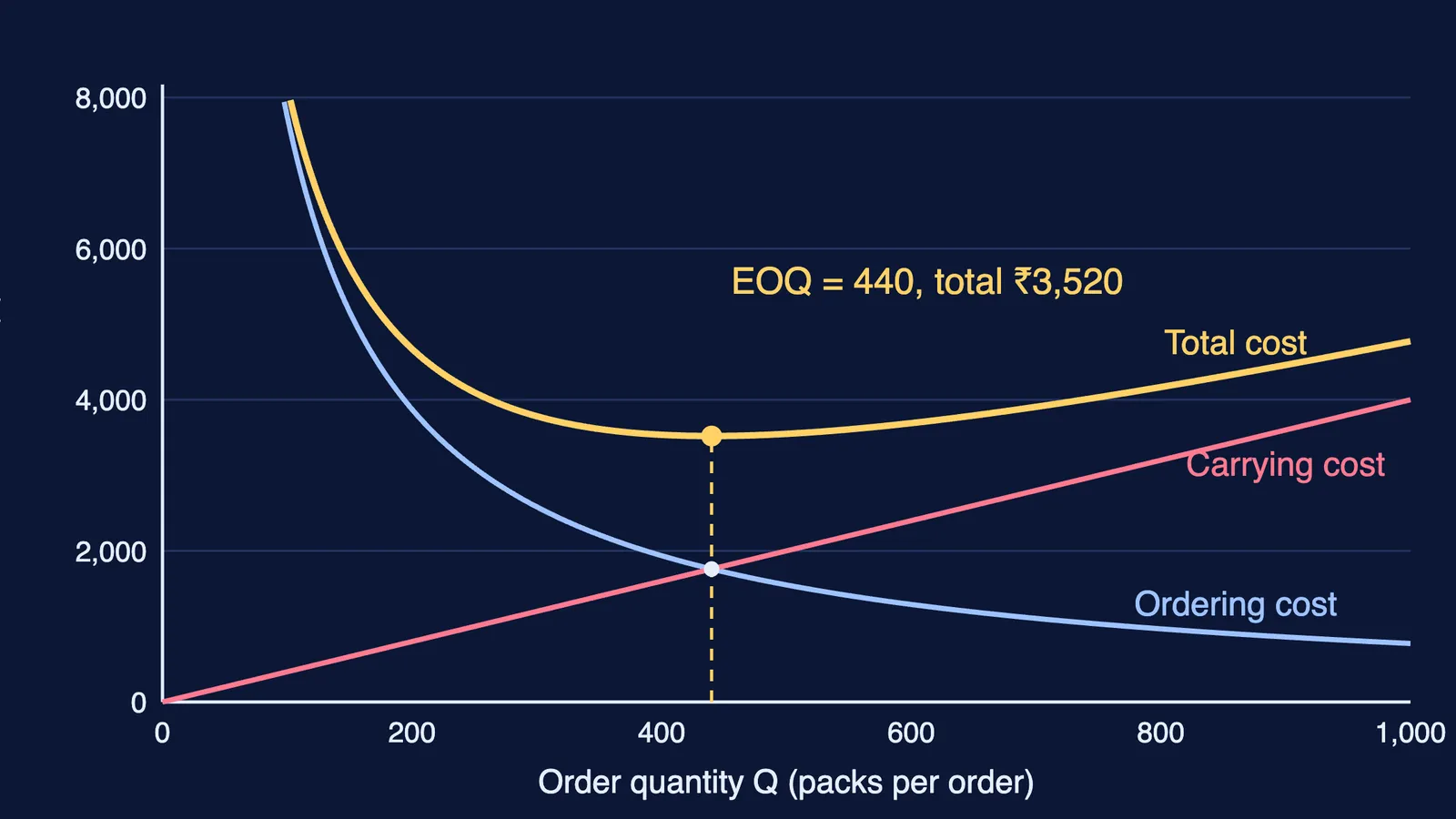
Inventory control means holding enough stock without tying up excess money. Bigger orders cut ordering cost (placing and receiving orders) but raise carrying cost (storing and financing stock). The economic order quantity is the order size with the lowest total:
EOQ = √(2DP ÷ C)
In the book's notation, D is annual demand in units, P the cost of placing and receiving one order and C the cost of carrying one unit for a year.
The canteen uses 2,420 packs of paper cups a year; each order costs ₹320 and carrying one pack for a year costs ₹8. EOQ = √(2 × 2,420 × 320 ÷ 8) = √1,93,600 = 440 packs. That is 5.5 orders a year costing ₹1,760; the average stock of 220 packs also costs ₹1,760 to carry. The ₹3,520 total is the lowest point on the chart above.
What is the difference between ROI and ROE?
In the marking scheme, ROI = net profit ÷ total capital employed × 100. The book defines ROE as profit left for the owner ÷ the owner's own money (equity) × 100.
A fictional food stall runs on ₹2,25,000 of the owner's money plus a ₹3,15,000 loan at 12% a year. It earns ₹81,000 before interest (ignore tax).
ROI = 81,000 ÷ 5,40,000 × 100 = 15% (like the book's grocery example, profit before interest)
Interest = ₹37,800, so the owner keeps ₹43,200
ROE = 43,200 ÷ 2,25,000 × 100 = 19.2%
ROE beats ROI because the loan costs 12% while the business earns 15%. In the exam, use the profit the question defines; the sample paper's ROI question deducts tax first.
Practice questions in the 2026-27 sample paper format
The 2026-27 sample paper has 1-mark MCQs and 2, 3 and 5-mark answers. The questions below are our own, with made-up figures.
(1 mark) Which is a current liability: (a) machinery (b) trade creditors (c) stock (d) cash?
(2 marks) A stationery stall sells 2,450 registers a year; each order costs ₹225 and carrying a register for a year costs ₹9. Find the EOQ.
(3 marks) A tuition start-up has ₹1,10,000 of equity and a ₹1,10,000 loan at 9% a year. Profit before interest is ₹39,600. Find ROI and ROE, ignoring tax.
(5 marks) A firm sells X and Y in the ratio 25:75. X sells at ₹90 (variable cost ₹54); Y at ₹44 (variable cost ₹32). Fixed costs are ₹64,800. Find each product's break-even units.
Answers: 1 (b); 2: 350 registers; 3: ROI 18%, ROE 27%; 4: 900 of X, 2,700 of Y.
Short on revision time? Fermi's AI tutor works out what you already know and builds a plan for the session.