On this page
A company's balance sheet follows one fixed vertical format, Schedule III to the Companies Act, 2013. The skill this chapter tests is putting each item under the right head and sub-head.
Where does this topic sit in the 2026-27 syllabus?
The CBSE Accountancy curriculum for 2026-27 lists "Financial statements of a Company" as the first topic of Analysis of Financial Statements, in Part B. The marks table numbers it Unit 3 with 12 marks; the detailed pages label it Unit 4.
Those 12 marks cover the whole unit, ratios included, not this chapter alone. Exceptional items, extraordinary items and discontinued operations are excluded.
Your textbook is Chapter 3 of NCERT Accountancy Part 2, whose pages carry "Reprint 2026-27" (imprint page).
The CBSE sample question paper 2026-27 has a 3-mark question (Q32) asking the main head and sub-head of three items; the marking scheme puts warranty claims payable under Current liabilities, Other current liabilities.
What are the major heads and sub-heads of a Schedule III balance sheet?
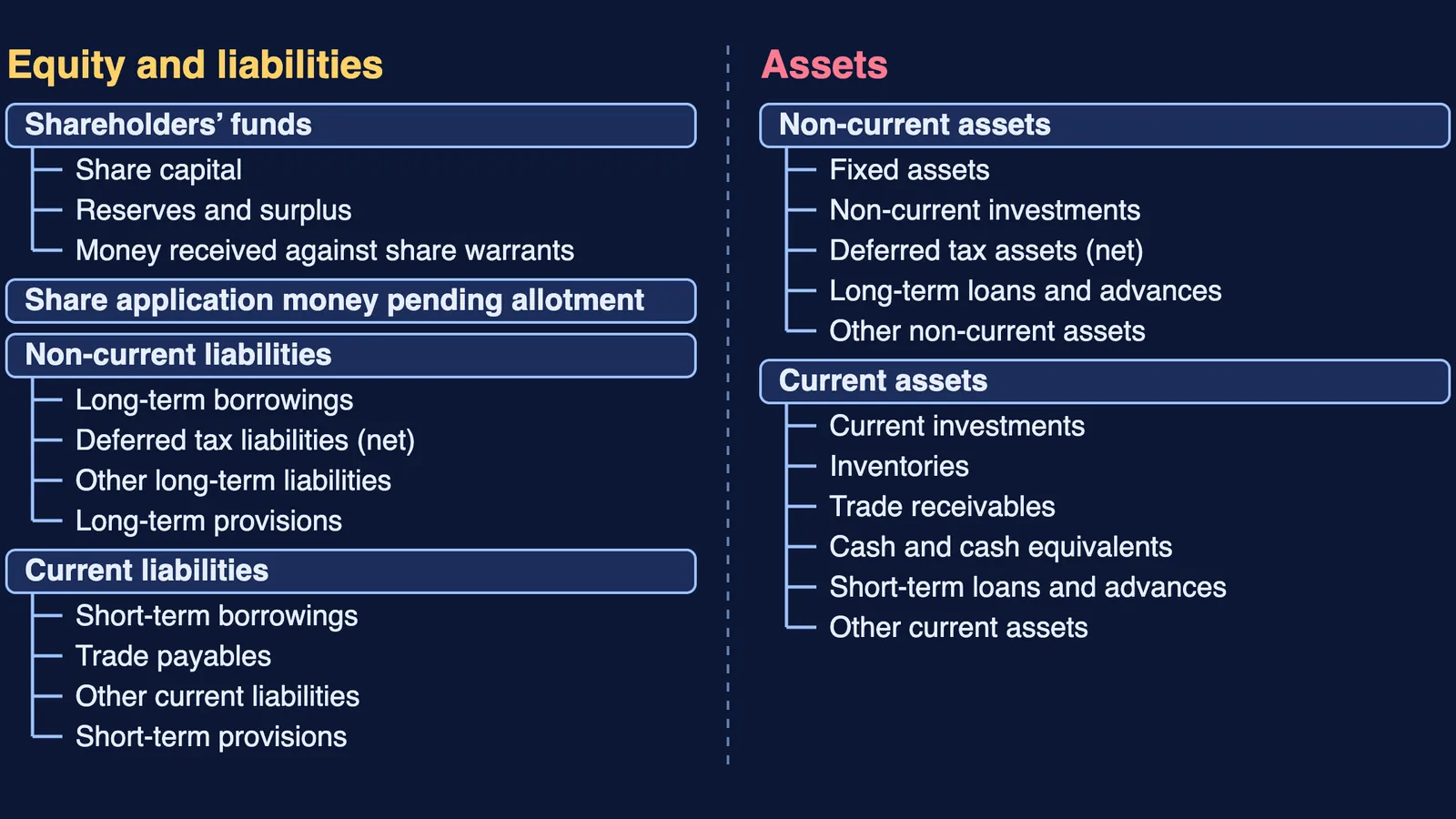
The format has two parts, Equity and Liabilities, and Assets, as set out in NCERT Chapter 3, Exhibit 3.1.
Shareholders' funds: share capital; reserves and surplus; money received against share warrants
Share application money pending allotment (a head on its own)
Non-current liabilities: long-term borrowings; deferred tax liabilities (net); other long-term liabilities; long-term provisions
Current liabilities: short-term borrowings; trade payables; other current liabilities; short-term provisions
Non-current assets: fixed assets (tangible, intangible, capital work-in-progress, intangible assets under development); non-current investments; deferred tax assets (net); long-term loans and advances; other non-current assets
Current assets: current investments; inventories; trade receivables; cash and cash equivalents; short-term loans and advances; other current assets
The face shows only these lines with a Note No.; detail goes in notes to accounts. The share capital note, for example, shows authorised, issued and subscribed capital, calls in arrears and forfeited shares, so revise issue of shares journal entries if those are shaky.
How do you decide if an item is current or non-current?
NCERT gives the test: an item is current if it is part of the operating cycle, will be realised or settled within twelve months, is held mainly for trading, is cash and cash equivalent, or is a liability the company cannot unconditionally defer for at least 12 months; everything else is non-current (NCERT Chapter 3).
Three fixed rules: inventories are always current. Deferred tax assets and liabilities are always non-current. Fixed assets stay non-current even if their useful life is under 12 months.
Worked example: where does each item go?
Sahyadri Masala Ltd (a made-up company) prepares its balance sheet as at 31 March 2027. Each answer is checked against NCERT Chapter 3.
Bank term loan of ₹20 lakh, of which ₹4 lakh is due before 31 March 2028: ₹16 lakh under Non-current liabilities, Long-term borrowings; ₹4 lakh under Current liabilities, Other current liabilities (current maturities of long-term debt).
Cash credit from the bank, repayable on demand: Current liabilities, Short-term borrowings.
Amount owed to a chilli farmer for raw material, payable in 45 days: Current liabilities, Trade payables.
Provision for tax for 2026-27: Current liabilities, Short-term provisions.
Securities premium from last year's share issue: Shareholders' funds, Reserves and surplus.
Debit balance in the statement of profit and loss: Shareholders' funds, Reserves and surplus, shown as a negative figure under Surplus.
A cold-storage warehouse still being built: Non-current assets, Fixed assets, Capital work-in-progress.
Shares of another company bought to hold for five years: Non-current assets, Non-current investments.
Sale to a hotel chain, payment agreed in 15 months: Non-current assets, Other non-current assets.
Packed masala in the godown: Current assets, Inventories.
Items 1, 6 and 9 are the traps: the obvious sub-head is wrong.
Which mistakes cost marks in this chapter?
Showing a debit balance of profit and loss as an asset instead of a negative Surplus.
Putting the whole long-term loan under long-term borrowings when an instalment falls due within 12 months.
Showing the current year's proposed dividend as a liability. NCERT puts it in notes to accounts as a contingent liability (AS-4).
Writing "sundry debtors" and "sundry creditors" instead of trade receivables and trade payables.
Leaving preliminary expenses as an asset. NCERT's rule is to write them off in the year incurred, first from securities premium, then from profit and loss.
Naming only the head. The 2026-27 marking scheme gives head and sub-head for every item.
How should you practise this before the board exam?
Write the blank format from memory until every sub-head comes out in order. Then classify ten items a day from the Chapter 3 exercises, applying the twelve-month test to each.
Current ratio and quick ratio use current assets and current liabilities exactly as classified here, so move on to ratio analysis formulas for Class 12, then the cash flow statement format.
If you are not sure where to start, Fermi's AI tutor can work out what you already know and build a plan for the session, so you sit down to a clear next step.