On this page
Share capital questions in Class 12 accountancy follow one path: application, allotment and calls, then forfeiture and reissue if someone stops paying. All the rules below are from NCERT's Class 12 chapter Accounting for Share Capital (Accountancy Part II, reprint 2026-27).
What are the steps in an issue of shares?
A company collects the price of a share in instalments: application money, allotment money, then first, second and final calls, according to the NCERT chapter. Each instalment has its own temporary account, debited when it falls due and credited when the cash arrives.
One-mark limits from the same chapter:
Application money should be at least 5% of the face value of the share.
Unless the company's articles say otherwise, a call should not exceed 25% of face value, with at least one month between two calls.
Minimum subscription cannot be less than 90% of the issued amount; if it is not received, the entire subscription amount is refunded.
If the articles are silent, interest on calls in arrears is charged at up to 10% a year, and interest on calls in advance is paid at up to 12% a year.
Premium is credited to the Securities Premium (Reserve) account, not to Share Capital. NCERT says a company cannot ordinarily issue shares at a discount, except on reissue of forfeited shares and for sweat equity shares.
How do you pass journal entries for over-subscription?
When applications exceed the shares offered, directors can reject some applications in full, allot pro-rata to everyone, or combine the two, and the NCERT chapter calls the combination the most common choice. Money on rejected applications is refunded. Extra money from pro-rata applicants is credited to Share Allotment, which reduces what they owe.
A worked example: application to reissue
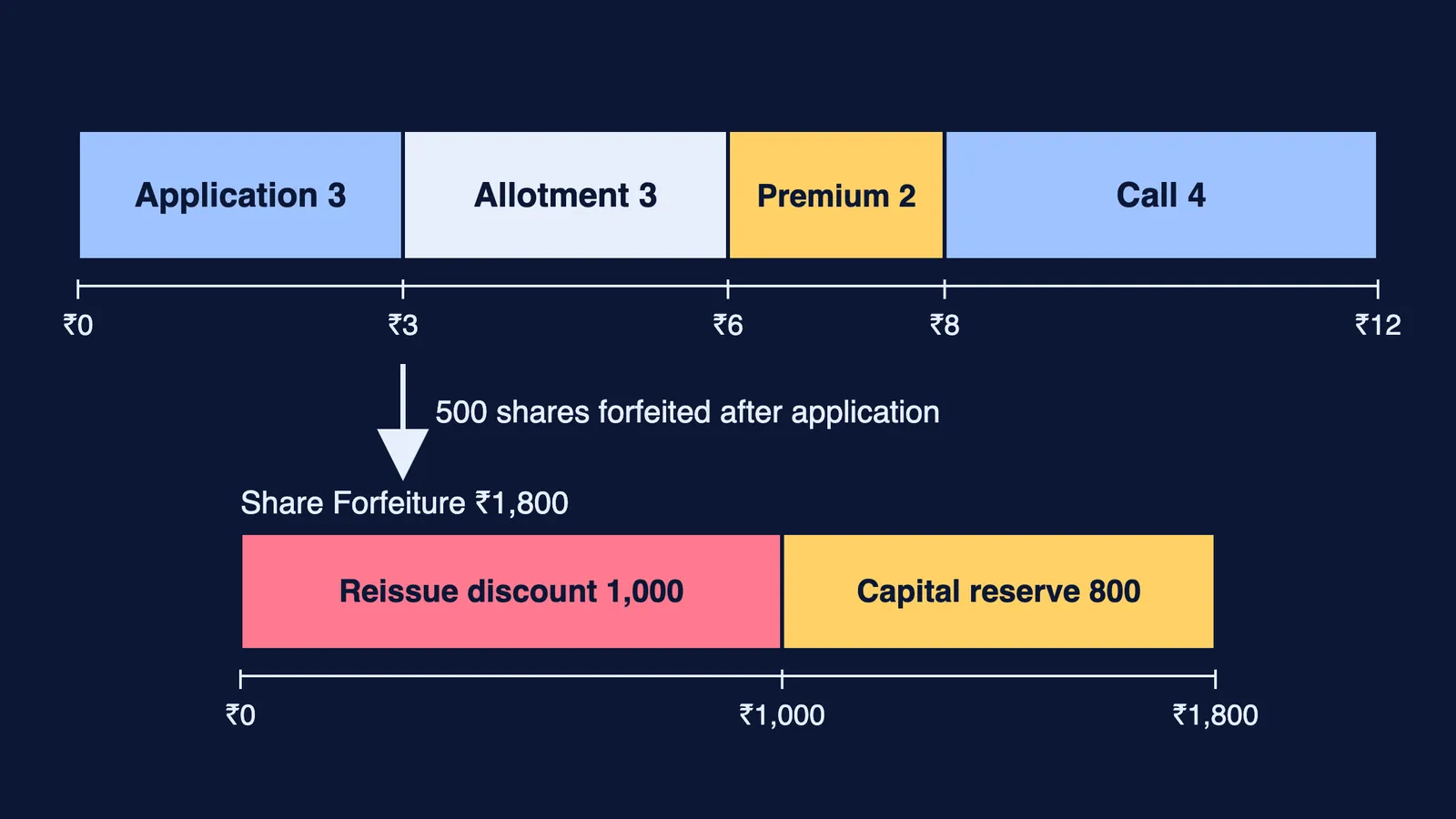
This example follows the pattern of Illustrations 13 and 15 in the NCERT chapter, with our own numbers. Shiva Ltd issues 10,000 shares of ₹10 at a premium of ₹2: ₹3 on application, ₹5 on allotment (including the premium) and ₹4 on first and final call. It receives applications for 15,000 shares, rejects 3,000 and allots 10,000 shares pro-rata to applicants for 12,000 (5 shares for every 6 applied). Riya applied for 600 shares, got 500, and paid nothing after application.
Entry 1: Bank A/c Dr ₹45,000 to Share Application A/c ₹45,000 (15,000 × ₹3).
Entry 2: Share Application A/c Dr ₹45,000 to Share Capital A/c ₹30,000, Share Allotment A/c ₹6,000 and Bank A/c ₹9,000 (excess on 2,000 shares adjusted; 3,000 rejected shares refunded).
Entry 3: Share Allotment A/c Dr ₹50,000 to Share Capital A/c ₹30,000 and Securities Premium A/c ₹20,000.
Entry 4: Bank A/c Dr ₹41,800 and Calls in Arrears A/c Dr ₹2,200 to Share Allotment A/c ₹44,000. Riya owed 500 × ₹5 = ₹2,500, less her ₹300 of extra application money.
Entry 5: Share First and Final Call A/c Dr ₹40,000 to Share Capital A/c ₹40,000.
Entry 6: Bank A/c Dr ₹38,000 and Calls in Arrears A/c Dr ₹2,000 to Share First and Final Call A/c ₹40,000.
How are forfeiture and reissue of shares recorded?
On forfeiture, reverse what was called up on those shares: debit Share Capital with the called-up amount, debit Securities Premium only if the premium was not received, credit Calls in Arrears with what is unpaid, and credit Share Forfeiture with what was paid (leaving out any premium already received). The NCERT chapter adds that the Share Forfeiture balance is shown as an addition to paid-up capital under Share Capital until the shares are reissued.
Entry 7: Share Capital A/c Dr ₹5,000 and Securities Premium A/c Dr ₹1,000 to Share Forfeiture A/c ₹1,800 and Calls in Arrears A/c ₹4,200.
The discount allowed on reissue cannot exceed the amount received on those shares at the original issue, and any balance left in Share Forfeiture for the reissued shares is a capital profit transferred to Capital Reserve. Shiva Ltd reissues Riya's 500 shares at ₹8 each, fully paid.
Entry 8: Bank A/c Dr ₹4,000 and Share Forfeiture A/c Dr ₹1,000 to Share Capital A/c ₹5,000.
Entry 9: Share Forfeiture A/c Dr ₹800 to Capital Reserve A/c ₹800.
Which mistakes cost marks in share capital questions?
Crediting premium to Share Capital, or debiting Securities Premium on forfeiture when the premium was already received.
Forgetting to subtract the pro-rata excess before working out unpaid allotment.
Allowing a reissue discount bigger than the amount forfeited.
Before you submit, run each entry past our guide to checking journal entries with the golden rules, and make sure total debits equal total credits in every entry. If the board paper wraps the question in a story, our guide to case-based questions in CBSE board exams shows how to pull out the numbers first.
If you are not sure which part to fix first, Fermi's AI tutor can work out what you already know and build a plan for the session, so you sit down to a clear next step.