On this page
Unit 5 of CBSE Class 11 Entrepreneurship asks who will buy what you plan to sell, and what shapes their choice. This guide follows the 2026-27 curriculum and CBSE's Class XI book. It is a study summary, not business or financial advice.
What does Unit 5 cover, and how many marks is it worth?
The CBSE Entrepreneurship (066) curriculum for 2026-27 lists four sub-topics for Unit 5, Understanding the Market: the concept and types of market; the micro and macro market environment; market research, with its concept, importance and process; and the marketing mix.
Unit 5 has its own row in the Class XI marks table: 15 marks of the 70 theory marks; project work adds 30. The curriculum's paper design gives 30 theory marks (43%) to applying ideas to new situations.
The prescribed book is CBSE's Entrepreneurship Class XI, third edition 2013. Its Unit 5 also covers e-business, trade and commerce, and pricing methods, which the 2026-27 curriculum does not list here.
What is a market, and what are its types?
The book traces the word to the Latin *marcatus*, meaning goods, trade or a place of business. It then shows the idea widening in three stages:
Traditional market: a physical place where one kind of goods is gathered for sale, such as a vegetable or grain market.
Modern market: buyers and sellers of a product in touch by any means, in person, by post or phone, across a region, a country or the world.
Emerging market: people with money and the wish to spend it, reached online, so place stops mattering.
How do micro and macro forces shape a market?
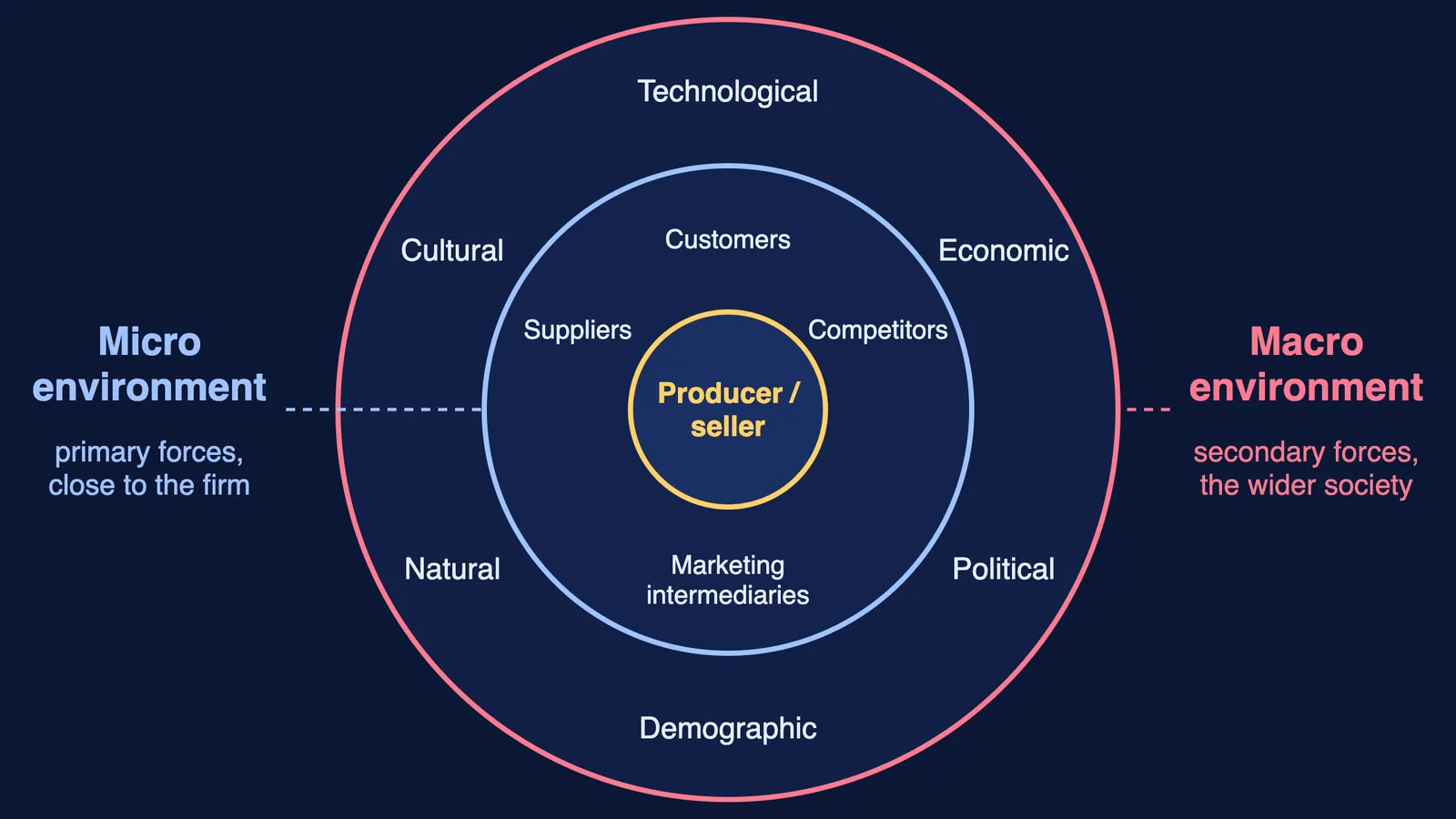
The book's market environment is the set of forces that affect how well a firm builds and keeps customer relationships. It splits them in two. Micro (primary) forces sit close to the firm and act on it directly: the producer or seller itself, customers, competitors, suppliers and marketing intermediaries such as wholesalers, retailers and transporters.
Macro (secondary) forces come from the wider society and are outside the firm's control: demographic, economic, technological, political, natural and cultural. The book's memory aid is DETPNC. A firm adapts by adjusting what it controls: the marketing mix.
What are the steps in market research?
The book calls market research the systematic study of every factor bearing on the movement of goods from producer to consumer. Seven steps:
Define the marketing problem.
List the information needed.
Plan the research design, checking records and published sources first.
Choose the instrument, sample type and sample size.
Analyse and interpret the information.
Summarise the findings.
Prepare the report.
The commonest instrument is the market survey, used when the data does not yet exist. Its four stages: plan, fieldwork, analysis, report. A census asks everyone; a sample asks some and scales up. Surveys reveal customer needs, lower risk and support forecasts.
What are the four Ps of the marketing mix?
The book defines the marketing mix as the blend of product, price, place and promotion a firm controls to reach its marketing goals. It credits James Culliton with the term and Jerome McCarthy with the four Ps.
Product: quality, design, brand name, packaging and after-sale service.
Price: the exchange value of the product; the only element that brings in revenue, while the rest add cost.
Place: channels (direct, or through one, two or three levels of intermediaries) and modes of transport and storage.
Promotion: personal selling, advertising, publicity, exhibitions, public relations and sales promotion.
For the chaat stall: chaat in a paper bowl, Rs 25, a table by the track, a poster in each classroom. No mix stays right forever, the book stresses, because surroundings, the firm and customer tastes change.
Practice questions for Unit 5
Mark values are our suggestion.
(1 mark) A club surveys all 40 members. Census or sample?
(1 mark) Families in a town now earn more. Which macro force is this?
(3 marks) A fictional juice stall gets a rival next door, then a water shortage hits town. Classify each force as micro or macro, with reasons.
(3 marks) A fictional stall surveys 60 of 480 students, and 27 say they would buy. Find the share and estimate the likely buyers.
(4 marks) Explain the four Ps for a fictional home-made pickle brand.
(6 marks) Apply the seven research steps to a fictional phone-cover printing service planned for your colony.
Answers: 1. census; 2. economic; 3. rival: competitor (micro); shortage: natural (macro); 4. 45%, about 216 buyers.
See also our Class 12 Entrepreneurship subject guide, the Class 12 Enterprise Marketing guide that builds on this unit, and the Business Studies take on the four Ps.
Planning your revision week? Fermi's AI tutor works out what you already know and builds a plan for the session.