On this page
Unit 6 of CBSE Class 12 Entrepreneurship (066), with a worked example and our own questions. This is a study summary, not business or financial advice.
What does the 2026-27 curriculum list for Resource Mobilization?
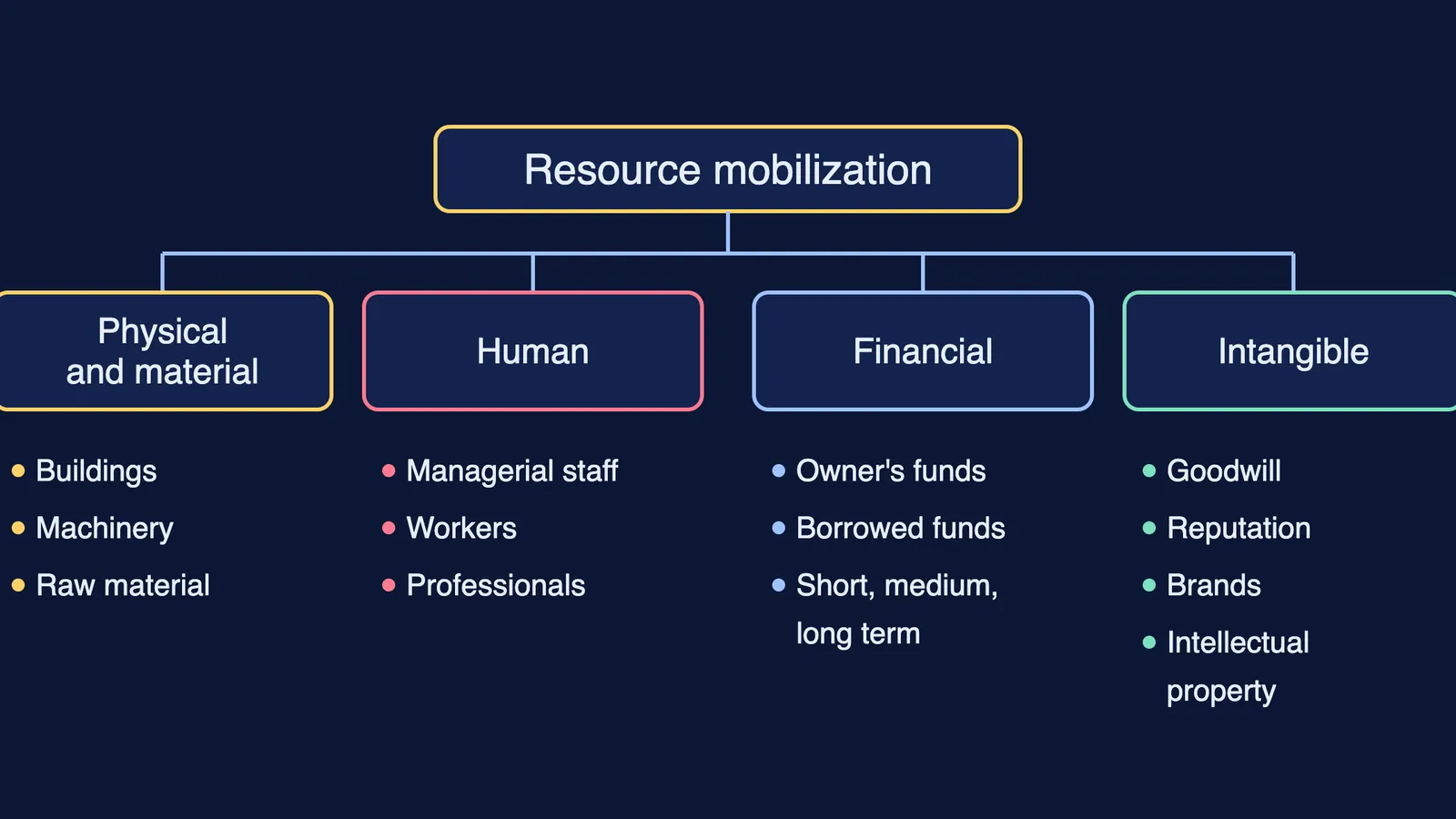
In the CBSE Entrepreneurship curriculum for 2026-27, Resource Mobilization is Unit 6 of Class 12. It shares 20 of the 70 theory marks with Unit 5, Business Arithmetic; CBSE prints no separate figure for Unit 6. The listed topics are capital market (concept), primary market (concept, methods of issue), angel investor (features) and venture capital (features, funding).
The prescribed book is CBSE's Entrepreneurship Class XII, revised edition 2014. Its Unit 6 also discusses stock exchanges, SEBI and specialised financial institutions, which the 2026-27 curriculum does not list. Class 11 has its own Resource Mobilization unit; this guide covers only Class 12. For the whole course, see our Entrepreneurship Class 12 subject guide.
What is a capital market?
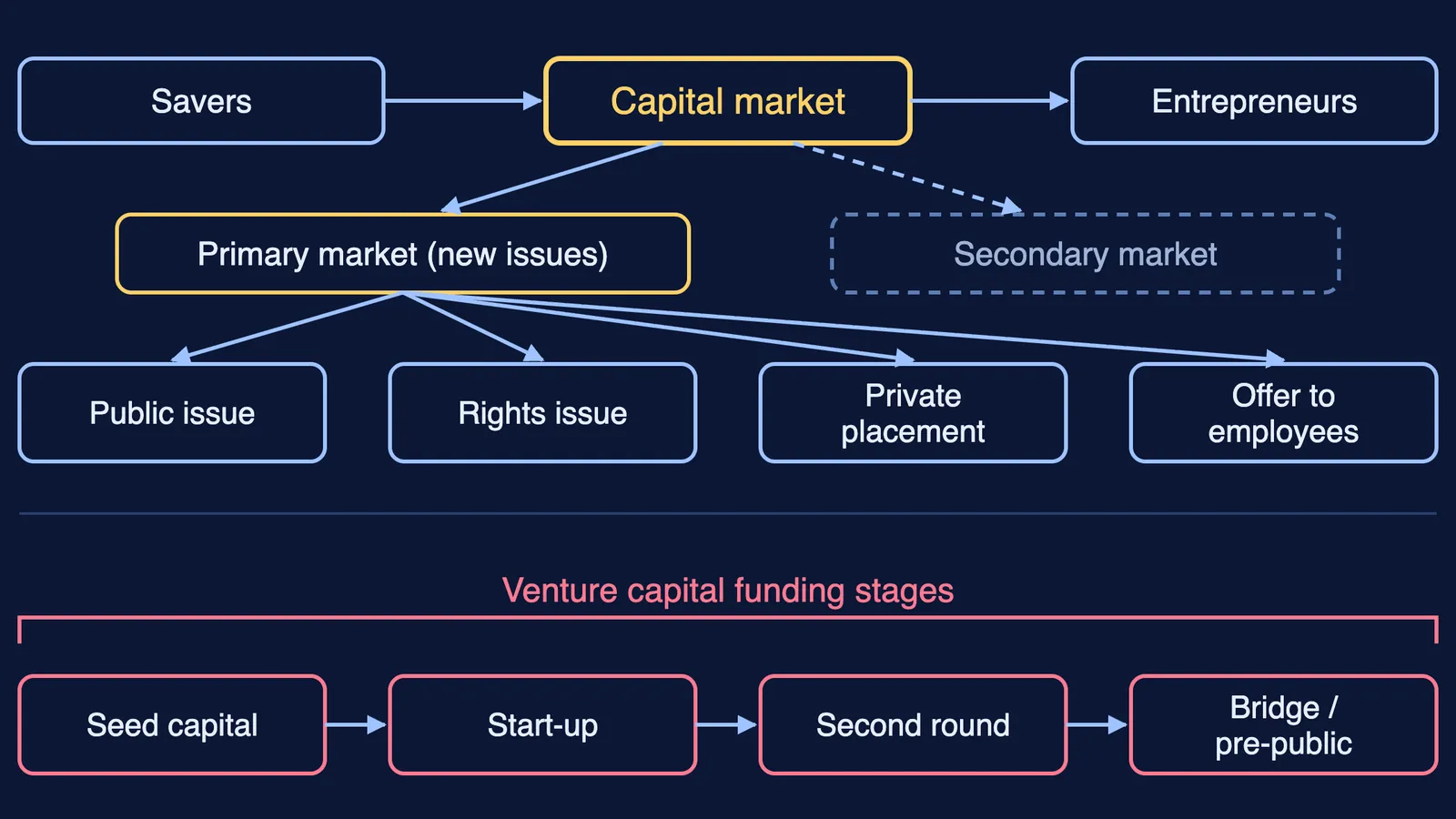
The CBSE book treats a capital market as an organised system that moves money from savers to entrepreneurs who will use it productively. This transfer is called financial intermediation.
It has two parts: the primary market sells new securities for the first time, and the secondary market (the stock exchange) trades securities issued earlier. Of the two, the curriculum names only the primary market. Our financial markets Class 12 guide covers the rest.
How can an entrepreneur raise money in the primary market?
A new company's first issue is an initial issue; an existing company's later one is a further issue. The book gives four methods of flotation:
Public issue: shares are offered to the public through a prospectus. It brings capital with no repayment or interest, but adds accountability, reporting costs, takeover risk and loss of privacy.
Rights issue: current shareholders are offered new shares in proportion to their holding and may accept or renounce them. It is cheap: no brokers, underwriters or prospectus.
Private placement: securities are sold directly to a few sophisticated, mostly institutional, investors, useful when a firm prefers not to disclose details publicly.
Offer to employees: staff buy shares or get stock options, which the book links to better efficiency and lower labour turnover.
What are the features of angel investors?
An angel investor is a wealthy individual who backs start-ups and early-stage firms with high risk and high possible return, usually for equity or convertible debt. They fill the gap between friends-and-family money and venture capital. Features:
Most are executives (serving or retired), business owners or other wealthy people, who bring know-how as well as money.
Very high risk, and later rounds often dilute their stake, so they expect a very high return.
They give advice, industry contacts and mentoring.
What is venture capital and how is it funded?
Venture capital is private equity for young, high-risk, high-growth firms. Its features: long-term equity finance; business skills alongside money; high risk-return; continued involvement; exit by selling to promoters or in the market.
Unlike a lender, a venture capitalist has no right to interest or repayment; it owns a share (see owner's versus borrowed funds in our sources of business finance Class 11 guide). It seeks innovative technology, rapid growth, a sound business model and a strong team, and, per the CBSE book, usually wants an exit within 3 to 7 years. Funding stages:
Seed capital: research before commercialisation.
Start-up: business plan, management team, tested prototype.
Second round: the product sells; funds go to expansion and diversification.
Last stage (bridge or pre-public): preparing to go public so investors can exit.
Worked example (fictional). Two founders start Tiffin Trail Pvt. Ltd., a lunch-box delivery firm, with 80,000 shares. An angel buys 20,000 new shares; later a venture capital fund buys 25,000 new shares.
After the angel: 100,000 shares, so the angel holds 20,000 / 100,000 = 20%.
After the fund: 125,000 shares, so the fund holds 25,000 / 125,000 = 20%.
The angel now holds 20,000 / 125,000 = 16%; the founders 80,000 / 125,000 = 64%, down from 80%.
The angel's fall from 20% to 16% is dilution.
Practice questions (our own)
Mark values follow the question types in the CBSE 2026-27 sample paper. All firms, names and numbers below are fictional.
(1 mark, MCQ) Kavya's bakery company offers its shareholders one new share for every five held. This is: (A) private placement (B) rights issue (C) public issue (D) offer to employees. Answer: B.
(2 marks) Give two reasons why an angel investor expects a very high return.
(3 marks) Meher Crafts Ltd. has 60,000 shares and makes a 1-for-4 rights issue at ₹15 a share. What can a holder of 2,000 shares buy, at what cost, and what does the company raise if all rights are taken? Answer: 500 shares, ₹7,500; ₹2,25,000.
(5 marks) A drone-repair firm sells its service regularly and wants funds to open in two more cities. Name its funding stage, describe the stage that follows, and explain how a venture capital fund's claim differs from a bank's.
Planning your revision week? Fermi's AI tutor works out what you already know and builds a plan for the session.