

On this page
Unit 10 of Class 12 Business Studies covers financial markets, the money market, the capital market and its primary and secondary types, stock exchanges, and SEBI's objectives and functions, according to the 2026-27 Business Studies syllabus published by Delhi's Directorate of Education. Here is one sorting rule for each comparison, a worked example and a checklist for SEBI answers.
What is a financial market?
A financial market is where the savings of households meet businesses and governments that need funds, through instruments such as shares, bonds and bills. It also sets prices for these instruments, lets you turn an investment back into cash, and cuts the cost of finding a buyer or seller. Build any "functions of a financial market" answer on those points.
Money market vs capital market: what is the difference?
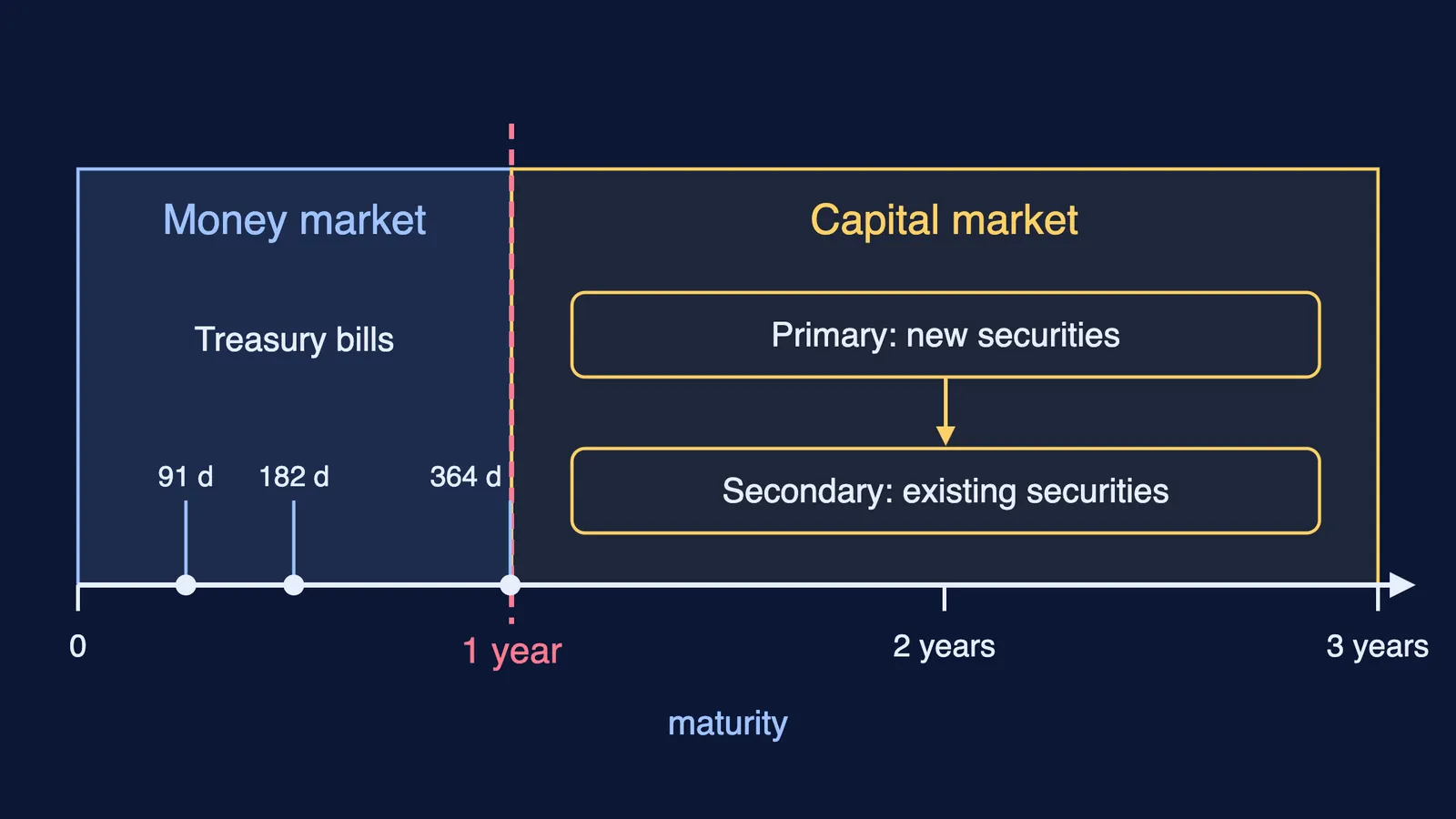
The dividing line is time. The Reserve Bank of India's primer on the government securities market says that by definition the money market is for a maximum tenor of one year. Anything that raises funds for longer, such as shares and long-term bonds, belongs to the capital market.
Treasury bills are the cleanest money market example. The same RBI primer describes them as short-term debt instruments issued by the Government of India in three tenors: 91, 182 and 364 days, all inside the one-year line.
When a question asks you to compare the two, use four headings:
Duration: up to one year in the money market; longer in the capital market.
Purpose: short-term needs such as working capital, versus long-term assets such as land, plant and machinery.
Risk and return: money market instruments are generally safer and earn less; shares carry more risk and can earn more.
Liquidity: money market instruments are close to cash.
Primary vs secondary market: how do you tell them apart?
Ask one question: does the money reach the company? In the primary market, a company sells new securities and receives the money. In the secondary market, investors trade securities that already exist, so money passes from one investor to another.
Trades on a stock exchange settle on a fixed cycle. In a September 2021 circular, SEBI allowed stock exchanges to offer T+1 settlement, a day after the trade day, as an option from 1 January 2022; the cycle had been T+2 since 1 April 2003.
A worked example with made-up figures:
A company, call it Meera Solar, sells new shares at ₹100 each in a public issue. Priya buys 100 for ₹10,000. Primary market: the money goes to Meera Solar.
A year later Priya sells those shares on a stock exchange to Arjun at ₹130 each. Secondary market: Arjun's ₹13,000 goes to Priya, not the company.
The company still gains indirectly: because its shares can be resold easily, investors were willing to buy them in the first place.
For how share prices and indices move day to day, read our explainer on shares, the Sensex and risk.
What are SEBI's functions for Class 12?
SEBI was set up as a non-statutory body on 12 April 1988 through a Government of India resolution, and became a statutory body when the SEBI Act came into force on 30 January 1992, according to SEBI's own About page.
Section 11(1) of the Securities and Exchange Board of India Act, 1992 makes it the Board's duty to protect the interests of investors in securities, to promote the development of the securities market and to regulate it. Those three verbs, protect, develop and regulate, are a reliable way to sort its functions. Section 11(2) of the Act lists measures the Board may take; here are some of them, sorted into those three groups:
Protective: prohibiting fraudulent and unfair trade practices relating to securities markets, and prohibiting insider trading in securities.
Developmental: promoting investors' education and the training of intermediaries of securities markets, and conducting research.
Regulatory: regulating the business in stock exchanges; registering and regulating stock brokers, merchant bankers, portfolio managers and other intermediaries; and regulating substantial acquisition of shares and takeovers.
A checklist for a long SEBI answer:
Open with SEBI's status and the 1992 Act.
State the three objectives in one sentence.
Give two functions under each heading, close to the Act's own words.
Add one real example, such as the T+1 settlement option.
In a case study, map the practice to its group first: insider trading is protective, registering a broker is regulatory, an investor-awareness drive is developmental.
How should you revise this chapter?
Draw the maturity line from memory: one year in the middle, Treasury bills on the left, the primary and secondary markets on the right. Explain each part aloud in two sentences, then write one SEBI answer against the checklist. For more case-study practice, see our guide to checking which management principle a case shows.
If you take Mathematics or Applied Mathematics alongside commerce, the Fermi Concept Library has a lesson for every concept in mathematics, so you can patch a gap before a test.
Thinking past the boards? Our guide to careers after commerce, from CA and CS to economics shows where this chapter leads.


