On this page
Social responsibility is the chapter where Business Studies stops being only about profit and asks who else a business answers to. Here is what CBSE asks for, how the NCERT chapter is built, and a plan for case-based questions.
Is social responsibility of business still in the Class 11 syllabus?
Yes. The CBSE Business Studies curriculum for 2026-27 keeps "Social Responsibility of Business and Business Ethics" as Unit 6 of Part A, Foundations of Business. Units 5 and 6 together carry 10 of the 80 theory marks.
The same document lists what you should be able to do:
state the concept of social responsibility and examine the case for it
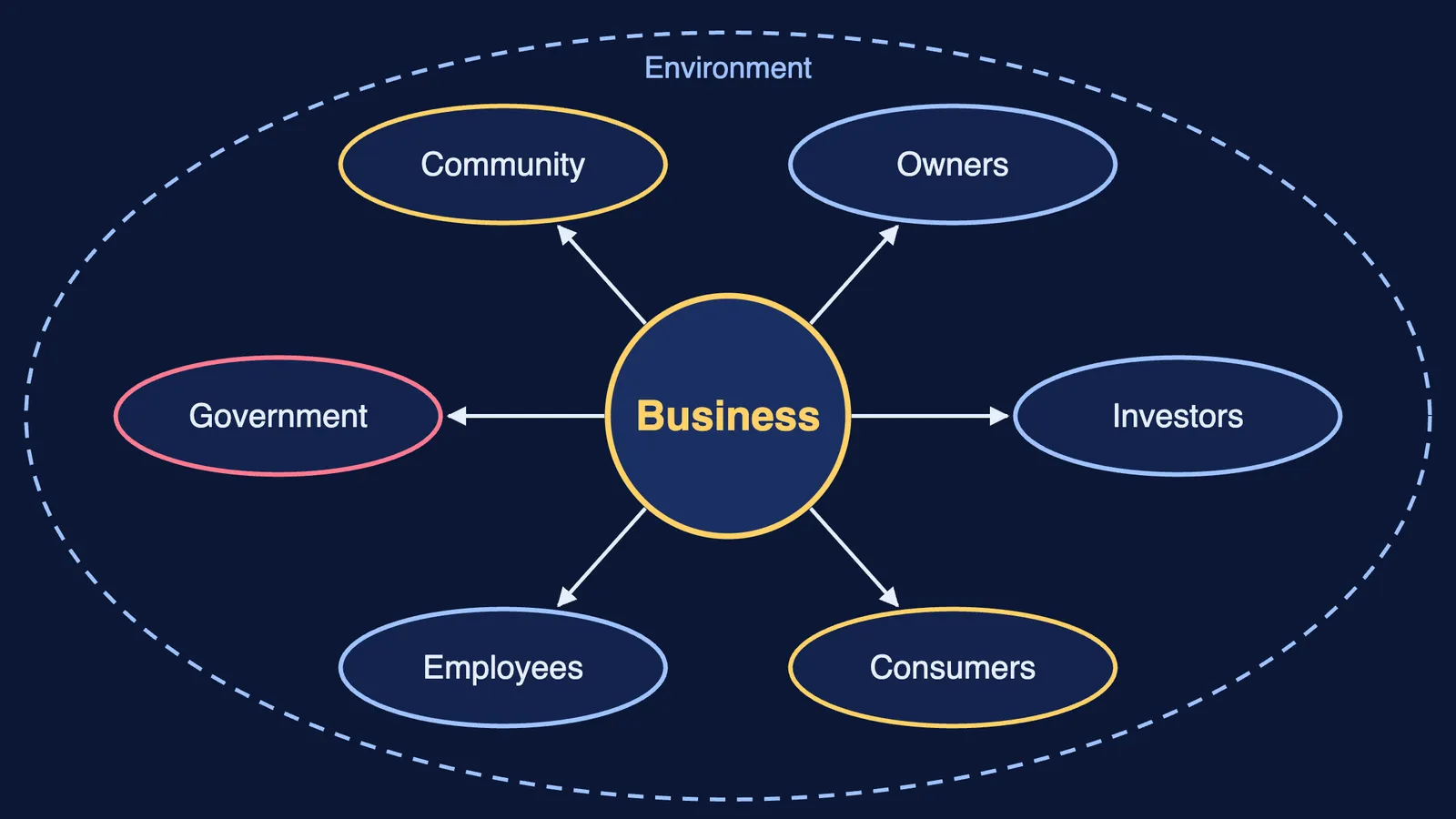
identify responsibility towards owners, investors, consumers, employees, government and community
appreciate the role of business in environment protection
state the concept of business ethics and describe its elements
The syllabus wording mentions only the case for social responsibility, but the NCERT chapter also sets out the arguments against, so learn both. The curriculum's project guidelines even ask students on an industry visit to note the social responsibilities the unit discharges towards workers, investors, society, environment and government.
What does social responsibility of business mean?
In the NCERT chapter, social responsibility means a business's duty to take decisions and actions that fit the goals and values of the society it works in, not only those of its owners.
The chapter sorts it into four kinds, which make a neat short answer:
Economic: produce what society wants and sell it at a profit.
Legal: obey the laws of the land.
Ethical: behave as society expects even where no law says so, such as advertising that respects people's beliefs.
Discretionary: purely voluntary acts, such as donating to schools or helping during floods.
What are the arguments for and against social responsibility?
The NCERT chapter gives eight arguments for: it justifies the business's existence; it serves the firm's long-term interest and image; it heads off new government regulation; it helps maintain a stable society; businesses have the money and managerial talent to help; they are good at turning problems into opportunities; a healthy society is a better place to do business; and business helped create some problems, such as pollution and unsafe workplaces, so it should help fix them.
It gives four arguments against:
it clashes with the aim of maximising profit
the cost is passed on to consumers as higher prices
business people lack the skills to solve social problems
the public does not broadly support business stepping into social programmes
How does Indian law turn CSR into a number?
This goes beyond the textbook but helps with projects. Under the Companies Act, 2013, a company that meets any one of three limits on net worth (Rs 500 crore), turnover (Rs 1,000 crore) or net profit (Rs 5 crore) must spend at least 2% of its average net profit of the previous three years on CSR, as PRS Legislative Research summarises. A Corporate Laws (Amendment) Bill introduced on 23 March 2026 would raise the net profit limit from Rs 5 crore to Rs 10 crore; a Joint Parliamentary Committee reported on it on 3 August 2026, so check its current status before quoting the figure.
A worked example with made-up figures: a company's net profits for the last three years were Rs 40 crore, Rs 55 crore and Rs 70 crore.
Average: (40 + 55 + 70) / 3 = Rs 55 crore.
Minimum CSR spend: 2% of 55 = Rs 1.1 crore.
If averages and percentages slow you down, the Fermi Problem Library has worked problems with a step-by-step solver that explains the reasoning rather than printing an answer.
What is the role of business in environmental protection?
The NCERT chapter names four kinds of pollution business causes: air, water, land and noise. It gives five reasons to control it: fewer health hazards, lower risk of paying compensation, cost savings from less waste, a better public image, and other social benefits such as clearer visibility and cleaner buildings.
Its steps, condensed:
top management commits to pollution prevention, and the commitment is shared across every division
clear policies on better raw materials, cleaner technology and safe waste disposal
full compliance with pollution laws and joining government clean-up and planting drives
regular cost-benefit checks of these programmes and training for suppliers, dealers and customers
What are the elements of business ethics?
The chapter defines business ethics as the moral principles, set by society, that should guide business activity, such as fair prices, honest weights and fair treatment of workers (NCERT). Its five elements are top management commitment, a published code of conduct, compliance mechanisms, involving employees at all levels, and measuring results.
For the rest of Part A, revise nature and purpose of business and the four forms of business organisation compared, and practise spotting principles in cases with asking AI which management principle a case shows.