On this page
Chapter 6 of the new NCERT Class 7 Social Science book, *Exploring Society: India and Beyond, Part I* (code gees1, First Edition April 2025, reprint 2026-27), covers roughly five centuries after the Maurya empire. It asks why this stretch is called an age of reorganisation, what values guided its rulers, and how newcomers became part of Indian society. Below: the chapter in order, a worked calendar example and practice questions.
CBSE publishes curriculum documents only for Classes 9 to 12 for 2026-27 (CBSE Academic), so Classes 6 to 8 follow the NCERT book. This chapter is assessed by the school; there are no board marks to quote.
Why is it called the Age of Reorganisation?
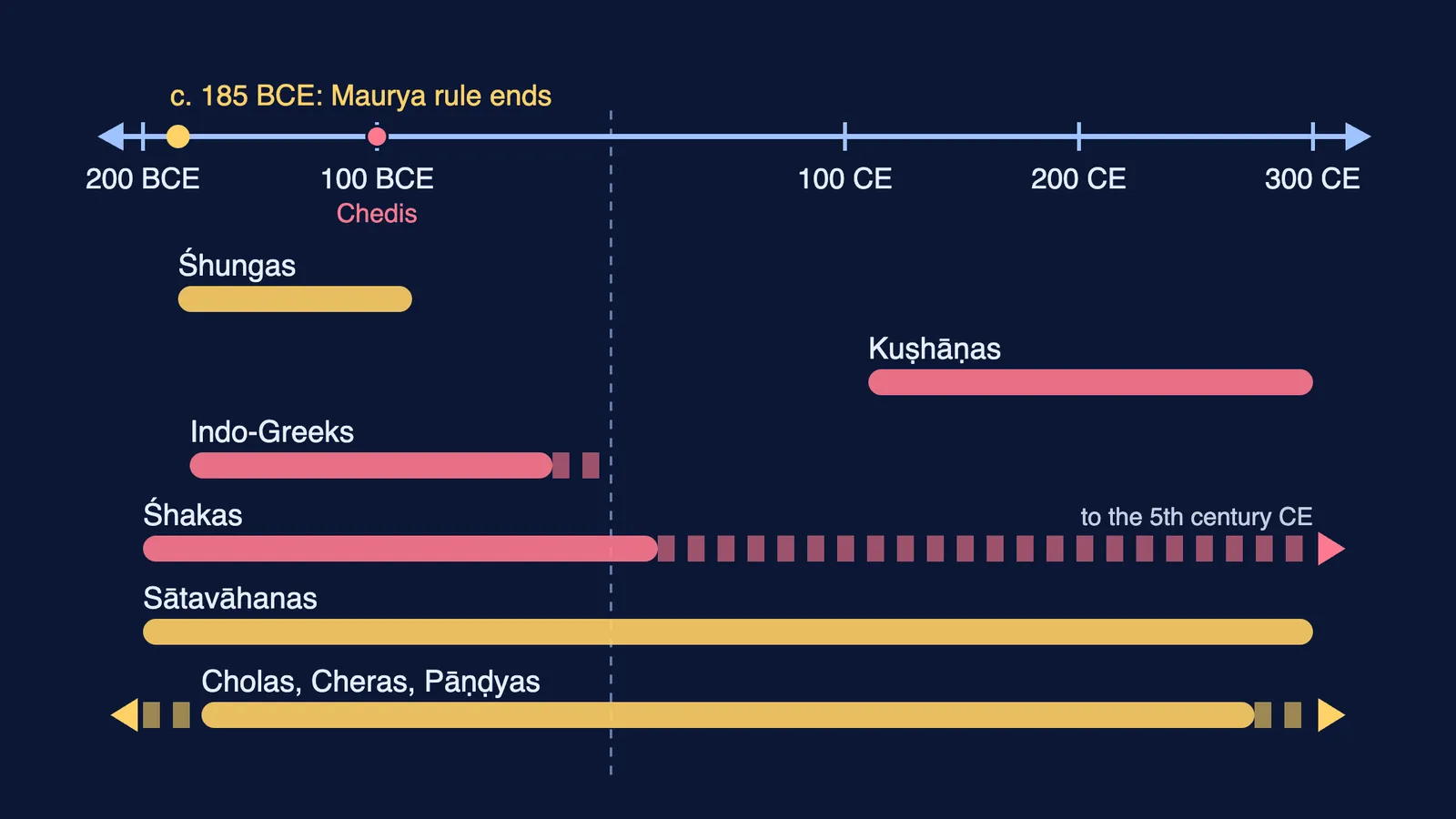
The chapter text says around 185 BCE the last Maurya emperor was assassinated by Puṣhyamitra Śhunga, the army's commander-in-chief, and the empire broke up. Many kingdoms that had once paid tribute to the Mauryas became independent and competed with one another. Some scholars call this the age of reorganisation because old regions were being rearranged into new kingdoms.
The book names two ways kingdoms gained ground: marriage alliances between royal families, and war. Kingdoms kept contesting border areas, because holding them helped protect a kingdom from attack. The period also saw new art, buildings, literature and trade.
Which kingdoms rose within the subcontinent?
Śhungas (north and central India): Puṣhyamitra performed a Vedic ritual, the aśhvamedha yajña, to show his standing as a ruler. The dynasty ended about a century after him. The book links this period to Patañjali's Yoga Sūtras and to the carved railings the Śhungas added at the Bharhut Stūpa.
Sātavāhanas (the Deccan, from the 2nd century BCE): capitals included Amrāvatī and Pratiṣhṭhāna (Paithan). Their coins show ships, a sign of sea trade, and their trade reached the Roman Empire. Princes were often named after their mothers, as with Gautamīputra Sātakarṇi, son of Gautamī Balaśhrī. The kingdom split up in the 3rd century CE.
Chedis (Kalinga): King Khāravela followed Jain teachings yet respected all traditions. His achievements are listed in the Hāthīgumphā inscription in the Udayagiri caves near Bhubaneswar.
Cholas, Cheras and Pāṇḍyas (the south): the "three crowned kings" of Sangam poetry. Karikāla's Kallaṇai (Grand Anicut) on the Kāveri is still used for irrigation. The Cheras ruled from Vanji (Karur), and the Pāṇḍyas from Madurai were known for pearls and naval strength. The epic *Silappadikāram* tells Kaṇṇagi's story.
Who came from outside, and what did they leave behind?
The Indo-Greeks grew from governors left behind after Alexander's campaign. Their coins, some showing Vāsudeva-Kṛiṣhṇa or Lakṣhmī, are the main evidence about them, and the Heliodorus pillar near Vidisha is named after an Indo-Greek ambassador whose inscription praises Vāsudeva. The Śhakas (Indo-Scythians) followed, ruling from late in the 2nd century BCE until the 5th century CE. The Kuṣhāṇas, from central Asia, probably reached India in the 2nd century CE. Kaṇiṣhka's coins carry both the Buddha and Śhiva, and Kuṣhāṇa control of parts of the Silk Route helped trade.
Two art schools grew in this period. Gāndhāra sculpture mixed Greco-Roman and Indian features in grey-black schist; Mathurā sculpture used red sandstone and looked more Indian. The chapter's summary notes that the different powers absorbed each other's influence in art, architecture and coinage.
How do you convert a Gregorian year to Śhaka Samvat?
The book says the Śhaka Samvat calendar developed in this period and became India's national calendar in 1957. Its year number trails the Gregorian one by 78, or by 79 from January to March (NCERT).
Worked example. Find the Śhaka year for 18 November 2026 and for 10 February 2027.
November is outside January to March, so subtract 78: 2026 − 78 = 1948.
February is inside January to March, so subtract 79: 2027 − 79 = 1948.
Both dates fall in Śhaka year 1948, even though their Gregorian years differ.
How does Chapter 6 connect to the rest of the book?
It picks up where Chapter 5, The Rise of Empires, ends, so revise the Mauryas first; our Class 6 guide on Ashoka and the Mauryan empire is a quick refresher. The BCE-to-CE switch draws on the Grade 6 timeline chapter. For more on the art, the Class 11 guide to post-Mauryan trends in Indian art goes further, and the Class 9 guide to State and Society up to 1000 CE shows where this story leads.
Practice questions to try
Marks are our suggestion.
Name two dynasties from within the subcontinent and two from outside it. (2 marks)
Give two pieces of evidence that the Sātavāhanas traded by sea. (2 marks)
What is the Śhaka year for 2 October 2027, and for 5 March 2028? Show your rule. (2 marks)
Compare the Gāndhāra and Mathurā schools on stone and style. (3 marks)
Using Khāravela and Kaṇiṣhka, explain how rulers of this age treated different schools of thought. (5 marks)
Answers to check: 3 gives 1949 for both (2027 − 78 and 2028 − 79).
Not sure which kingdom to revise first? Fermi's AI tutor works out what you already know and builds a plan for the session.