On this page
Chapter 4 of NCERT's *An Introduction to Indian Art* Part I traces Indian sculpture, stupas and rock-cut caves from the second century BCE onwards. The current NCERT chapter PDF carries the line "Reprint 2026-27". This guide follows that book and maps it to the CBSE curriculum unit; the curriculum itself does not name a textbook.
Where does this chapter fit in the Class 11 Fine Arts paper?
The CBSE 2026-27 Fine Arts curriculum sets a 30-mark, 2-hour theory paper, History of Indian Art. Graphics, Sculpture and Applied Art (Commercial Art) have separate papers with the same syllabus. Unit 1 carries 15 marks. That 15 covers prehistoric rock painting, the Indus civilisation and "Buddhist, Jain and Hindu Art" (which also includes Mauryan art) together, so no separate figure belongs to this chapter.
Within that unit, the curriculum lists the Kushana period (Gandhara and Mathura), the Gupta period (the two styles blending), the Seated Buddha from Katra Mound, a Jain Tirthankara and an introduction to Ajanta. The book adds Amaravati, Ellora, Bagh and Elephanta. New to art history? Start with the Class 9 introduction to the history of arts.
How did sculpture change from Bharhut to Sanchi?
The NCERT chapter shows carving moving from flat and stiff to deep and lively.
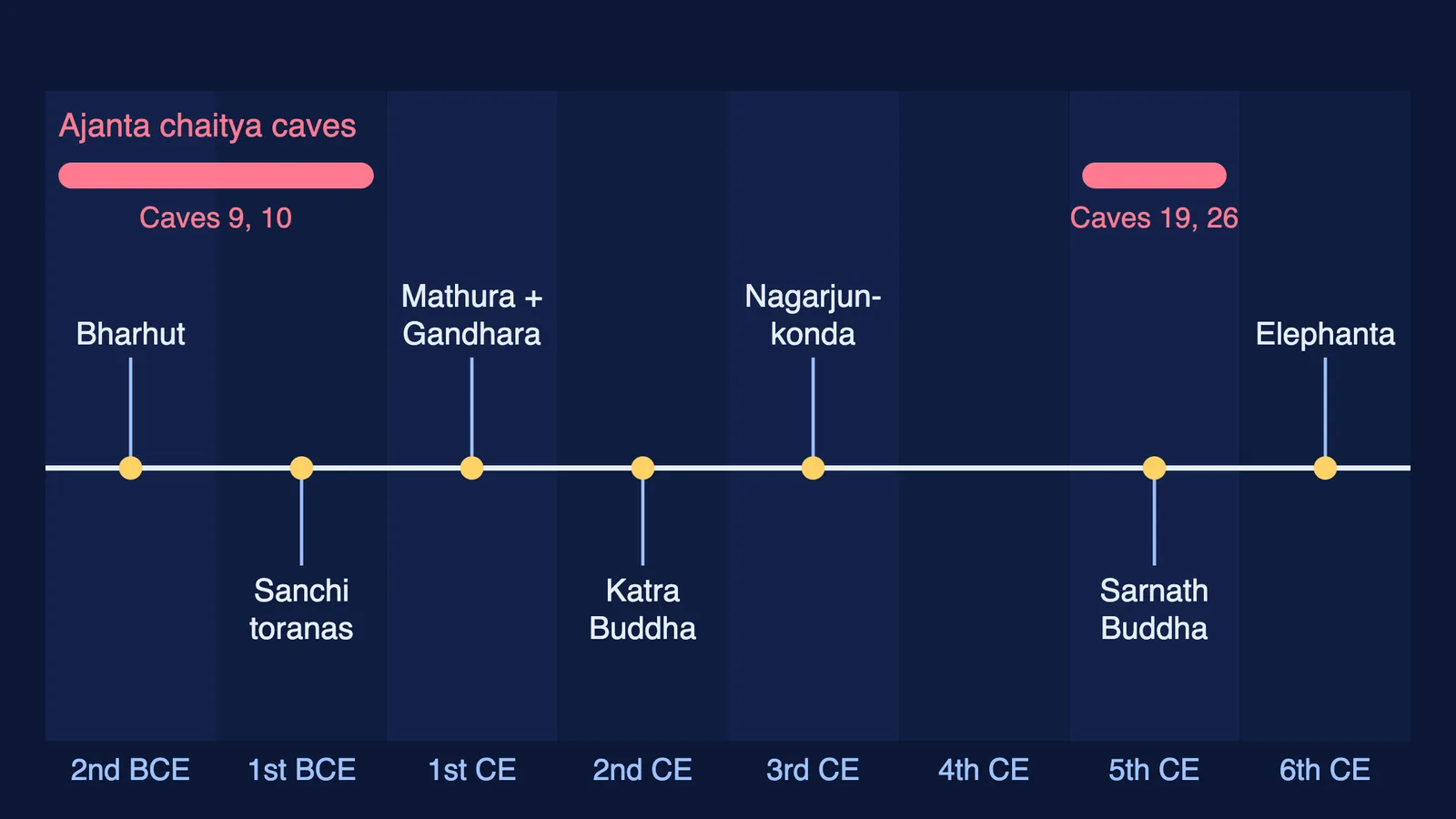
Bharhut (second century BCE onwards): tall figures like Mauryan Yaksha images, shallow relief, hands held flat on the chest, few characters per story panel, and tilted perspective to hint at depth. The Ruru Jataka panel groups its events by place.
Sanchi Stupa-1: figures in high relief fill the whole panel, poses become natural and bodies move. The Buddha is still shown only through symbols such as an empty throne, feet, a chhatra or a stupa.
Learn the stupa parts: vedika, anda, medhi, harmika, chhatri, torana (gateway) and pradakshinapatha (path for walking around). Sanchi Stupa-1 has four toranas, each built from two upright pillars and three crossbars, with shalbhanjika figures supporting the lowest bar.
Gandhara or Mathura: how do you tell the styles apart?
From the first century CE, the chapter names Gandhara, Mathura and Vengi as major centres, and in Mathura and Gandhara the Buddha moves from symbol to human figure.
Mathura: the Buddha follows the older Yaksha type; faces are round and smiling; the robe covers the left shoulder. Early Jain Tirthankara images, a headless Kanishka portrait and Vaishnava and Shaiva images also come from here, though Buddhist images are the most numerous.
Gandhara: blends Bactrian, Parthian and local traditions with Hellenistic features. The Taxila Buddha head (second century CE) has thick curls cut in sharp strokes, half-closed eyes, long earlobes and strong light and shade.
Sarnath (fifth to sixth century CE): thin, see-through drapery over both shoulders and a halo with little ornament, while Mathura keeps robe folds and a richly decorated halo.
Katra Mound Buddha, as the book describes it: second century CE; seated in padmasana; right hand in abhayamudra raised just above the shoulder, left hand on the thigh; robe over one shoulder; lion throne; attendants Padmapani (lotus) and Vajrapani (vajra); a large halo with simple geometric motifs and two flying figures above it.
For the Jain Tirthankara, the curriculum gives circa fifth century, Gupta period, stone, State Museum, Lucknow.
What should you know about Ajanta, chaityas and viharas?
Key points from the chapter:
Chaitya: a prayer hall, usually apsidal with a vaulted roof and a stupa at the back. Karla has the largest rock-cut chaitya hall.
Vihara: a monastery cave of veranda, hall and cells around the walls; adding a stupa at the back made it a chaitya-vihara.
Ajanta: Aurangabad District, Maharashtra. Chaitya Caves 10 and 9 date to the second and first centuries BCE; Caves 19 and 26 to the fifth century CE.
Patrons: Varahadeva, prime minister of the Vakataka king Harishena (Cave 16); Upendragupta (Caves 17 to 20); Buddhabhadra (Cave 26); Mathuradasa (Cave 4).
Paintings: many survive in Caves 1, 2, 16 and 17, on the Buddha's life, Jatakas and Avadanas. The Padmapani in Cave 1 (late fifth century CE) holds a lotus and stands in a three-bend pose.
Mara Vijaya, Cave 26: the largest sculptural panel at Ajanta.
A spelling note: the book prints both "Boddhisattva" and "Bodhisattva"; we use the standard spelling, Bodhisattva.
Practice questions for this chapter
Mark labels are our suggestion.
(2 marks) Name the two attendants of the Katra Mound Buddha and what each holds.
(2 marks) Define chaitya and vihara in one line each.
(4 marks) Compare a Gandhara and a Mathura Buddha under face, hair and drapery.
(4 marks) How do the Sanchi Stupa-1 reliefs differ from Bharhut's?
(6 marks) Describe Ajanta's two phases, naming two caves from each and one patron.
For how historians read Sanchi's stupa as evidence, see our Class 12 History guide to thinkers, beliefs and buildings.
Not sure where to begin your revision? Fermi's AI tutor works out what you already know and builds a plan for the session.