On this page
These terms come from Unit 2 of the NCERT Class 11 Chemistry Part I textbook (Reprint 2026-27), which matches Unit 2 of the CBSE 2026-27 Class XI Chemistry syllabus.
What are the particles inside an atom?
Source: NCERT sections 2.1 and 2.2.
Cathode rays: negative particles streaming from cathode to anode in a low-pressure discharge tube. They behave alike for any gas or electrode, so electrons are in every atom.
Electron: the negative particle, charge −1.602 × 10⁻¹⁹ C, mass about 9.11 × 10⁻³¹ kg.
Proton: the positive particle of the nucleus, the lightest positive ion, obtained from hydrogen. Don't confuse with: canal rays, positive ions of whatever gas fills the tube.
Neutron: a neutral nuclear particle slightly heavier than a proton, found by Chadwick in 1932.
Atomic number (Z): the number of protons, equal to the electrons in a neutral atom. Example: sodium, Z = 11.
Mass number (A): protons plus neutrons (the nucleons). Example: chlorine-37 has 17 protons and 20 neutrons.
Isotopes: atoms of one element with different mass numbers. Example: carbon-12 and carbon-14. Don't confuse with: isobars, different elements with the same mass number, such as carbon-14 and nitrogen-14.
Thomson model: a sphere of spread-out positive charge with electrons embedded in it.
Nucleus: the tiny, dense centre holding all the positive charge and nearly all the mass. Rutherford inferred it when about 1 in 20,000 α-particles bounced back from gold foil.
Rutherford's nuclear model: electrons circling a nucleus like planets. It cannot explain why the atom is stable.
Light and energy terms
Source: NCERT section 2.3.
Electromagnetic radiation: energy carried by electric and magnetic fields oscillating at right angles; it needs no medium and travels at 3.0 × 10⁸ m s⁻¹ in vacuum.
Frequency (ν): waves passing a point per second, in hertz; c = νλ. Don't confuse with: wavenumber, wavelengths per unit length (1/λ).
Quantum: Planck's smallest packet of radiant energy, E = hν. A quantum of light is a photon.
Photoelectric effect: electrons leave a metal the instant light of high enough frequency strikes it.
Threshold frequency (ν₀): the lowest frequency that ejects electrons from a metal, however bright the light; 5.0 × 10¹⁴ Hz for potassium. Don't confuse with: work function (hν₀), the minimum energy; extra photon energy becomes kinetic energy.
Line spectrum: light at a few sharp wavelengths, unique to each element, like a fingerprint. Don't confuse with: continuous spectrum, white light's unbroken violet-to-red band.
What does Bohr's model mean by an orbit?
Source: NCERT section 2.4.
Stationary state: a fixed circular orbit of definite energy; the electron absorbs or emits energy only when it jumps between two. Hydrogen's first orbit has a radius of 52.9 pm.
Ground state: the lowest-energy state (n = 1 for hydrogen); higher ones are excited states. Its energy is negative because a free electron at rest counts as zero.
Balmer series: lines from electrons falling to n = 2, hydrogen's only visible series. Don't confuse with: the Lyman series (to n = 1, ultraviolet).
Terms of the quantum mechanical model
Source: NCERT sections 2.5 and 2.6.
de Broglie relation: every moving particle has a wavelength, λ = h/mv; electron beams diffract like waves.
Heisenberg uncertainty principle: an electron's exact position and momentum cannot both be known at once, so it has no definite path.
Atomic orbital: the wave function (ψ) of an electron in an atom, holding at most two electrons. Don't confuse with: orbit, Bohr's exact path, which the uncertainty principle rules out.
Probability density: |ψ|², the chance per unit volume of finding the electron at a point.
Principal quantum number (n): 1, 2, 3...; names the shell and largely sets size and energy. Shell n has n² orbitals.
Azimuthal quantum number (l): 0 to n − 1; names the subshell (s, p, d, f) and sets the shape. Example: n = 3 gives 3s, 3p, 3d.
Magnetic quantum number (mₗ): orientation, with 2l + 1 values from −l to +l, so three p and five d orbitals.
Spin quantum number (mₛ): +½ or −½, drawn ↑ and ↓.
Node: where probability density is zero. Don't confuse radial nodes (n − l − 1) with angular nodes (l). Example: 2s has one radial node, 2p one angular node.
Effective nuclear charge: the net positive charge an outer electron feels, less than the full charge because inner electrons shield it.
What rules decide electronic configuration?
Source: NCERT sections 2.6.4 to 2.6.6.
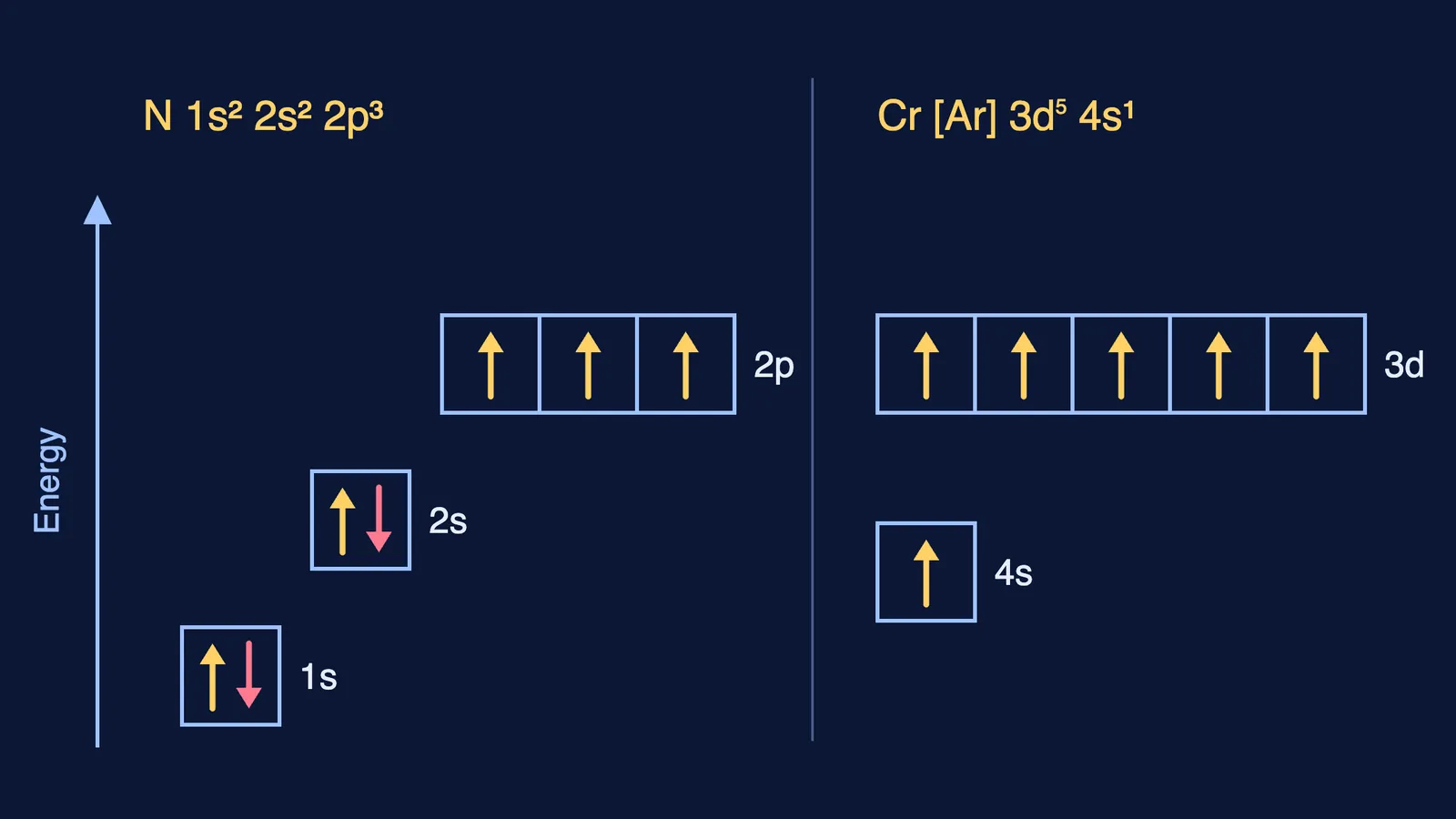
Aufbau principle: electrons fill the lowest-energy orbitals first. Example: nitrogen is 1s² 2s² 2p³.
(n + l) rule: lower n + l means lower energy; on a tie, lower n first. Example: 4s (4 + 0) fills before 3d (3 + 2).
Pauli exclusion principle: no two electrons in an atom share all four quantum numbers, so an orbital holds at most two, with opposite spins, and a shell at most 2n².
Hund's rule of maximum multiplicity: each orbital of a subshell gets one electron, with parallel spins, before any pairing. Example: nitrogen's three 2p electrons are unpaired. Don't confuse with: Pauli, which caps each orbital at two.
Valence electrons: electrons in the shell with the highest n. Don't confuse with: core electrons, in filled inner shells. Example: sodium, [Ne] 3s¹.
Exchange energy: energy released as same-spin electrons in equal-energy (degenerate) orbitals swap places, largest for half-filled and full subshells. Together with symmetry, it is why chromium is 3d⁵ 4s¹ and copper 3d¹⁰ 4s¹.
How to learn these terms
Turn each "Don't confuse with" pair into a flashcard: orbit and orbital, isotope and isobar, Pauli and Hund.
Build the quantum number table for n = 1 to 3 yourself and check the orbital counts come to 1, 4 and 9.
Draw box diagrams for N, O, Cr and Cu and name the rule behind each arrow.
If a term feels abstract, the Fermi Concept Library gives each chemistry concept its own lesson. Read our Structure of Atom Class 11 guide, then practise with the Structure of atom Class 11 formulas and case study questions.