On this page
Structure of Atom is Unit 2 of the NCERT Class 11 Chemistry Part 1 textbook (Reprint 2026-27), and the CBSE Class XI Chemistry syllabus for 2026-27 lists its topics. This sheet follows NCERT's equations, with units. For the theory, see our Structure of Atom Class 11 chapter guide.
Constants (NCERT values): h = 6.626 × 10⁻³⁴ J s, c = 3.0 × 10⁸ m s⁻¹, mₑ = 9.1094 × 10⁻³¹ kg, e = 1.602176 × 10⁻¹⁹ C, NA = 6.022 × 10²³ mol⁻¹, 1 eV = 1.602 × 10⁻¹⁹ J.
Sub-atomic particles: charge, mass and atomic number
Electron charge-to-mass ratio: e/mₑ = 1.758820 × 10¹¹ C kg⁻¹.
Atomic number: Z = number of protons = number of electrons in a neutral atom (pure number).
Mass number: A = Z + number of neutrons (pure number).
Ion of charge q+ (or q−): electrons = Z − q (or Z + q).
Isotopes share Z, differ in A; isobars share A, differ in Z.
Worked example: ⁵⁹Co²⁺ (Z = 27) has 27 protons, 59 − 27 = 32 neutrons and 27 − 2 = 25 electrons.
Watch for: taking electrons = Z for an ion; charge changes electrons only.
What are the formulas for photons and the photoelectric effect?
Wave relation (vacuum): c = νλ, with ν in Hz (s⁻¹), λ in m.
Wavenumber: ν̄ = 1/λ, in m⁻¹ (SI) or cm⁻¹ (common).
Photon energy (Planck): E = hν = hc/λ, in J. N photons: E = Nhν (J); one mole: E = NA hν (J mol⁻¹).
Photoelectric effect (Einstein): hν = hν₀ + ½mₑv², with ν₀ = threshold frequency (Hz) and v = electron speed (m s⁻¹).
Work function: W₀ = hν₀ (J, often in eV). Emission needs ν ≥ ν₀; brighter light ejects more electrons, not faster ones.
Worked example: 420 nm light on potassium (W₀ = 2.25 eV, NCERT Table 2.2). ν = 3.0 × 10⁸/(420 × 10⁻⁹) ≈ 7.14 × 10¹⁴ Hz, E = hν ≈ 4.73 × 10⁻¹⁹ J. W₀ ≈ 3.60 × 10⁻¹⁹ J, so ½mₑv² ≈ 1.13 × 10⁻¹⁹ J and v ≈ 5.0 × 10⁵ m s⁻¹.
Watch for: nm not converted (1 nm = 10⁻⁹ m), or eV subtracted from J.
Bohr model and the hydrogen spectrum
These hold only for one-electron species: H, He⁺, Li²⁺, Be³⁺.
Quantised angular momentum: mₑvr = nh/2π (J s), n = 1, 2, 3 …
Orbit radius: rₙ = 52.9 n²/Z pm; for hydrogen rₙ = n²a₀, a₀ = 52.9 pm.
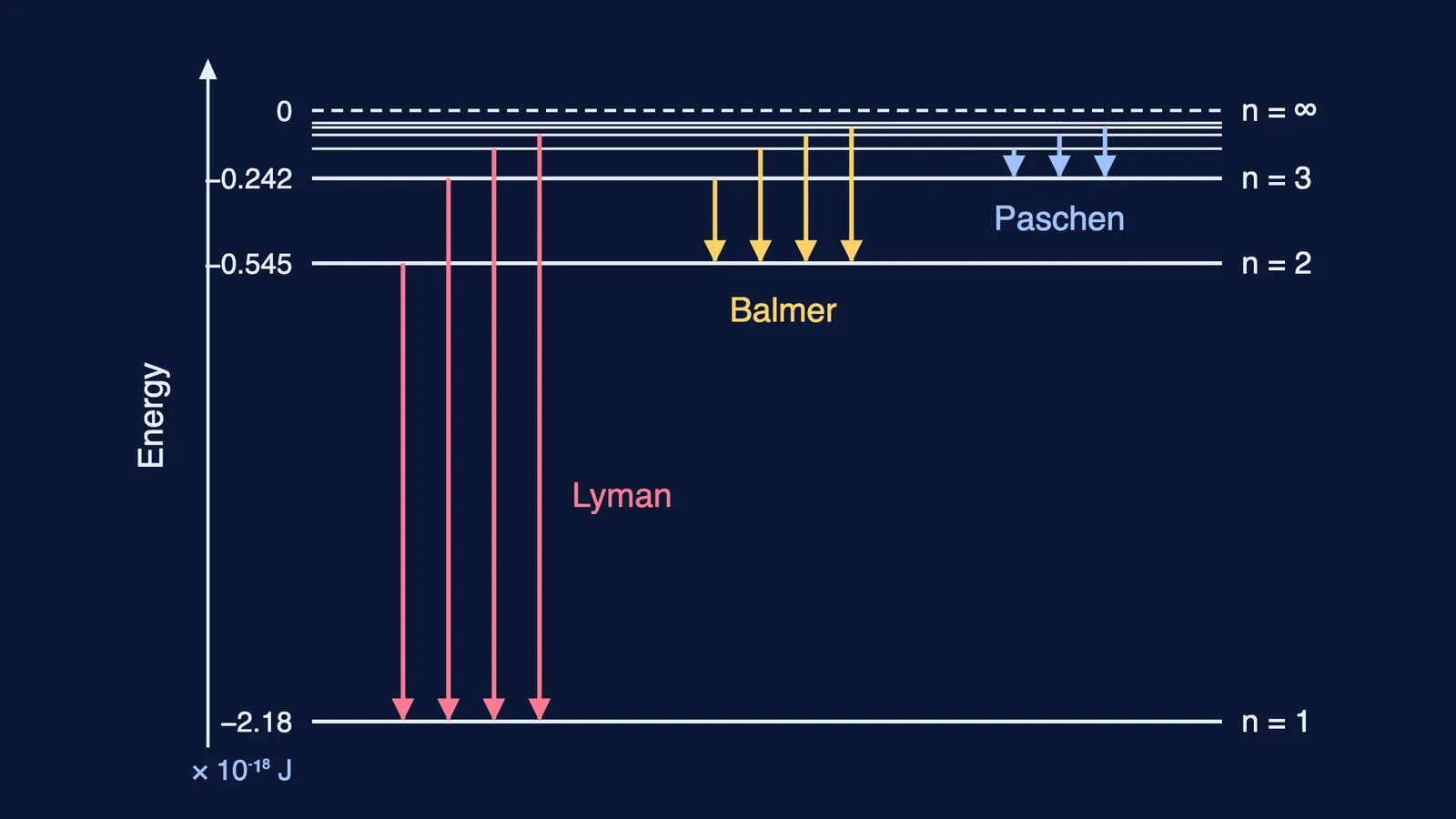
Orbit energy: Eₙ = −2.18 × 10⁻¹⁸ (Z²/n²) J; zero at n = ∞, negative when bound.
Ionisation energy from orbit n: +2.18 × 10⁻¹⁸ Z²/n² J per atom.
Bohr frequency rule: ν = ΔE/h = (E₂ − E₁)/h, in Hz.
Hydrogen transition (NCERT sign): ΔE = E_f − E_i = 2.18 × 10⁻¹⁸ (1/nᵢ² − 1/n_f²) J; negative for emission, positive for absorption.
Same in other units: ν = 3.29 × 10¹⁵ (1/nᵢ² − 1/n_f²) Hz; ν̄ = 1.09677 × 10⁷ (1/nᵢ² − 1/n_f²) m⁻¹ (take magnitudes).
Rydberg: ν̄ = 109,677 (1/n₁² − 1/n₂²) cm⁻¹, n₂ > n₁. Lyman n₁ = 1 (ultraviolet), Balmer 2 (visible), Paschen 3, Brackett 4, Pfund 5 (infrared).
Worked example: Li²⁺ (Z = 3), n = 2: r₂ = 52.9 × 4/3 ≈ 70.5 pm and E₂ = −2.18 × 10⁻¹⁸ × 9/4 = −4.905 × 10⁻¹⁸ J. In hydrogen, the first Paschen line (4 → 3) has ν̄ = 109,677 (1/9 − 1/16) ≈ 5,332 cm⁻¹, so λ ≈ 1,876 nm.
Watch for: missing Z² for He⁺ or Li²⁺, or using these for many-electron atoms.
What are de Broglie's equation and the uncertainty principle?
de Broglie: λ = h/mv = h/p, with m in kg, v in m s⁻¹, p in kg m s⁻¹, λ in m.
From kinetic energy: λ = h/√(2m × KE), KE in J.
Heisenberg: Δx × Δpₓ ≥ h/4π, or Δx × Δvₓ ≥ h/4πm (Δx in m, Δvₓ in m s⁻¹).
Worked example: an electron at 2.0 × 10⁶ m s⁻¹ has λ = 6.626 × 10⁻³⁴/(9.1094 × 10⁻³¹ × 2.0 × 10⁶) ≈ 3.64 × 10⁻¹⁰ m (364 pm). Fixing its position to Δx = 1.0 × 10⁻¹⁰ m gives Δv ≥ h/(4π mₑ Δx) ≈ 5.8 × 10⁵ m s⁻¹.
Watch for: mass in grams (25 g = 0.025 kg), and dropping m when switching from Δp to Δv.
Quantum numbers, orbitals and nodes
All are pure numbers.
Principal: n = 1, 2, 3 … (shells K, L, M, N …).
Azimuthal: l = 0 … (n − 1); l = 0, 1, 2, 3 are s, p, d, f.
Magnetic: mₗ = −l … +l, so (2l + 1) orbitals per subshell.
Spin: mₛ = +½ or −½; at most two electrons per orbital, opposite spins.
Shell n: n² orbitals, at most 2n² electrons. Subshell: at most 2(2l + 1) electrons.
Nodes: radial = n − l − 1, angular = l, total = n − 1.
(n + l) rule, many-electron atoms: lower n + l is lower in energy; for a tie, lower n first. In hydrogen, energy depends on n alone.
Worked example: 4d (n = 4, l = 2) has 1 radial and 2 angular nodes (3 total), 5 orbitals and room for 10 electrons. 5s (n + l = 5) fills before 4d (6), which fills before 5p (6, higher n).
Watch for: l = n (not allowed), and applying the (n + l) order to hydrogen, where 2s and 2p have equal energy.
How to revise this formula sheet
Rebuild 3.29 × 10¹⁵ Hz and 109,677 cm⁻¹ from 2.18 × 10⁻¹⁸ J, h and c.
Write a unit beside every number, especially nm, Å (10⁻¹⁰ m) and eV.
Before any Bohr formula, check for one electron.
Sketch the energy ladder at the top of this page and mark emission (down) and absorption (up) before writing a sign.
Practise with the structure of atom case study questions for Class 11 and the structure of atom assertion-reason questions.
If quantum numbers keep tripping you up, the Fermi Concept Library gives every concept in chemistry its own lesson and its place in the map.