On this page
Structure of atom is Unit 2, Atomic Structure, in the NEET (UG)-2026 Chemistry syllabus (NEET (UG) syllabus, NTA). Every statement below was checked against Unit 2 of NCERT Class 11 Chemistry Part I, Reprint 2026-27.
If the chapter is new to you, start with our guide on how to prepare Atomic Structure for NEET.
How do you answer assertion-reason questions?
Judge each line on its own as true or false. Only when both are true, ask: is R the direct reason NCERT gives for A?
Use these keys for Q1 to Q6:
(A) Both A and R are true and R is the correct explanation of A.
(B) Both A and R are true but R is NOT the correct explanation of A.
(C) A is true but R is false.
(D) A is false but R is true.
For the full method, see our assertion-reason question strategy.
Assertion-reason questions on structure of atom
Q1 (easy). Assertion (A): The energy of the electron in every Bohr orbit of the hydrogen atom is negative. Reason (R): A free electron at rest, infinitely far from the nucleus, is given zero energy; a bound electron has less.
Answer: (A). Both are true, and R is how NCERT explains the minus sign: energy is measured from the free electron at n = ∞.
Trap: reading "negative" as "less than nothing" rather than "below the chosen zero".
Q2 (easy). Assertion (A): Light below a metal's threshold frequency ejects no electrons from it, however bright. Reason (R): The kinetic energy of the ejected electrons increases as the intensity of the light increases.
Answer: (C). A is true. R is false: brighter light ejects more electrons, but their kinetic energy rises with the frequency of the light, not its intensity.
Trap: swapping intensity (how many electrons) with frequency (how fast).
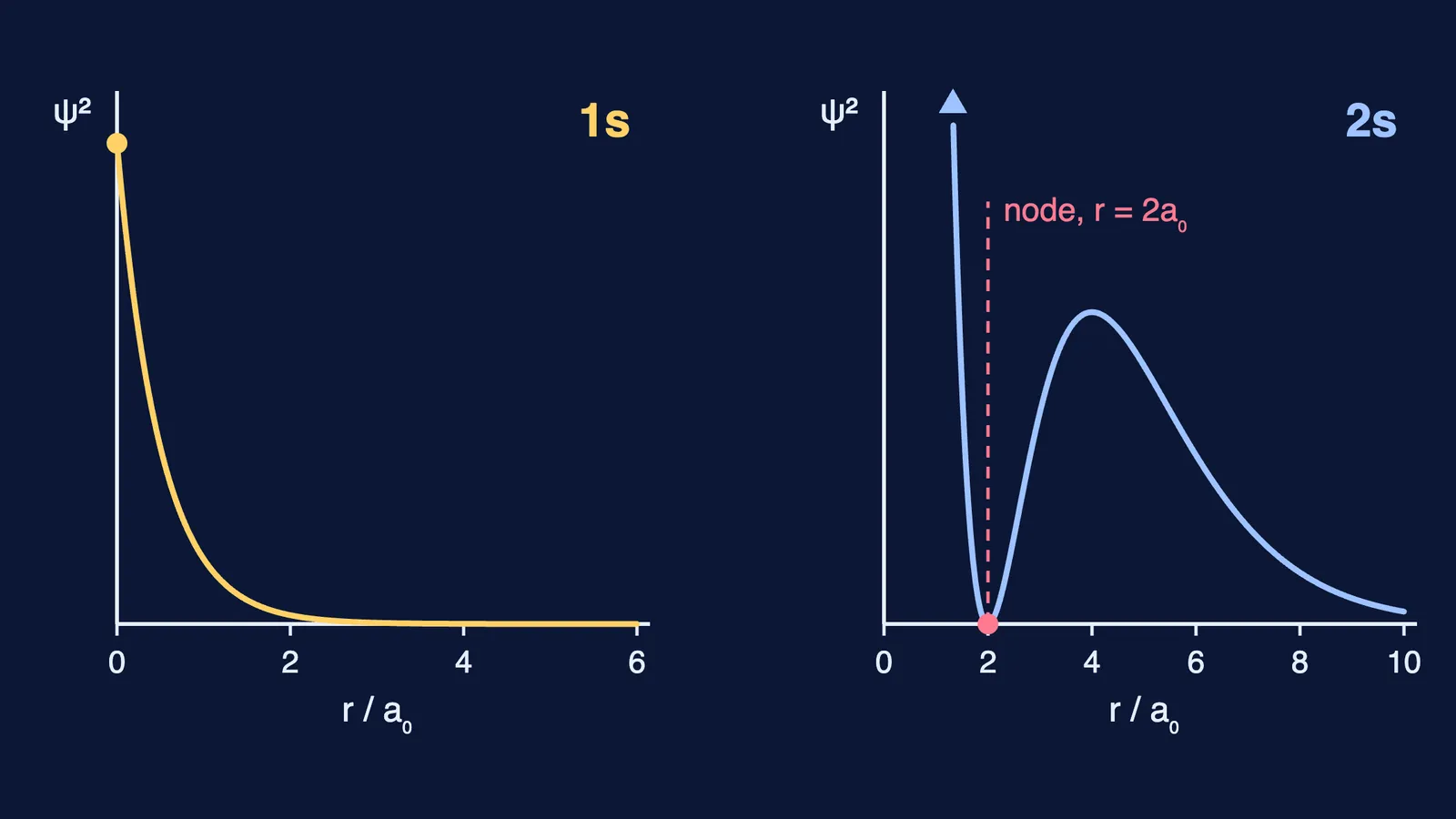
Q3 (medium). Assertion (A): A 2s orbital has one radial node. Reason (R): All s orbitals are spherically symmetric.
Answer: (B). Both are true, but symmetry does not set the node count: 1s is just as spherical and has none. Radial nodes number n − l − 1, which is 1 for 2s.
Trap: picking (A) because both lines are about the same orbital.
Q4 (medium). Assertion (A): A 3p orbital has two angular nodes. Reason (R): The number of angular nodes of an orbital equals its azimuthal quantum number l.
Answer: (D). R is true and makes A false: for 3p, l = 1, so one angular node. The other node is radial (3 − 1 − 1 = 1).
Trap: confusing total nodes (n − 1) with angular nodes (l).
Q5 (hard). Assertion (A): The valence configuration of chromium is 3d⁵ 4s¹, not 3d⁴ 4s². Reason (R): By the (n + l) rule, the 4s orbital has lower energy than 3d and fills first.
Answer: (B). Both are true, but R predicts 3d⁴ 4s², which chromium does not take. A holds because a half-filled 3d subshell is extra stable (symmetry, larger exchange energy).
Trap: ticking (A) because R contains the right orbitals.
Q6 (hard). Assertion (A): For an electron in the 1s orbital, the probability density ψ² is zero at the nucleus. Reason (R): For a 1s electron, ψ² decreases as you move away from the nucleus.
Answer: (D). A is false: NCERT says the 1s probability density is maximum at the nucleus. R is true; it falls sharply with distance.
Trap: mixing up the 1s curve with the 2s curve, which drops to zero at its node.
Statement I and Statement II questions
Use these keys for Q7 to Q10:
(A) Both statements are correct.
(B) Both statements are incorrect.
(C) Statement I is correct, Statement II is incorrect.
(D) Statement I is incorrect, Statement II is correct.
Q7 (medium). Statement I: A shell with principal quantum number n contains n² orbitals. Statement II: A subshell with azimuthal quantum number l holds at most 2(2l + 1) electrons, so a 4f subshell can hold 14.
Answer: (A). Both are correct. A subshell has 2l + 1 orbitals of two electrons each; for f, l = 3.
Trap: using 2n² (a whole shell's capacity) for a single subshell.
Q8 (medium). Statement I: Lines of the Balmer series arise from transitions ending at n = 2 and appear in the visible region. Statement II: Lines of the Lyman series arise from transitions ending at n = 1 and appear in the infrared region.
Answer: (C). Statement I is correct. Statement II fails on the region: Lyman lines are ultraviolet.
Trap: checking the n value and skipping the region.
Q9 (hard). Statement I: By Hund's rule, a nitrogen atom (Z = 7) in its ground state has one unpaired electron. Statement II: Pauli's exclusion principle forbids two electrons in one atom from sharing the same values of n, l and mₗ.
Answer: (B). Both are wrong. Nitrogen is 1s² 2s² 2p³, and Hund's rule puts one electron in each 2p orbital: three unpaired. Pauli forbids the same set of all four quantum numbers; two electrons in one orbital share n, l and mₗ and differ in spin.
Trap: dropping the spin quantum number from Pauli's principle.
Q10 (hard). Statement I: An electron and a proton with the same kinetic energy have equal de Broglie wavelengths. Statement II: An electron and a proton with the same momentum have equal de Broglie wavelengths.
Answer: (D). Statement I is wrong: λ = h/p and p = √(2mK), so the lighter electron has less momentum and a longer wavelength. Statement II is correct, because λ depends only on p.
Trap: treating kinetic energy and momentum as interchangeable.
How should you use this set?
Attempt all ten without notes, writing T or F beside each line before you pick a key.
For every miss, note what went wrong: A, R, or the link between them.
Sketch ψ² against r for 1s and 2s from memory, mark the 2s node, then compare with NCERT Fig. 2.12.
Then try our Atomic Structure NEET practice questions with solutions.
If a term such as exchange energy or degenerate orbital still feels vague, the Fermi Concept Library covers every concept in chemistry, each with its own lesson.