On this page
These 8 original single-correct questions climb from quantum-number rules to Bohr-model spectra. Each answer shows the working, and each "Why not" line names the slip behind the most tempting wrong option.
Every question sits inside Unit 2, Atomic Structure, of the NEET (UG) syllabus that NTA posted for 2026, and inside Unit 2, Structure of Atom, of the NCERT Class 11 Chemistry Part I textbook (Reprint 2026-27).
How should you use this Structure of Atom practice set?
In NEET (UG)-2026, each correct answer earned +4 and each wrong answer cost 1 mark, with 180 questions in 180 minutes, according to the NTA information bulletin. So:
Give yourself 8 minutes for all eight before reading any solution.
Mark each answer "sure" or "guess"; a lucky guess still goes on your revision list.
For numericals, write the formula and units before substituting.
Read every "Why not" line.
The full chapter plan is in our guide on how to prepare Atomic Structure for NEET.
Easy: do you know the rules for n, l and mₗ?
Q1 (easy). Which set of quantum numbers (n, l, mₗ) is not allowed?
(A) 4, 3, −3 (B) 3, 1, −1 (C) 2, 2, 0 (D) 5, 0, 0
Answer: (C). NCERT gives l the values 0 to n − 1, so n = 2 allows only l = 0 or 1. An l of 2 needs n ≥ 3. Why not (A)? An mₗ of −3 looks extreme, but mₗ runs from −l to +l, so it is allowed for l = 3, a 4f orbital.
Q2 (easy). Which orbital has two radial nodes and one angular node?
(A) 3p (B) 4p (C) 3d (D) 4s
Answer: (B). Angular nodes = l, so one angular node means a p orbital (l = 1). Radial nodes = n − l − 1, so 2 = n − 2 and n = 4. Why not (A)? It uses n − l for radial nodes; 3p has only one.
Q3 (easy). By the (n + l) rule, which orbital has the highest energy in a many-electron atom?
(A) 4s (B) 3d (C) 4p (D) 5s
Answer: (D). The n + l values are 4, 5, 5 and 5. Among orbitals with equal n + l, the one with larger n is higher in energy, so 3d < 4p < 5s. Why not (C)? 4p beats 3d on the tie-break, but 5s has a larger n still.
Medium: can you handle photons, uncertainty and exceptions?
Q4 (medium). Light of wavelength 248 nm falls on a metal whose threshold wavelength is 400 nm. Taking h = 6.626 × 10⁻³⁴ J s and c = 3.0 × 10⁸ m s⁻¹, the maximum kinetic energy of the emitted electrons is
(A) 3.0 × 10⁻¹⁹ J (B) 5.0 × 10⁻¹⁹ J (C) 8.0 × 10⁻¹⁹ J (D) 1.3 × 10⁻¹⁸ J
Answer: (A). KE = hc(1/λ − 1/λ₀) = (1.988 × 10⁻²⁵ J m)(4.032 × 10⁶ − 2.500 × 10⁶) m⁻¹ = 3.0 × 10⁻¹⁹ J. Why not (D)? It uses hc/(λ₀ − λ); energies subtract, wavelengths do not. (C) ignores the work function; (B) is the work function.
Q5 (medium). An electron's position is known to within 120 pm. Using Δx · mΔv ≥ h/4π with m = 9.109 × 10⁻³¹ kg, the minimum uncertainty in its speed is about
(A) 4.8 × 10⁴ m s⁻¹ (B) 9.6 × 10⁵ m s⁻¹ (C) 6.1 × 10⁶ m s⁻¹ (D) 4.8 × 10⁵ m s⁻¹
Answer: (D). Δv = h/(4πmΔx) = 6.626 × 10⁻³⁴ ÷ (4π × 9.109 × 10⁻³¹ × 1.20 × 10⁻¹⁰) = 4.8 × 10⁵ m s⁻¹. Why not (C)? It drops the 4π. (B) uses 2π, and (A) reads 120 pm as 1.2 nm.
Q6 (medium). In a ground-state copper atom (Z = 29), how many electrons have l = 0, and how many have l = 2?
(A) 8 and 9 (B) 7 and 10 (C) 6 and 10 (D) 7 and 9
Answer: (B). NCERT gives copper 3d¹⁰ 4s¹, not 3d⁹ 4s², because a filled d subshell is extra stable. The s electrons are 1s² 2s² 3s² 4s¹ = 7; the d electrons are 3d¹⁰ = 10. Why not (A)? It follows plain Aufbau filling and misses the exception.
Hard: can you link Bohr orbits to waves and spectra?
Q7 (hard). Using rₙ = 52.9 n²/Z pm, the de Broglie wavelength of the electron in the n = 3 orbit of He⁺ is closest to
(A) 499 pm (B) 238 pm (C) 997 pm (D) 1496 pm
Answer: (A). Bohr's mvr = nh/2π with de Broglie's λ = h/mv gives 2πr = nλ. Here r₃ = 52.9 × 9/2 = 238 pm, so λ = 2π × 238/3 = 499 pm. Why not (D)? It treats the whole circumference as one wavelength. (C) forgets Z, and (B) is the radius itself.
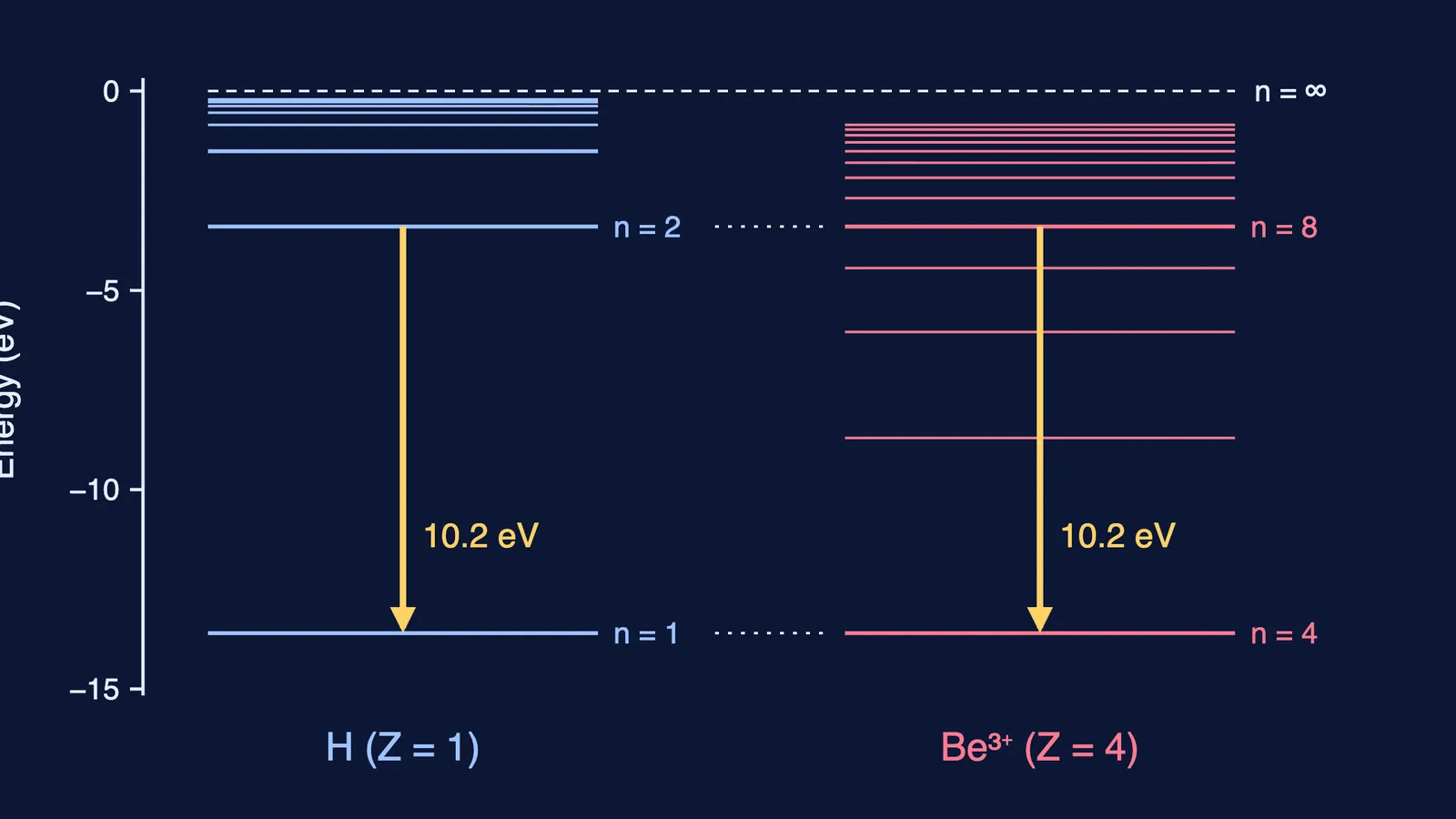
Q8 (hard). Which transition in Be³⁺ emits light of the same wavelength as the first line of hydrogen's Lyman series (n = 2 → 1)?
(A) 2 → 1 (B) 4 → 2 (C) 8 → 4 (D) 16 → 8
Answer: (C). For one-electron species, 1/λ is proportional to Z²(1/n₁² − 1/n₂²). Hydrogen's line gives 1 × (1 − 1/4) = 3/4. For Be³⁺, Z² = 16, and 8 → 4 gives 16 × (1/16 − 1/64) = 3/4. Why not (B)? It matches only if you multiply by Z = 4 instead of Z² = 16. The diagram at the top shows it: Be³⁺ levels 4 and 8 sit at −13.6 and −3.4 eV, exactly where hydrogen's levels 1 and 2 are.
What should you do after checking your answers?
7 or 8 right: move to mixed timed sets. Our photoelectric effect problems add more numericals.
4 to 6 right: redo every miss tomorrow on a blank page, starting from the formula, not the options.
3 or fewer: reread NCERT Unit 2 on the Bohr model and quantum numbers, then retry in three days. Know where Q7 and Q8's model fails: the limitations of the Bohr model.
Log each miss as the rule you broke: "n − l − 1", "Z², not Z", "energies subtract". If a method keeps slipping, the Fermi Problem Library has worked problems with a step-by-step solver that explains the reasoning rather than printing an answer.