On this page
Three original case studies on Structure of Atom, easiest first. Class 11 exams are set by schools, so treat these as practice, not a forecast. Every fact follows the NCERT Chemistry Part I chapter (Reprint 2026-27), inside Unit 2 of the CBSE 2026-27 Class XI Chemistry curriculum. For the theory first, read our Structure of Atom Class 11 guide with solved examples.
Case 1: Which ions are in a borewell water report?
A water-testing lab in Nagpur checks a borewell sample for a housing society. It lists fluoride (F⁻) at 1.2 mg/L, magnesium (Mg²⁺) at 38 mg/L and calcium (Ca²⁺) at 96 mg/L. Per IUPAC's Commission on Isotopic Abundances and Atomic Weights, magnesium occurs as three isotopes, ²⁴Mg, ²⁵Mg and ²⁶Mg, and about 79% of it is ²⁴Mg. About 97% of calcium is ⁴⁰Ca, and fluorine has only one natural isotope, ¹⁹F. The secretary asks whether the society's softener will treat ²⁴Mg²⁺ and ²⁶Mg²⁺ differently.
(i) How many electrons does a ²⁴Mg²⁺ ion have? (a) 12 (b) 10 (c) 14 (d) 24
(ii) Which other ion in the report has the same number of electrons as Mg²⁺?
(iii) Find the protons, neutrons and electrons in ⁴⁰Ca²⁺ and in ¹⁹F⁻.
(iv) Will the softener treat ²⁴Mg²⁺ and ²⁶Mg²⁺ differently? Explain, and give the configuration of Mg²⁺ with n and l for its highest-energy electrons.
Answers.
(i) (b) 10. Z = 12, and the 2+ ion has lost two electrons.
(ii) F⁻: 9 + 1 = 10 electrons. (Ca²⁺ has 18.)
(iii) ⁴⁰Ca²⁺: 20 protons, 40 − 20 = 20 neutrons, 18 electrons. ¹⁹F⁻: 9 protons, 19 − 9 = 10 neutrons, 10 electrons.
(iv) No. They are isotopes (12 protons; 12 and 14 neutrons), and NCERT notes that electrons, not neutrons, control chemical properties. Mg²⁺ is 1s² 2s² 2p⁶; its highest-energy electrons are 2p, so n = 2 and l = 1.
Case 2: Why does only some LED light free electrons?
In a school lab in Kochi, students shine four LEDs of equal brightness on a clean metal plate in a vacuum tube wired to a current meter: red (650 nm), green (530 nm), blue (450 nm) and ultraviolet (395 nm). The plate's threshold frequency is 5.6 × 10¹⁴ Hz. Three LEDs give a current; one does not. A student then doubles the blue LED's brightness. Take h = 6.626 × 10⁻³⁴ J s, c = 3.0 × 10⁸ m s⁻¹ and electron mass 9.1 × 10⁻³¹ kg.
(i) Which LED gives no current, however bright? (a) red (b) green (c) blue (d) ultraviolet
(ii) When the blue LED is made twice as bright, what happens to the number and the kinetic energy of ejected electrons?
(iii) Find the kinetic energy of an electron ejected by blue light.
(iv) Find the speed of the fastest electrons from the ultraviolet LED, and explain why green only just works.
Answers.
(i) (a) Red. ν = c/λ = 3.0 × 10⁸ / 650 × 10⁻⁹ = 4.62 × 10¹⁴ Hz, below the threshold.
(ii) More electrons leave (more photons), but their kinetic energy is unchanged: it depends on frequency, not brightness.
(iii) hc/λ = (6.626 × 10⁻³⁴ × 3.0 × 10⁸) / 450 × 10⁻⁹ = 4.42 × 10⁻¹⁹ J. hν₀ = 6.626 × 10⁻³⁴ × 5.6 × 10¹⁴ = 3.71 × 10⁻¹⁹ J. Kinetic energy = 7.1 × 10⁻²⁰ J.
(iv) hc/λ = 5.03 × 10⁻¹⁹ J, so kinetic energy = 5.03 − 3.71 = 1.32 × 10⁻¹⁹ J and v = √(2 × 1.32 × 10⁻¹⁹ / 9.1 × 10⁻³¹) = 5.4 × 10⁵ m s⁻¹. The threshold wavelength is c/ν₀ = 536 nm; green at 530 nm is barely shorter, leaving each photon only 4.0 × 10⁻²¹ J to spare.
Case 3: Which hydrogen line does a lab filter show?
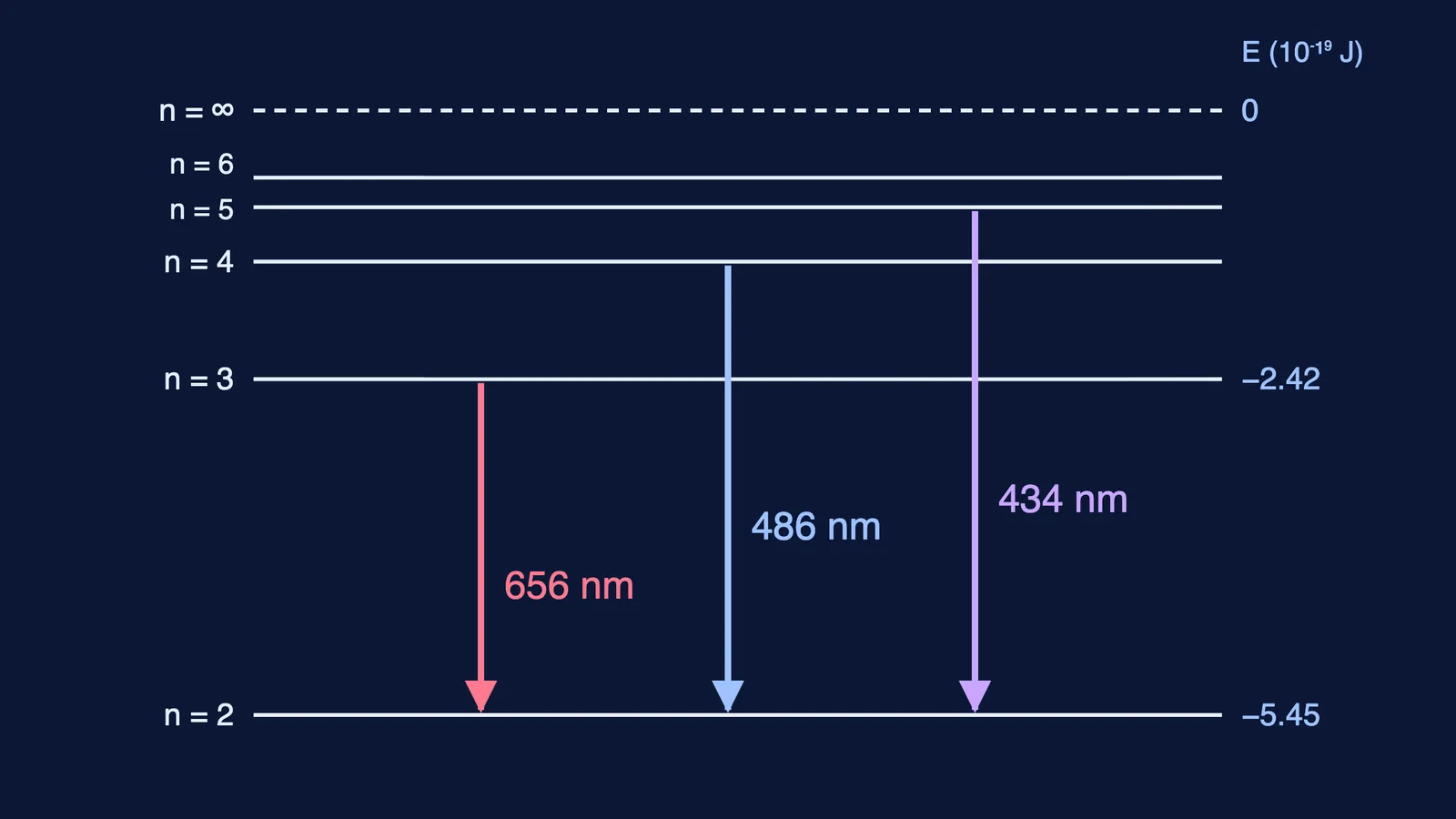
A college lab in Pune runs a hydrogen discharge lamp. Through a filter that passes only light between 655 nm and 658 nm, students see one bright red line; without it, the lamp shows several more lines of other colours. The teacher asks them to identify the Bohr-orbit drop behind the red line before the lab orders a second filter for the next line of the same series. Use the Rydberg constant 1.09677 × 10⁷ m⁻¹ and Eₙ = −2.18 × 10⁻¹⁸/n² J.
(i) Lines that end on n = 2 belong to: (a) Lyman, ultraviolet (b) Balmer, visible (c) Paschen, infrared (d) Brackett, infrared
(ii) Which transition gives the red line: 3 → 1, 3 → 2, 4 → 2 or 4 → 3? Show your working.
(iii) Calculate the energy of one photon of the red line.
(iv) What wavelength should the second filter pass, and what is the shortest possible wavelength in this series?
Answers.
(i) (b) Balmer, visible (NCERT Table 2.3).
(ii) 3 → 2. Wavenumber = 1.09677 × 10⁷ × (1/4 − 1/9) = 1.523 × 10⁶ m⁻¹, so λ = 656 nm, inside the band. The others give 103 nm, 486 nm and 1876 nm.
(iii) ΔE = 2.18 × 10⁻¹⁸ × (1/4 − 1/9) = 3.03 × 10⁻¹⁹ J, emitted. Check: hc/λ at 656 nm gives the same.
(iv) The next line is 4 → 2: 1.09677 × 10⁷ × (1/4 − 1/16) = 2.056 × 10⁶ m⁻¹, so λ = 486 nm. The shortest line comes from n = ∞: 1.09677 × 10⁷ / 4 = 2.742 × 10⁶ m⁻¹, so λ = 365 nm.
How to attack case-study questions
Use the passage's constants, not memorised ones.
Convert nm to m before E = hc/λ.
For ions, count electrons last: protons from Z, neutrons from A − Z, then add electrons for anions and remove them for cations.
The lower level names the series; the sign of ΔE says emitted or absorbed.
Give the NCERT reason in "explain" parts: brightness changes the number of electrons, not their energy; isotopes share chemistry because they share electrons.
For a general method, read how to answer case-based questions in CBSE board exams; for another format, try our Structure of Atom assertion-reason questions. If your method keeps going wrong, the Fermi Problem Library has worked problems with a step-by-step solver that explains the reasoning rather than printing an answer.