On this page
Structural Organisation in Animals is Chapter 7 of the NCERT Class 11 Biology textbook (Reprint 2026-27). The CBSE Biology syllabus for 2026-27 covers the morphology of the frog and the anatomy and functions of its digestive, circulatory, respiratory, nervous and reproductive systems. Below, the key terms follow that order, in our own words and checked against the NCERT text. For the full chapter walkthrough, see our Structural Organisation in Animals Class 11 guide.
Not in the current chapter: the subtypes of animal tissue, the earthworm and the cockroach, all removed according to NCERT's list of rationalised content for Class XI. The text still names the four basic tissues, but no longer describes them.
How are cells, tissues and organs organised?
The NCERT chapter opens with these levels of organisation before turning to the frog.
Tissue: a group of similar cells, plus the substance between them, doing a particular job.
Four basic tissues: epithelial, connective, muscular and neural; every complex animal is built from these. Example: the heart contains all four.
Organ: tissues arranged in a fixed proportion and pattern. Example: stomach, lung, kidney.
Organ system: two or more organs working together, physically or chemically, on one function. Example: the digestive system.
Division of labour: cells, tissues, organs and systems each taking a share of the work so the whole body survives.
Morphology: the study of external form. In animals, it means the outward appearance of body parts.
Anatomy: the study of the internal organs. Don't confuse with: morphology, which stays on the outside.
What do the frog's body and behaviour tell us?
The chapter's frog is *Rana tigrina*, the common Indian species, in class Amphibia of phylum Chordata.
Poikilotherm (cold-blooded): an animal whose body temperature rises and falls with its surroundings, as the frog's does.
Camouflage: changing colour to stay hidden from enemies; NCERT calls this protective colouration mimicry.
Aestivation: summer sleep in a deep burrow to escape heat. Don't confuse with: hibernation, the same shelter-seeking in winter to escape cold.
Nictitating membrane: a thin covering over the bulging eyes that protects them under water.
Tympanum: the membrane beside each eye that receives sound; the frog has no external ear.
Sexual dimorphism: visible differences between male and female. Example: only males have vocal sacs and a copulatory pad on the first digit of each forelimb.
What happens to food inside a frog?
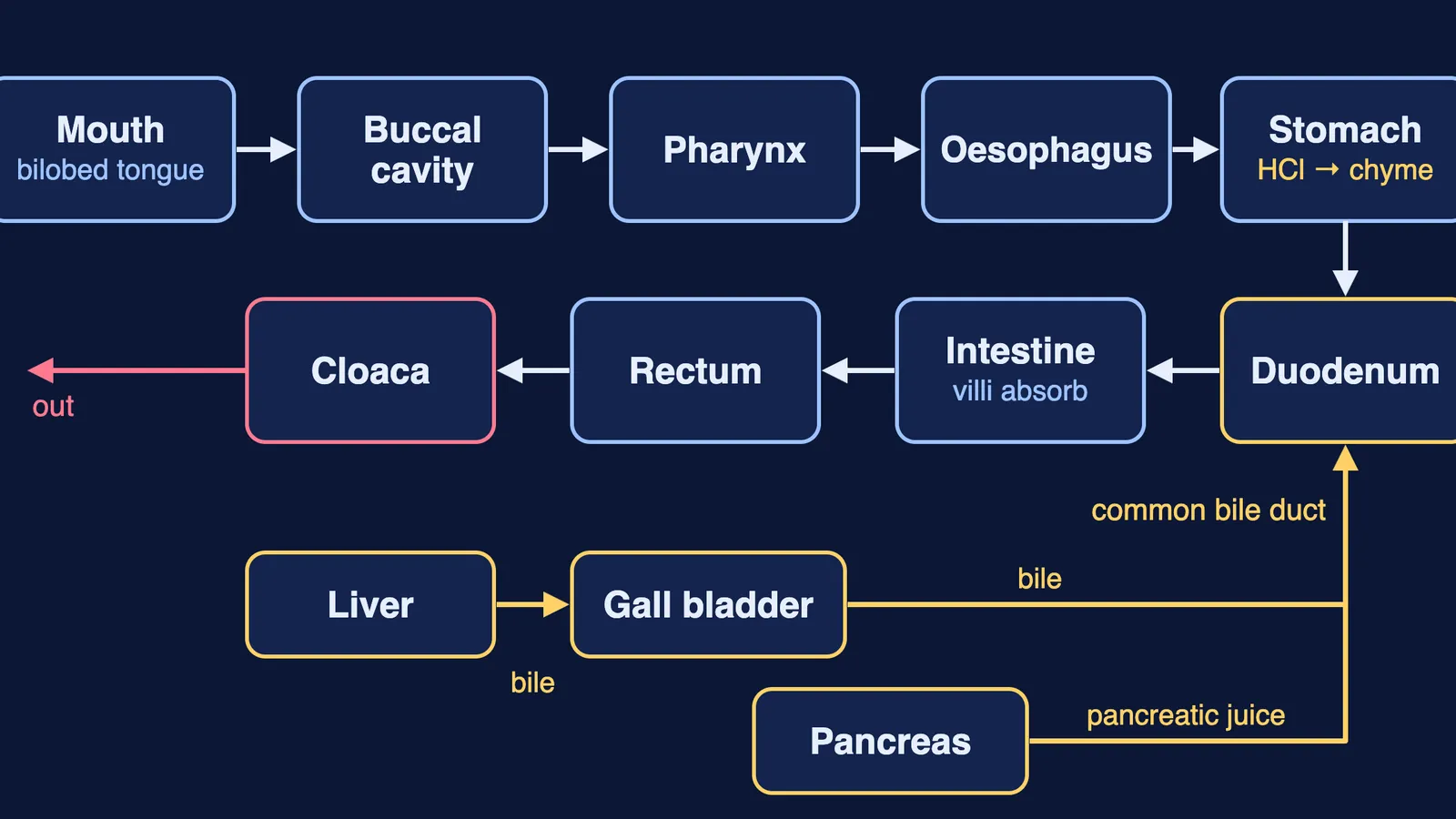
Chyme: food partly digested in the stomach by HCl and gastric juices, then passed on to the intestine.
Duodenum: the first part of the small intestine, where bile and pancreatic juice arrive.
Common bile duct: the shared tube that brings bile from the gall bladder and pancreatic juice from the pancreas into the duodenum.
Bile: made by the liver and stored in the gall bladder; it emulsifies fat. Don't confuse with: pancreatic juice, which digests carbohydrates and proteins.
Villi and microvilli: finger-like folds of the inner intestinal wall that absorb digested food.
Cloaca: the single chamber where faeces, urine and sperms all leave the body. Example: the rectum, ureters and urinary bladder open into it.
How does a frog breathe and move blood?
Cutaneous respiration: gas exchange through moist skin by diffusion; this is how the frog breathes in water and during aestivation and hibernation.
Pulmonary respiration: breathing with the lungs, used on land along with the skin and buccal cavity. Don't confuse with: cutaneous respiration.
Closed circulation: blood stays inside the heart and vessels; the frog also has a separate lymphatic system.
Three-chambered heart: two atria and one ventricle, wrapped in the pericardium.
Sinus venosus: a triangular chamber that collects blood from the vena cava and joins the right atrium.
Conus arteriosus: a sac on the ventral side into which the ventricle opens.
Hepatic portal system: a special vein link between intestine and liver. Don't confuse with: the renal portal system, which links the lower body to the kidneys.
Lymph: a fluid unlike blood, lacking RBCs and a few proteins. Frog RBCs are nucleated and carry haemoglobin.
How are control and reproduction organised?
The counts below (ten pairs, 10-12 tubes) are from the NCERT chapter.
Central nervous system: the brain and spinal cord. Don't confuse with: the peripheral nervous system (cranial and spinal nerves) and the autonomic system (sympathetic and parasympathetic).
Cranial nerves: ten pairs, arising from the brain.
Optic lobes: the paired lobes that mark the midbrain. Example: the forebrain holds the olfactory lobes and cerebral hemispheres; the hindbrain, the cerebellum and medulla oblongata.
Mesorchium: a double fold of peritoneum that attaches each testis to the kidney.
Vasa efferentia: 10-12 tubes from the testes that enter the kidney and open into Bidder's canal.
Urinogenital duct: in males, the ureter carrying both urine and sperms to the cloaca. Don't confuse with: females, whose ureters and oviducts open into the cloaca separately.
External fertilisation: egg and sperm meet in water, outside the body.
Metamorphosis: the change of the larva, the tadpole, into the adult frog.
The chapter also describes the frog's excretory system (kidneys built of nephrons; the frog excretes urea). The syllabus line does not name it, so we have left it out here.
How to learn these terms
Trace the food path aloud from tongue to cloaca, adding bile and pancreatic juice at the duodenum, as in the diagram above.
Learn the pairs together: aestivation and hibernation, cutaneous and pulmonary, hepatic and renal portal, morphology and anatomy.
Draw the male and female urinogenital systems side by side and circle where they differ.
Sort brain parts into forebrain, midbrain and hindbrain cards, then shuffle and re-sort.
Compare each frog feature with its counterpart in our Animal Kingdom Class 11 guide, and try the questions in our structural organisation in animals post for NEET.
If a term still feels abstract, the Fermi Concept Library covers every concept in biology, each with its own lesson and its place in the map.