On this page
These are the key terms of Chapter 9, Straight Lines, in the NCERT Class 11 Mathematics textbook (Reprint 2026-27), each with a worked example. For the full chapter, read our Straight Lines Class 11 guide.
The CBSE Mathematics curriculum for 2026-27 lists recall of two-dimensional geometry, slope, angle between lines, forms of the equation of a line and distance of a point from a line. Shifting of origin and normal form are not in the current NCERT chapter, so they are left out.
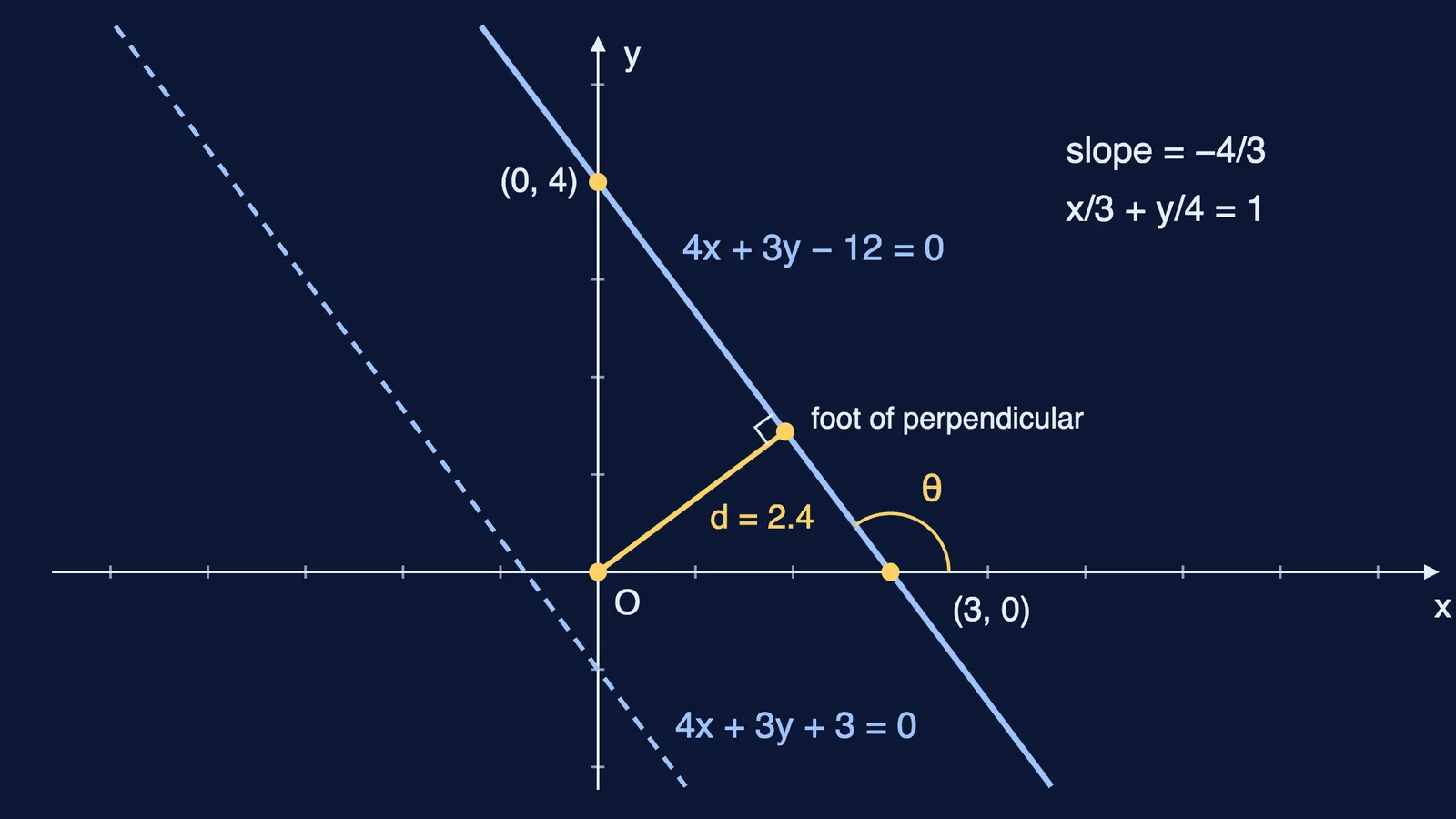
Many examples reuse one line, 4x + 3y − 12 = 0.
Which coordinate geometry terms should you recall first?
Distance formula: the distance between P(x₁, y₁) and Q(x₂, y₂) is √[(x₂ − x₁)² + (y₂ − y₁)²]. Example: (1, 2) and (4, 6) are √(9 + 16) = 5 units apart.
Section formula (internal division): the point dividing (x₁, y₁) to (x₂, y₂) in the ratio m : n is ((mx₂ + nx₁)/(m + n), (my₂ + ny₁)/(m + n)). Example: (0, 0) to (6, 3) in the ratio 1 : 2 gives (2, 1).
Mid-point: the case m = n. Example: (2, 4) and (6, 8) give (4, 6).
Area of a triangle: ½ |x₁(y₂ − y₃) + x₂(y₃ − y₁) + x₃(y₁ − y₂)| for vertices (x₁, y₁), (x₂, y₂), (x₃, y₃). Example: (0, 0), (4, 0), (0, 3) give 6.
Collinear points: points on one line; A, B, C are collinear if their triangle has zero area, or slope of AB = slope of BC. Example: (0, 1), (1, 3), (2, 5).
What is the slope of a line?
Inclination (θ): the angle from the positive x-axis to the line, measured anticlockwise, between 0° and 180°. Example: the y-axis has θ = 90°.
Slope or gradient (m): m = tan θ, defined only when θ ≠ 90°. Example: θ = 45° gives m = 1.
Slope from two points: m = (y₂ − y₁)/(x₂ − x₁), with x₁ ≠ x₂. Example: (1, 2) and (4, 6) give m = 4/3.
Zero slope: a horizontal line, like y = 3. Don't confuse with: undefined slope, a vertical line like x = 3.
Parallel lines: two non-vertical lines are parallel if and only if m₁ = m₂. Example: y = 2x + 1 and y = 2x − 3.
Perpendicular lines: two non-vertical lines are perpendicular if and only if m₁m₂ = −1. Example: slopes −4/3 and 3/4. Don't confuse with: the plain reciprocal; you need the negative reciprocal.
Angle between two lines: the acute angle θ satisfies tan θ = |(m₂ − m₁)/(1 + m₁m₂)|, with 1 + m₁m₂ ≠ 0; the obtuse angle is 180° − θ. Example: slopes 1 and 0 give θ = 45°.
What are the forms of the equation of a line?
Equation of a line: an equation in x and y satisfied by every point on the line and by no other point.
Horizontal and vertical lines: y = a and x = b. Example: through (−1, 4), y = 4 and x = −1.
Point-slope form: y − y₀ = m(x − x₀) for slope m through (x₀, y₀). Example: slope 3 through (2, 1) gives y = 3x − 5.
Two-point form: y − y₁ = [(y₂ − y₁)/(x₂ − x₁)](x − x₁). Example: through (1, 2) and (4, 6), 4x − 3y + 2 = 0.
y-intercept (c) and x-intercept (d): the line meets the axes at (0, c) and (d, 0). Both are signed. Example: y = 2x − 4 has c = −4, d = 2. Don't confuse with: a distance, never negative.
Slope-intercept form: y = mx + c, or y = m(x − d) using the x-intercept. Example: y = 2(x − 2) is the same line as y = 2x − 4.
Intercept form: x/a + y/b = 1 for intercepts a and b on the x- and y-axes. Example: x/3 + y/4 = 1 is 4x + 3y − 12 = 0.
General equation of a line: Ax + By + C = 0, with A and B not both zero. Slope −A/B when B ≠ 0. Example: 4x + 3y − 12 = 0 has slope −4/3.
How far is a point from a line?
Distance of a point from a line: the length of the perpendicular from the point to the line, d = |Ax₁ + By₁ + C| / √(A² + B²). Example: the origin is 12/5 = 2.4 from 4x + 3y − 12 = 0.
Foot of the perpendicular: the point where that perpendicular meets the line. Example: (1.92, 1.44) for the origin and 4x + 3y − 12 = 0.
Distance between parallel lines: for Ax + By + C₁ = 0 and Ax + By + C₂ = 0, d = |C₁ − C₂| / √(A² + B²). Example: 4x + 3y − 12 = 0 and 4x + 3y + 3 = 0 are |−12 − 3|/5 = 3 apart. Don't confuse with: 4x + 3y + 3 = 0 and 8x + 6y − 5 = 0; make A and B match first.
Point of intersection: the point satisfying both equations. Example: 4x + 3y = 12 and y = x meet at (12/7, 12/7).
Concurrent lines: three or more lines through one point. Example: x = 1, y = 1 and x + y = 2 meet at (1, 1).
Image of a point in a line: with the line as a mirror, the line is the perpendicular bisector of the point-image segment. Example: the image of (1, 2) in y = x is (2, 1).
How to learn these terms
Keep 4x + 3y − 12 = 0 and write it in every form above.
Sketch zero vs undefined slope, and parallel vs perpendicular, side by side.
Say each formula's condition: x₁ ≠ x₂, 1 + m₁m₂ ≠ 0, matching A and B.
Check answers by substituting a point back.
Revise the Straight lines Class 11 formulas and test yourself with the straight lines assertion-reason questions. If a term feels slippery, the Fermi Concept Library gives every concept in mathematics its own lesson and its place in the map.