On this page
Every item stays inside the Straight Lines unit of the CBSE 2026-27 Class XI Mathematics syllabus: slope, angle between two lines, the forms of a line, and the distance of a point from a line. Each was checked against the NCERT Straight Lines chapter (Reprint 2026-27), and every number with Python. Treat this as practice, not a prediction of any paper. For the theory, see our Straight Lines Class 11 guide.
How do you answer assertion-reason questions on straight lines?
Judge A alone, then R alone. If both are true, read "A, because R": does R produce exactly A? Our assertion-reason question strategy has the full routine.
Assertion-reason keys:
(A) Both A and R are true and R is the correct explanation of A.
(B) Both A and R are true but R is NOT the correct explanation of A.
(C) A is true but R is false.
(D) A is false but R is true.
Statement I / Statement II keys:
(A) Both statements are correct.
(B) Both statements are incorrect.
(C) Statement I is correct, Statement II is incorrect.
(D) Statement I is incorrect, Statement II is correct.
Straight lines assertion-reason questions with answers
Q1 (easy). Assertion (A): The slope of the line through (2, 5) and (6, −3) is −2. Reason (R): The slope of a non-vertical line through (x1, y1) and (x2, y2) is (y2 − y1)/(x2 − x1).
Answer: (A). R gives (−3 − 5)/(6 − 2) = −8/4 = −2, which is exactly A.
Trap: flipping the fraction and getting −1/2.
Q2 (easy). Assertion (A): The points (1, 2), (3, 6) and (−2, −4) are collinear. Reason (R): The line through (1, 2) and (3, 6) passes through the origin.
Answer: (B). Both slopes, (1, 2) to (3, 6) and (3, 6) to (−2, −4), are 2, so A is true. R is true but says nothing about (−2, −4); NCERT's test is equal slopes.
Trap: a fact about two points proves nothing about three.
Q3 (medium). Assertion (A): The inclination of the line y = −x + 3 is 135°. Reason (R): The inclination of a line is always an acute angle.
Answer: (C). tan 135° = −1, the slope, so A is true. R is false: NCERT allows 0° ≤ θ ≤ 180°, and a negative slope means an obtuse inclination.
Trap: answering 45° or −45°.
Q4 (medium). Assertion (A): The line x/2 + y/5 = 1 is perpendicular to the line 5x − 2y = 3. Reason (R): Two non-vertical lines are perpendicular if and only if the product of their slopes is −1.
Answer: (D). Slopes are −5/2 and 5/2; the product is −25/4, so A is false. R is the NCERT condition.
Trap: taking the slope of x/a + y/b = 1 as +b/a.
Q5 (medium). Assertion (A): The perpendicular distance of (2, −1) from 3x + 4y − 12 = 0 is 2 units. Reason (R): The distance of (x1, y1) from Ax + By + C = 0 is |Ax1 + By1 + C| / √(A² + B²).
Answer: (A). R gives |6 − 4 − 12| / 5 = 10/5 = 2.
Trap: a negative distance from a dropped modulus.
Q6 (hard). Assertion (A): The distance between the lines 5x − 12y + 4 = 0 and 10x − 24y − 18 = 0 is 1 unit. Reason (R): Both lines have slope 5/12.
Answer: (B). Halve the second equation: 5x − 12y − 9 = 0, so d = |4 − (−9)| / 13 = 13/13 = 1. R only shows the lines are parallel; the value comes from the distance formula.
Trap: writing |4 + 18| / 13 = 22/13 before matching coefficients.
Statement I and Statement II questions on straight lines
Q7 (easy). Statement I: The line with slope −2 and y-intercept 3 is y = −2x + 3. Statement II: The line x/5 − y/3 = 1 cuts the y-axis at (0, 3).
Answer: (C). I is y = mx + c. In II, x = 0 gives y = −3, so the point is (0, −3).
Trap: ignoring the minus sign in the intercept form.
Q8 (medium). Statement I: The points (0, 3), (2, 7) and (5, 12) are collinear. Statement II: The line through (1, 4) with inclination 45° passes through (6, 9).
Answer: (D). In I, the slopes are 2 and 5/3, so not collinear. In II, the line is y = x + 3, and 9 = 6 + 3.
Trap: judging collinearity by eye.
Q9 (hard). Statement I: Lines with slopes 3 and −1/2 meet at an acute angle of 45°. Statement II: The vertical lines at distance 3 from the y-axis are y = 3 and y = −3.
Answer: (B). In I, tan θ = |(−1/2 − 3)/(1 − 3/2)| = 7, not 1, so θ is not 45°. In II, vertical lines are x = ±3.
Trap: a sign slip, since +1/2 (not −1/2) gives 45°.
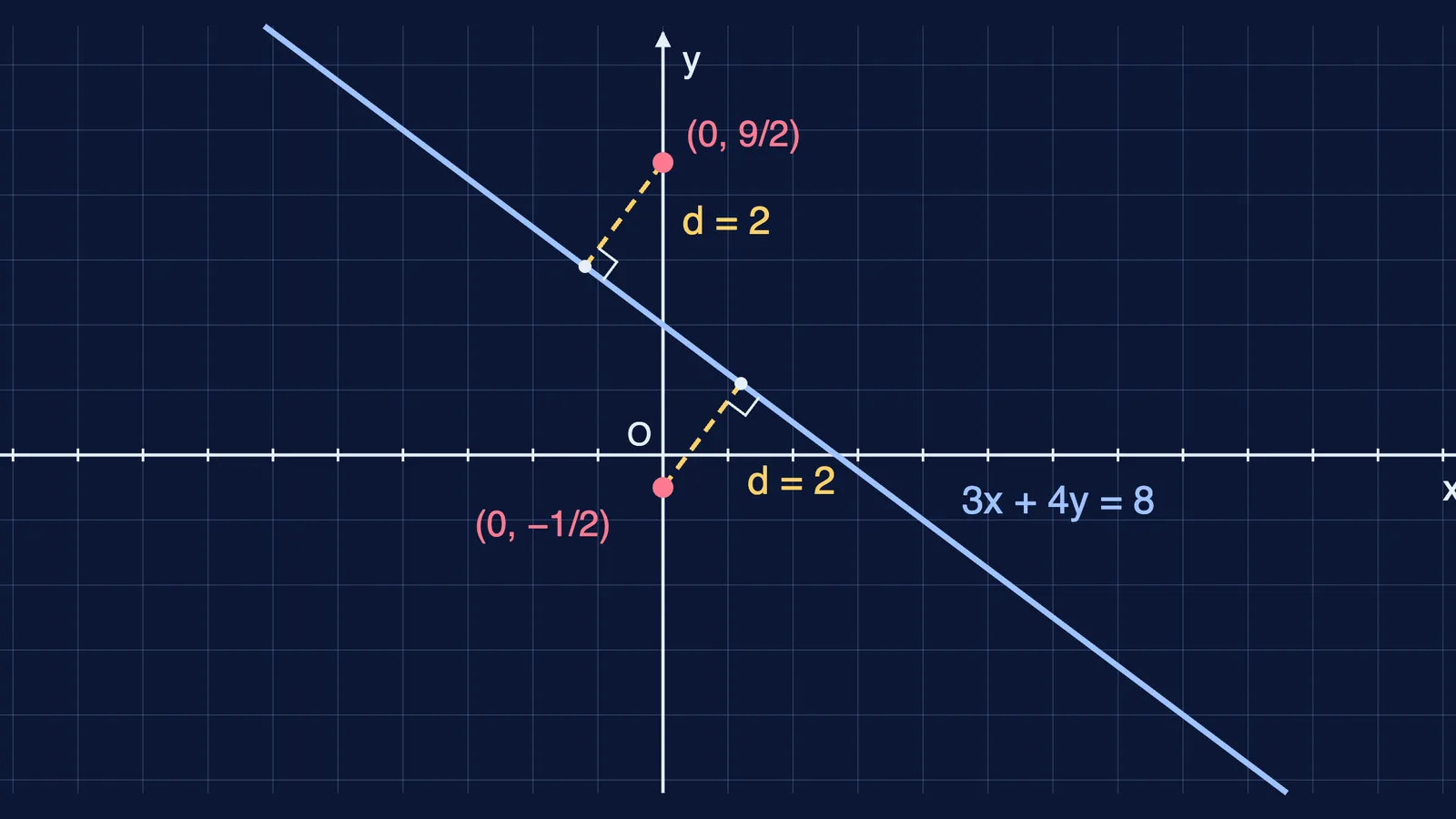
Q10 (hard). Statement I: The points (0, 9/2) and (0, −1/2) on the y-axis are both at perpendicular distance 2 from 3x + 4y − 8 = 0. Statement II: The line through (2, 3) perpendicular to 3x + 4y − 8 = 0 is 4x − 3y + 1 = 0.
Answer: (A). For I, |4y − 8| / 5 = 2 gives y = 9/2 or −1/2 (the pink points in the figure). For II, the perpendicular slope is 4/3, and y − 3 = (4/3)(x − 2) becomes 4x − 3y + 1 = 0.
Trap: solving 4y − 8 = 10 only and rejecting (0, −1/2).
How should you use this set?
Cover the answers and key all ten in one sitting.
Label each miss: wrong call on A, wrong call on R, or wrong "because" link.
Redo the matching NCERT example for every wrong truth call.
Most misses here are sign slips. If the same step keeps costing you, the Fermi Problem Library has worked problems with a step-by-step solver that explains the reasoning rather than printing an answer, so you see where your method went wrong.
For longer problems, try our Straight Lines JEE Main practice questions with solutions.