On this page
This sheet covers Chapter 9, Straight Lines, of NCERT Class 11 Mathematics, in its Reprint 2026-27 edition. The CBSE 2026-27 Mathematics syllabus lists the unit as a recall of two-dimensional geometry, slope, angle between two lines, five forms of the equation of a line and the distance of a point from a line. The normal form is not in the 2026-27 NCERT chapter, so it is left out. For the full chapter walkthrough, see our Straight Lines Class 11 guide.
Coordinate geometry formulas to recall
Distance between P(x₁, y₁) and Q(x₂, y₂): PQ = √[(x₂ − x₁)² + (y₂ − y₁)²].
Section formula: the point dividing the segment from (x₁, y₁) to (x₂, y₂) internally in the ratio m : n is ((mx₂ + nx₁)/(m + n), (my₂ + ny₁)/(m + n)).
Mid-point (m = n): ((x₁ + x₂)/2, (y₁ + y₂)/2).
Area of a triangle with vertices (x₁, y₁), (x₂, y₂), (x₃, y₃): ½ |x₁(y₂ − y₃) + x₂(y₃ − y₁) + x₃(y₁ − y₂)|.
Worked example. For A(2, 1) and B(8, 9), AB = √(36 + 64) = 10, the point dividing AB in ratio 1 : 3 is ((8 + 6)/4, (9 + 3)/4) = (3.5, 3), and the mid-point is (5, 5). The triangle (2, 1), (8, 9), (6, −1) has area ½ |20 − 16 − 48| = 22 square units.
Watch for: swapping m and n. The ratio's first number multiplies the far end (x₂, y₂), not the start.
How do you find the slope of a line?
Slope from inclination: m = tan θ, where θ is the angle from the positive x-axis measured anticlockwise, θ ≠ 90°.
Slope through two points: m = (y₂ − y₁)/(x₂ − x₁) = (y₁ − y₂)/(x₁ − x₂), valid only when x₁ ≠ x₂.
Horizontal line: slope 0. Vertical line: slope not defined.
Parallel (non-vertical) lines: m₁ = m₂.
Perpendicular (non-vertical) lines: m₁m₂ = −1, that is, m₂ = −1/m₁.
Collinear points: A, B, C lie on one line if and only if slope AB = slope BC (when AB and BC are not vertical).
Worked example. For P(−1, 2) and Q(3, 10), m = 8/4 = 2. R(1, 6) gives slope of PR = 4/2 = 2 too, so P, Q, R are collinear. A line perpendicular to PQ has slope −1/2.
Watch for: mixing the order of points. If the numerator starts with y₂, the denominator must start with x₂.
What is the formula for the angle between two lines?
Acute angle θ between lines with slopes m₁ and m₂: tan θ = |(m₂ − m₁)/(1 + m₁m₂)|, valid when 1 + m₁m₂ ≠ 0. If m₁ = m₂, the lines are parallel and θ = 0.
The obtuse angle between the same lines is φ = 180° − θ.
If 1 + m₁m₂ = 0, the lines are perpendicular (θ = 90°).
Worked example. Slopes 2 and −3 give tan θ = |(−3 − 2)/(1 − 6)| = 1, so the acute angle is 45° and the obtuse angle 135°.
Watch for: dropping the modulus when a slope is unknown. Solve both (m₂ − m₁)/(1 + m₁m₂) = tan θ and = −tan θ; NCERT's Example 2 gets two possible slopes this way.
Equations of a line in every form
Lines parallel to the axes: y = a or y = −a (distance a from the x-axis); x = b or x = −b (distance b from the y-axis).
Point-slope form: y − y₀ = m(x − x₀), slope m through (x₀, y₀).
Two-point form: y − y₁ = [(y₂ − y₁)/(x₂ − x₁)](x − x₁), through (x₁, y₁) and (x₂, y₂) with x₁ ≠ x₂.
Slope-intercept form: y = mx + c, where c is the y-intercept.
Slope with x-intercept d: y = m(x − d).
Intercept form: x/a + y/b = 1, for a line cutting the x-axis at (a, 0) and the y-axis at (0, b), with a ≠ 0 and b ≠ 0.
General equation: Ax + By + C = 0, where A and B are not both zero.
Worked example. Through (2, −3) and (5, 3) the slope is 6/3 = 2. Two-point form gives y + 3 = 2(x − 2), that is y = 2x − 7, or 2x − y − 7 = 0. The intercepts are 7/2 and −7, so the intercept form is x/(7/2) + y/(−7) = 1.
Watch for: using the intercept form for a line through the origin; both intercepts are 0, so it cannot be written.
How do you find the distance of a point from a line?
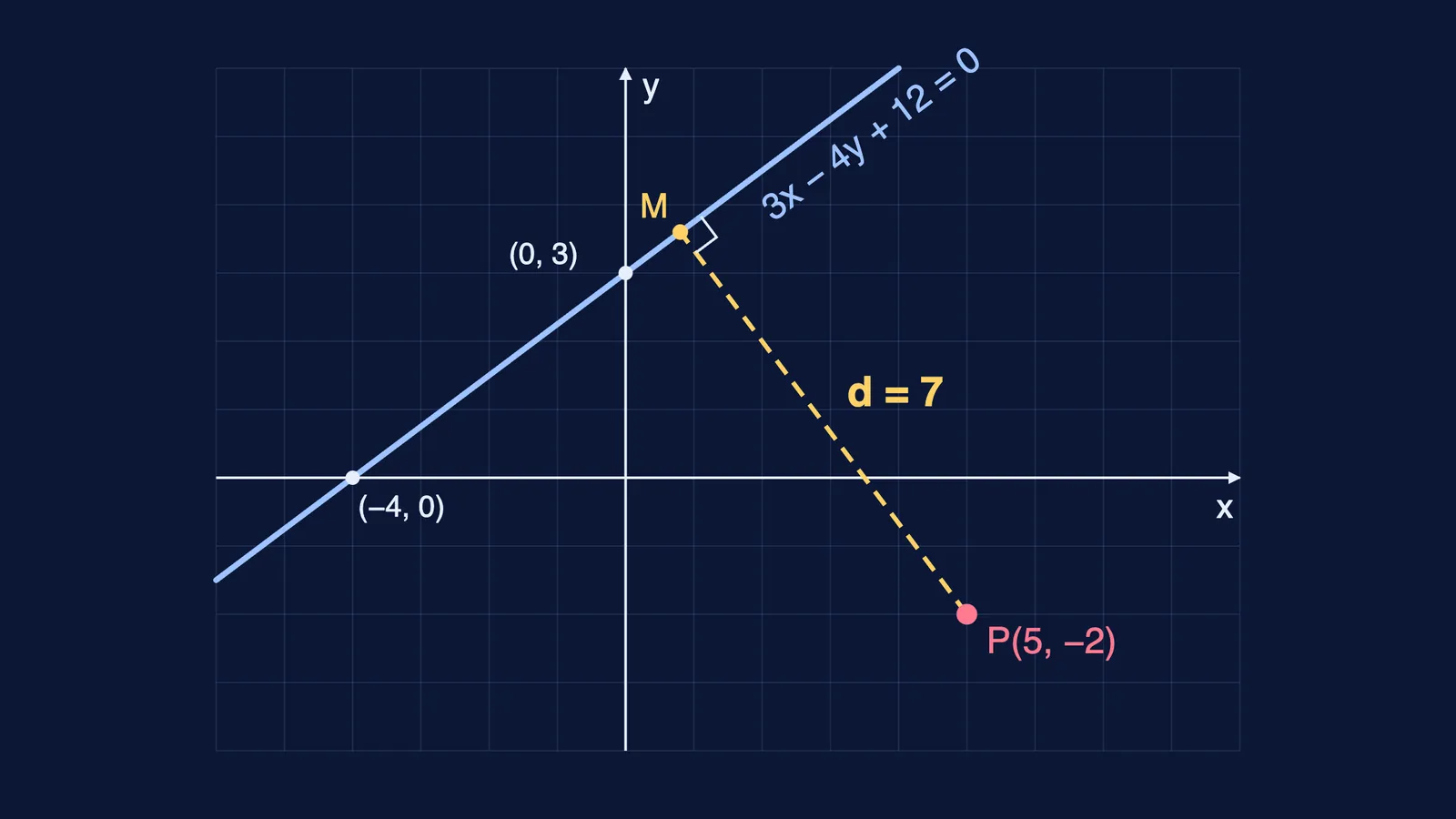
Perpendicular distance of (x₁, y₁) from Ax + By + C = 0: d = |Ax₁ + By₁ + C| / √(A² + B²).
Distance between parallel lines y = mx + c₁ and y = mx + c₂: d = |c₁ − c₂| / √(1 + m²).
Distance between parallel lines Ax + By + C₁ = 0 and Ax + By + C₂ = 0: d = |C₁ − C₂| / √(A² + B²).
Worked example. P(5, −2) is |15 + 8 + 12| / √(9 + 16) = 35/5 = 7 units from 3x − 4y + 12 = 0. For the parallel lines 3x − 4y + 12 = 0 and 6x − 8y − 11 = 0, divide the second by 2 to get 3x − 4y − 5.5 = 0; then d = |12 + 5.5| / 5 = 3.5.
Watch for: using |C₁ − C₂| before the x and y coefficients match. Skipping the division above gives 23/5 = 4.6, which is wrong.
How to revise this formula sheet
Write each formula with its condition: x₁ ≠ x₂ for slope, 1 + m₁m₂ ≠ 0 for the angle, a, b ≠ 0 for the intercept form.
Take one line through every form, as in the worked example above.
Sketch distance questions to check the answer is sensible.
Test the traps with our straight lines assertion-reason questions, then the straight lines case study questions.
If a problem keeps going wrong at one step, the Fermi Problem Library has worked problems with a step-by-step solver that explains the reasoning rather than printing an answer.