On this page
Chapter 13 of *Khel Praveen*, the new NCERT Physical Education and Well-being book for Class 9 (First Edition, April 2026), is called Sports and Disability. It sits in the book's Unit 4, Sports for All (NCERT, Unit 4 PDF).
What does Sports and Disability Class 9 cover?
The chapter opens with a story of a village boy who developed a disability after a serious illness, took up swimming in a well, and went on to represent India at the Paralympics. The lesson the book draws is that disability is not inability (NCERT).
The book defines disability as a condition that limits everyday activities because of an impairment in physical, sensory, intellectual or psychological functioning. A disability can be congenital (present from birth) or acquired later through illness, an accident or ageing (NCERT).
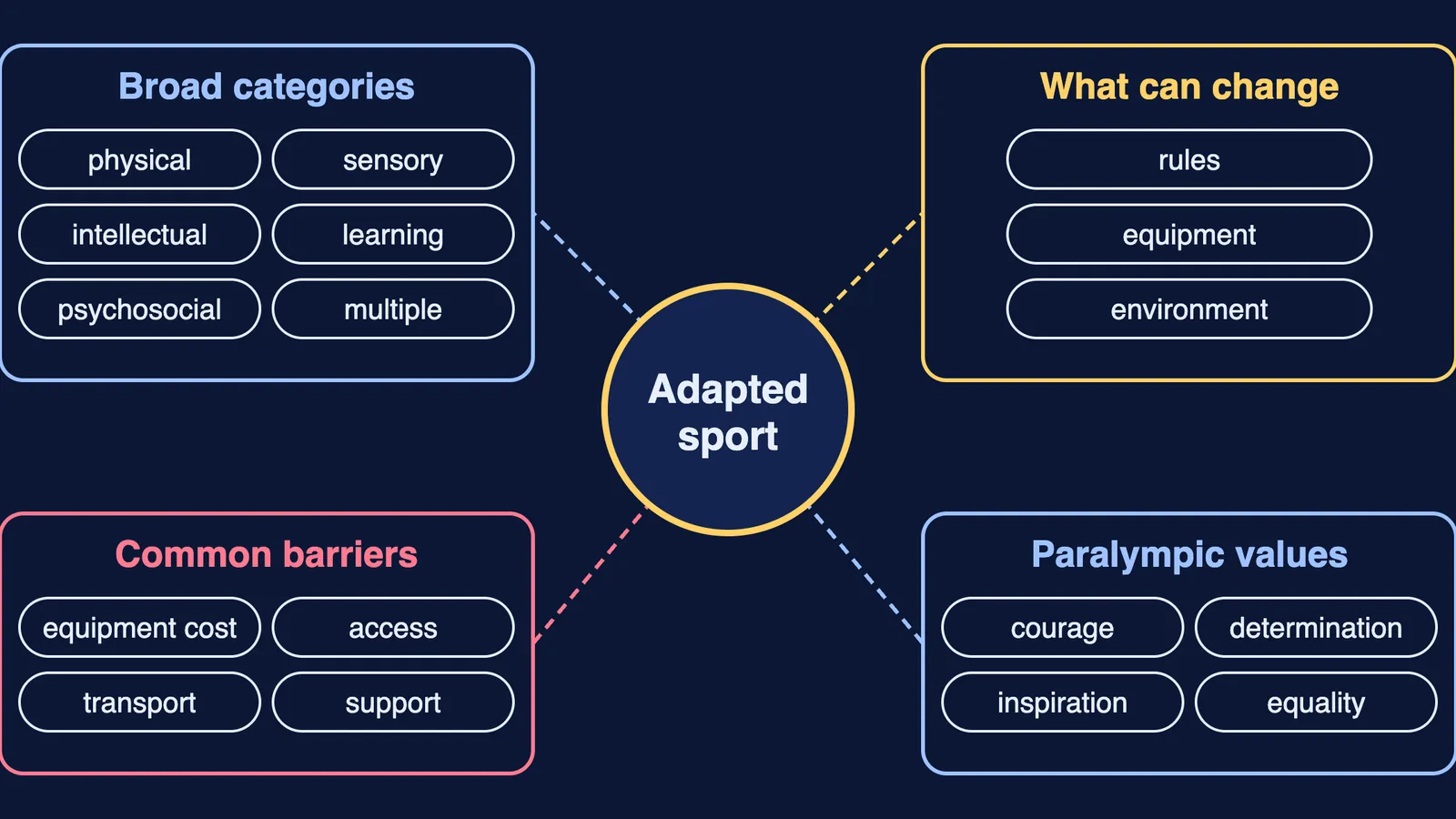
According to the book, WHO and India's Rights of Persons with Disabilities (RPwD) Act, 2016 group disabilities into six broad categories. Three are physical, sensory and intellectual; the other three are learning, psychosocial and multiple disabilities. The book also states that the RPwD Act recognises 21 types of disability for support (NCERT).
The chapter also separates visible disabilities, such as a person who uses a wheelchair, from disabilities you cannot see by looking at someone. Its examples of the second kind are learning disabilities, autism and blood disorders (NCERT).
What are adapted sports?
Adapted sports are games where the rules, the equipment or the playing environment are changed so that everyone can take part (NCERT). Our own school-level examples:
Rules: in a class relay, a classmate who uses a wheelchair runs a leg of the same length on the smoothest part of the track, and the team result still counts.
Equipment: a game of catch uses a larger, softer ball that is easier to track and hold.
Environment: a ramp is added so every player can reach the court, and the playing area is kept clear of loose objects.
What are the benefits and barriers?
The book sorts the benefits by group. Children and teenagers make friends, enjoy teamwork and feel they belong. Adults stay fit, gain confidence and independence, and find purpose. Elite athletes win recognition, break stereotypes about disability and inspire others (NCERT).
It also names barriers: playgrounds that are not accessible, costly equipment, transport problems, little information about opportunities, too few activities, lack of social support, and health issues such as pain or injury risk. Its matching activity pairs each barrier with a fix, for example ramps and accessible facilities, school transport with wheelchair space, funding for equipment, awareness events and buddy systems (NCERT).
What are the Paralympic Games and their values?
"Paralympic" joins the Greek word para, meaning beside, with "Olympic", because the Games run alongside the Olympic Games. The book's trivia box says the Paralympics currently include 28 sports, 22 for summer and 6 for winter (NCERT).
The book lists four Paralympic values: courage, determination, inspiration and equality. Its Fig. 13.2 shows 10 eligible impairment types: impaired muscle power, impaired passive range of movement, limb deficiency, leg-length difference, short stature, hypertonia, ataxia, athetosis, visual impairment, and intellectual impairment, which must be present before age 18 (NCERT). Note that one line of the text describes the Games as for athletes with physical disabilities, while Fig. 13.2 also includes vision and intellectual impairments.
How is this chapter assessed in 2026-27?
Physical Education and Well-being is a school-based subject. The CBSE 2026-27 curriculum gives 100 marks: 20 for theory and 80 for practical work. Theory has 2 marks for each of 8 units (16 marks) plus a 4-mark viva (CBSE curriculum). The curriculum places this topic in its Unit 5, Sports for All, which also covers inclusion, disability etiquette and the STEP model, women in sport, and community sport. Those 2 marks are shared across the whole unit, not given to this chapter alone. Etiquette is the subject of the next chapter, Chapter 14. Note that the book numbers this unit 4 and the curriculum numbers it 5, and the curriculum names only three disability types (intellectual, physical, sensory).
Practice questions (marks are our suggestion)
Is a disability caused by an accident congenital or acquired? (1 mark)
What does "para" mean in the word Paralympic? (1 mark)
State two benefits of sport for children and teenagers with disabilities, as listed in the chapter. (2 marks)
Your school's sports day is held on a field reached only by stairs. Name the barrier and suggest one way to remove it. (2 marks)
Your class plays throwball. Suggest one change to rules, equipment or environment so that a classmate with low vision can join in. (2 marks)
Related reading: our Class 11 guides on physical education and sports for CWSN and Olympism and Olympic values, and our guide to scholarships for students with disabilities.
Not sure where to start your revision? Fermi's AI tutor works out what you already know and builds a plan for the session.