On this page
Solutions is Unit 1 of the NCERT Class 12 Chemistry textbook, Part I (reprint 2026-27). The CBSE Chemistry syllabus for 2026-27 covers types of solutions, concentration, solubility, vapour pressure, ideal and non-ideal solutions, colligative properties and abnormal molar masses. For answers and a revision plan, see our Solutions Class 12 board exam guide.
What do solution, solute and concentration mean?
Solution: a homogeneous mixture, same composition throughout, of two or more components. Example: copper dissolved in gold, a solid solution.
Solvent and solute: the solvent is usually the component present in the largest amount and decides the solution's physical state; the others are solutes.
Mass percentage (w/w): grams of a component per 100 g of solution. Example: 10% glucose by mass is 10 g glucose in 90 g water.
Volume percentage (V/V): millilitres of a component per 100 mL of solution. Example: 35% (v/v) ethylene glycol as car antifreeze (NCERT section 1.2).
Mass by volume percentage (w/V): grams of solute per 100 mL of solution, common in medicine and pharmacy.
Parts per million (ppm): parts of a component per million parts of the whole, for trace amounts such as pollutants.
Mole fraction (x): moles of one component divided by total moles; all mole fractions in a solution add up to 1.
Molarity (M): moles of solute per litre of solution.
Molality (m): moles of solute per kilogram of solvent. Don't confuse with: molarity, which changes with temperature because volume does; molality does not.
What controls solubility?
Solubility: the concentration of solute in a saturated solution, which depends on temperature (and, for gases, pressure). Like dissolves like.
Saturated solution: one in dynamic equilibrium with undissolved solute, where dissolving and crystallising run at the same rate. Don't confuse with: an unsaturated solution, which can take more solute.
Henry's law: at fixed temperature, a gas's mole fraction in a liquid is proportional to its partial pressure above it: p = KH x.
Henry's law constant (KH): differs for each gas; a larger KH means lower solubility. For oxygen and nitrogen it rises with temperature, so they dissolve less in warm water.
Bends and anoxia: bends are nitrogen bubbles in a diver's blood as pressure falls on surfacing; anoxia is weakness from low blood oxygen at high altitude.
What is the difference between ideal and non-ideal solutions?
Figures here are from NCERT section 1.5.
Vapour pressure: the pressure of a liquid's vapour in equilibrium with it at a given temperature. A non-volatile solute lowers it.
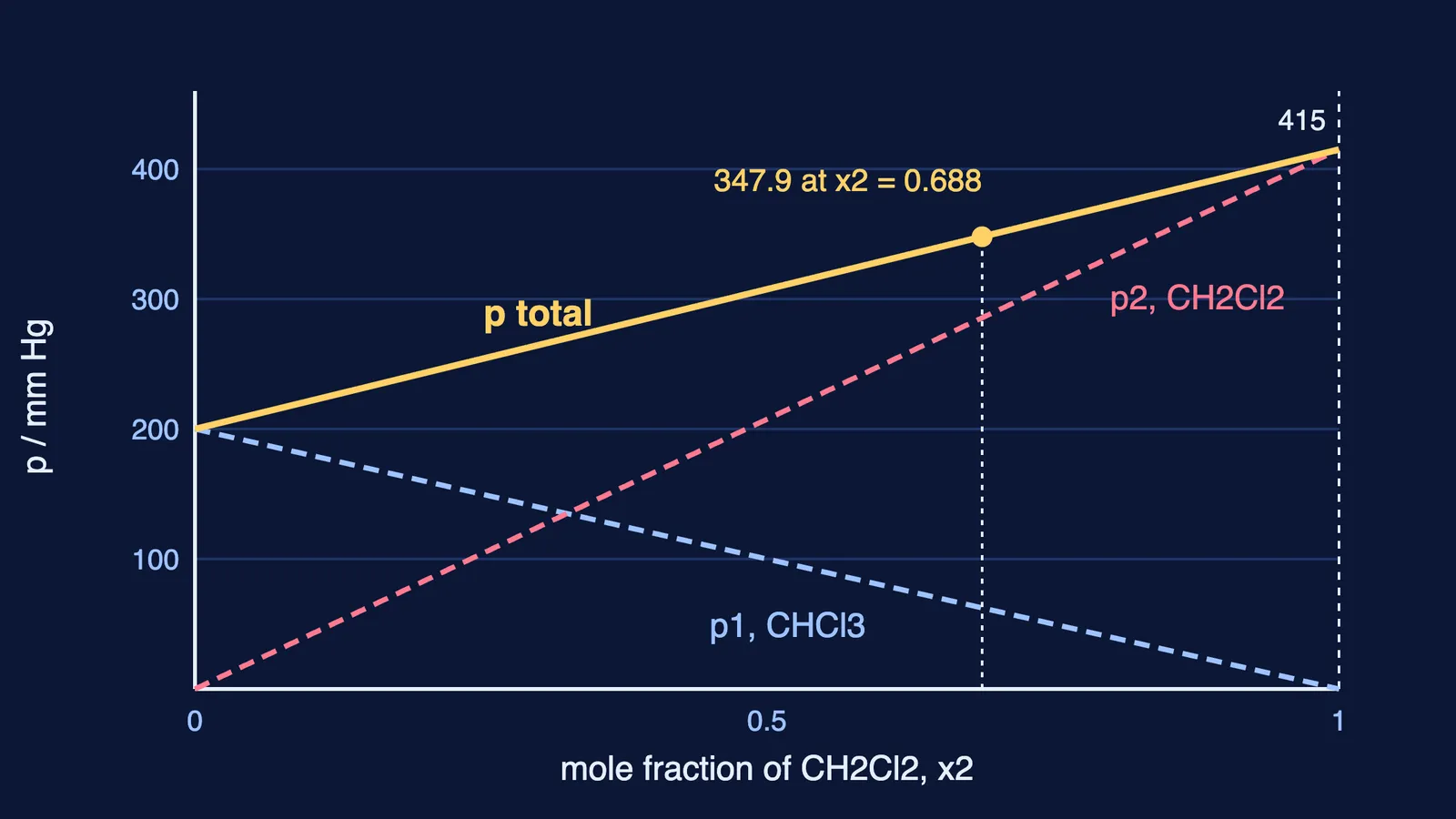
Raoult's law: each volatile component's partial vapour pressure equals its mole fraction times its pure vapour pressure (p1 = x1 p1°). Don't confuse with: Henry's law, which has the same linear form; Raoult's law is the special case where KH equals p1°.
Ideal solution: obeys Raoult's law at every concentration, with zero heat and volume change on mixing. Example (nearly ideal): benzene and toluene.
Non-ideal solution: its vapour pressure is higher or lower than Raoult's law predicts.
Positive deviation: higher than predicted, because A-B attractions are weaker than A-A and B-B. Example: ethanol and acetone.
Negative deviation: lower than predicted, because A-B attractions are stronger. Example: chloroform and acetone.
Azeotrope: a binary mixture that boils at constant temperature with the same composition in liquid and vapour, so fractional distillation cannot separate it. Large positive deviation gives a minimum boiling azeotrope (ethanol-water, about 95% ethanol by volume); large negative deviation gives a maximum boiling one (nitric acid-water, about 68% acid by mass, boiling at 393.5 K).
What are colligative properties?
Constants here are from NCERT section 1.6.
Colligative property: depends on the number of solute particles relative to the total, not on their identity.
Relative lowering of vapour pressure: the drop in the solvent's vapour pressure divided by its pure value; for a non-volatile solute it equals the solute's mole fraction.
Elevation of boiling point (ΔTb): how much higher the solution boils than the solvent; ΔTb = Kb m. The ebullioscopic constant Kb is 0.52 K kg mol⁻¹ for water.
Depression of freezing point (ΔTf): how much lower it freezes; ΔTf = Kf m. The cryoscopic constant Kf is 1.86 K kg mol⁻¹ for water.
Semipermeable membrane (SPM): a film whose tiny pores pass solvent molecules but block solute. Example: cellophane.
Osmosis: solvent flowing through an SPM from pure solvent, or a dilute solution, into a concentrated one. Example: a raw mango shrivelling in brine.
Osmotic pressure (Π): the extra pressure on the solution side that just stops osmosis; Π = CRT for dilute solutions. Measured near room temperature, it suits proteins.
Isotonic, hypertonic, hypotonic: isotonic solutions share one osmotic pressure. Blood-cell fluid matches 0.9% (mass/volume) sodium chloride, normal saline; cells shrink in a stronger (hypertonic) solution and swell in a weaker (hypotonic) one.
Reverse osmosis: forcing pure solvent out of a solution with more than the osmotic pressure, as in desalinating sea water through cellulose acetate. Don't confuse with: osmosis, where solvent flows in.
What are abnormal molar mass and the van't Hoff factor?
Abnormal molar mass: a molar mass from a colligative measurement that is lower or higher than the true value.
Dissociation and association: dissociation (KCl into K⁺ and Cl⁻) gives more particles and a lower measured molar mass; association (ethanoic acid dimerising in benzene) gives fewer and a higher one.
van't Hoff factor (i): normal molar mass divided by abnormal molar mass. Per NCERT section 1.7, it is close to 2 for KCl in water and nearly 0.5 for ethanoic acid in benzene, and it enters each colligative formula as a multiplier, as in ΔTf = i Kf m.
How to learn these terms
Pair the look-alikes: molarity vs molality, Henry vs Raoult, Kb vs Kf, osmosis vs reverse osmosis.
Draw the Raoult's law graph, then sketch the total-pressure line bowing up (positive deviation) and down (negative).
Write one example mixture beside each deviation and azeotrope type.
Keep each colligative formula next to its definition; our Solutions Class 12 formulas sheet works them out.
Test yourself with these Solutions practice questions with solutions.
If a term feels abstract, the Fermi Concept Library covers every concept in chemistry, each with its own lesson and its place in the map.