On this page
Alcohols, Phenols and Ethers is Unit 7 of the NCERT Class 12 Chemistry textbook, Part 2 (reprint 2026-27). The CBSE Chemistry curriculum for 2026-27 lists its scope as "Classification, Nomenclature, Structures of Functional Groups, Alcohols and Phenols, Some commercially Important Alcohols, Ethers". Definitions are our own, checked against the chapter. For answers and traps, see our Alcohols, phenols and ethers Class 12 board exam guide.
What are alcohols, phenols and ethers?
Alcohol: a compound with one or more –OH groups on an aliphatic (non-aromatic) carbon. Example: methanol, CH3OH.
Phenol: a compound with –OH bonded directly to a carbon of an aromatic ring. Example: C6H5OH. Don't confuse with: benzyl alcohol, C6H5CH2OH, whose –OH sits on a CH2 next to the ring, so it is an alcohol.
Ether: a compound where one oxygen links two alkyl or aryl groups, R–O–R'. Example: CH3OCH3.
Monohydric, dihydric, trihydric: one, two or three –OH groups in the molecule. Example: ethane-1,2-diol is dihydric; glycerol, propane-1,2,3-triol, is trihydric.
Primary, secondary, tertiary alcohol: the carbon carrying –OH is bonded to one, two or three other carbons. Example: propan-1-ol, propan-2-ol, 2-methylpropan-2-ol.
Allylic alcohol: –OH on an sp3 carbon right next to a C=C double bond. Example: CH2=CH–CH2OH.
Benzylic alcohol: –OH on an sp3 carbon right next to a benzene ring. Example: C6H5CH2OH.
Vinylic alcohol: –OH on an sp2 carbon that is itself part of a C=C double bond. Example: CH2=CH–OH. Don't confuse with: allylic, where the –OH carbon is next to the double bond, not in it.
Symmetrical and unsymmetrical ether: the same group on both sides of the oxygen, or two different groups. Example: C2H5OC2H5 (symmetrical), C2H5OCH3 (unsymmetrical).
How are they named?
IUPAC "-ol" name: replace the final "e" of the alkane with "ol" and number the chain from the end nearest the –OH. Example: CH3CH2CH2OH is propan-1-ol. Polyhydric alcohols keep the "e": ethane-1,2-diol.
Cresols: methylphenols. Example: p-cresol is 4-methylphenol.
Benzenediols: catechol (1,2-), resorcinol (1,3-) and hydroquinone or quinol (1,4-).
Alkoxy name for ethers: IUPAC treats an ether as the larger hydrocarbon with an –OR group. Example: C2H5OC2H5 is ethoxyethane; anisole, C6H5OCH3, is methoxybenzene.
How are alcohols and phenols made?
Acid-catalysed hydration: water adds across an alkene's double bond with an acid catalyst, following Markovnikov's rule. Example: propene gives propan-2-ol.
Hydroboration-oxidation: diborane adds to the alkene, then H2O2 with aqueous NaOH gives an alcohol, as if water had added against Markovnikov's rule. Example: propene gives propan-1-ol. Don't confuse with: acid-catalysed hydration, which gives propan-2-ol.
Grignard route: a Grignard reagent adds to a carbonyl group and hydrolysis gives the alcohol: methanal gives a primary, other aldehydes a secondary and ketones a tertiary alcohol.
Cumene process: air oxidises cumene (isopropylbenzene) to cumene hydroperoxide; dilute acid then splits this into phenol and acetone.
Fermentation: in the absence of air, the yeast enzyme zymase turns glucose and fructose into ethanol and carbon dioxide; invertase first converts the sugar into glucose and fructose.
Denatured alcohol: commercial ethanol made unfit to drink by adding copper sulphate and pyridine. Don't confuse with: methanol, "wood spirit", which is itself highly poisonous.
Why is phenol more acidic than ethanol?
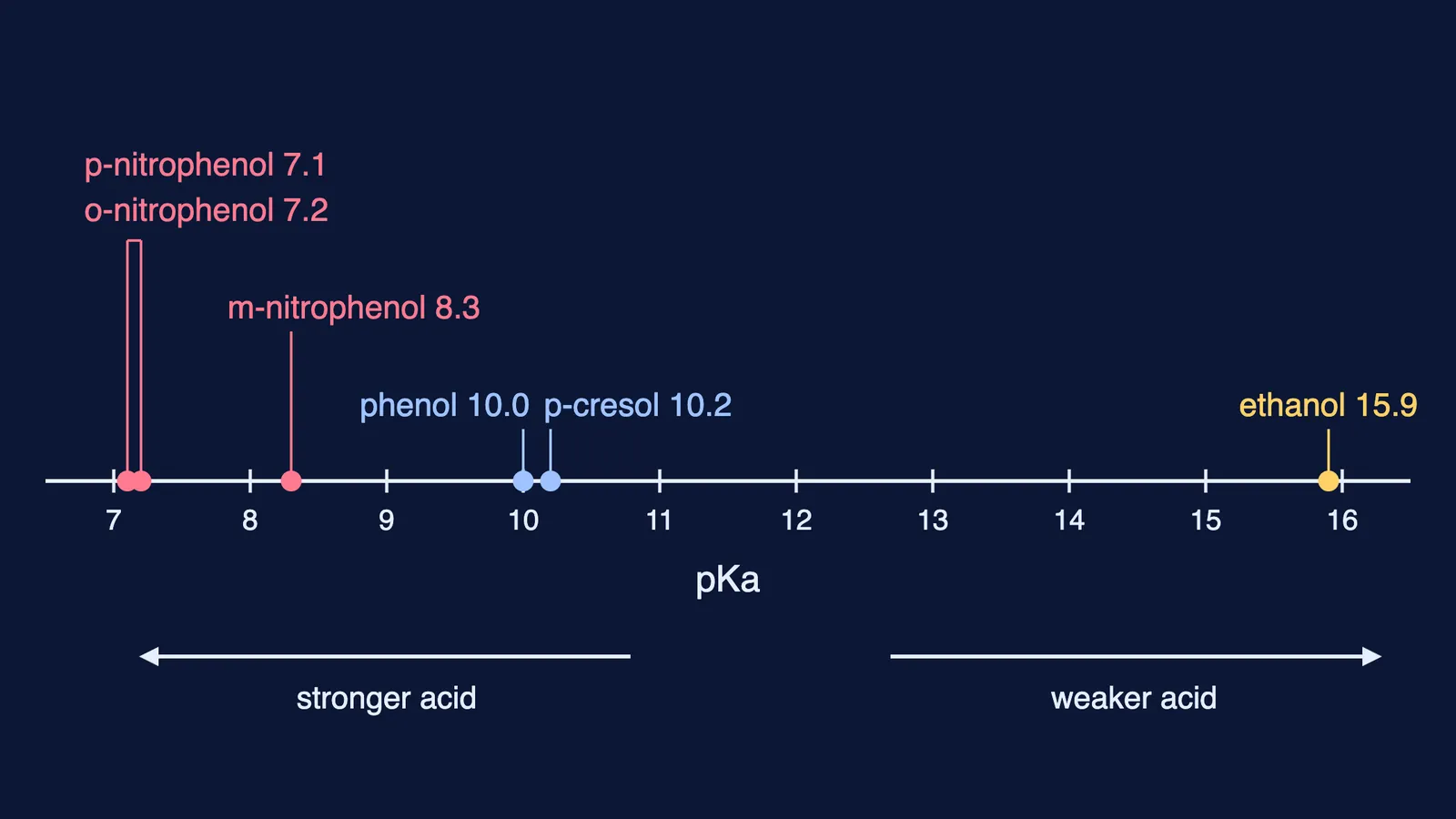
pKa values come from Table 7.3 and boiling points from section 7.6.2 of the NCERT chapter.
Brönsted acid: a proton donor, as alcohols and phenols both are. With sodium they give alkoxides or phenoxides and hydrogen.
Alkoxide and phenoxide ion: in an alkoxide such as ethoxide the negative charge stays on oxygen; in phenoxide, resonance spreads it over the ring, so the ion is more stable.
pKa: the higher the pKa, the weaker the acid. Example: ethanol 15.9, phenol 10.0.
Electron-withdrawing group: a group such as –NO2 that pulls electron density away and raises phenol's acidity, most strongly from ortho and para. Example: p-nitrophenol 7.1, m-nitrophenol 8.3; three nitro groups make 2,4,6-trinitrophenol (picric acid) a strong acid. Don't confuse with: electron-releasing groups such as –CH3, which lower it: p-cresol 10.2.
Hydrogen bonding: the attraction between the H of an –OH group and a nearby oxygen atom. It gives alcohols higher boiling points than ethers of similar mass and helps lower alcohols dissolve in water. Example: butan-1-ol boils at 390 K, ethoxyethane at 307.6 K.
Intramolecular and intermolecular hydrogen bond: o-nitrophenol bonds within one molecule, so it is steam volatile; p-nitrophenol bonds between molecules and is less volatile.
Which reactions and tests have names?
Esterification: an alcohol or phenol reacts with a carboxylic acid, acid chloride or anhydride to give an ester. Acetylation adds a CH3CO group; acetylating salicylic acid gives aspirin.
Lucas test: conc. HCl with ZnCl2. Tertiary alcohols turn cloudy at once; primary alcohols stay clear at room temperature.
Dehydration: removing water to form an alkene; tertiary alcohols dehydrate most easily, primary least. Ethanol with conc. H2SO4 gives ethene at 443 K but ethoxyethane at 413 K (NCERT).
Oxidation: primary alcohol to aldehyde (PCC or CrO3) and on to carboxylic acid (acidified KMnO4); secondary to ketone; tertiary alcohols resist.
Bromination of phenol: bromine water gives a white precipitate of 2,4,6-tribromophenol; in CHCl3 or CS2 at low temperature, monobromophenols form.
Kolbe's reaction: sodium phenoxide reacts with CO2, mainly giving ortho-hydroxybenzoic acid (salicylic acid).
Reimer-Tiemann reaction: phenol with chloroform and NaOH gains a –CHO group at the ortho position, giving salicylaldehyde. Don't confuse with: Kolbe's reaction, which adds –COOH.
Williamson synthesis: an alkoxide attacks a primary alkyl halide by SN2 to give an ether. With a tertiary halide only an alkene forms: CH3ONa and (CH3)3C–Br give 2-methylpropene.
Ether cleavage by HI: hot concentrated HI breaks a C–O bond; anisole gives phenol and CH3I.
How to learn these terms
Learn mix-ups as pairs: allylic vs vinylic, alkoxide vs phenoxide, Kolbe vs Reimer-Tiemann, acid hydration vs hydroboration-oxidation, intramolecular vs intermolecular hydrogen bonding.
Draw the Table 7.3 pKa line with one reason beside each compound, then try our acidity order of substituted phenols.
Make one card per reaction: reagent, conditions, product.
Before naming an alcohol, say whether it is primary, secondary or tertiary, and allylic or benzylic.
Practise the reasoning with our assertion-reason questions on alcohols, phenols and ethers.
If a term still feels abstract, the Fermi Concept Library covers every concept in chemistry, each with its own lesson and its place in the map.