On this page
Our Environment is Chapter 13 of the NCERT Class 10 Science textbook (Reprint 2026-27). The CBSE 2026-27 Class X Science syllabus lists it under Unit V as ecosystem, environmental problems, ozone depletion, waste production and their solutions, and biodegradable and non-biodegradable substances. Below, the chapter's key terms are grouped by topic, each in plain words with an example. For worked examples, move on to our Our Environment Class 10 chapter guide.
What is an ecosystem and what are its parts?
Ecosystem: all the living things in an area plus the non-living surroundings they interact with. Example: a garden, a pond or a forest.
Biotic components: the living part of an ecosystem. Example: grass, frogs, insects, birds, bacteria.
Abiotic components: the non-living physical factors. Example: temperature, rainfall, wind, soil and minerals. Don't confuse with: biotic components, which are alive.
Natural ecosystem: one that forms on its own. Example: a forest, pond or lake.
Artificial (human-made) ecosystem: one that people set up and look after. Example: a garden, a crop field or an aquarium. Don't confuse with: natural ecosystems, which need no human upkeep.
Who makes food and who eats it?
Producers (autotrophs): green plants and some bacteria that make their own food by photosynthesis, using sunlight and chlorophyll to build sugar and starch. Example: grass, algae. Don't confuse with: heterotrophs.
Consumers (heterotrophs): organisms that eat food made by producers, either directly or by eating other consumers.
Herbivores: consumers that eat plants. Example: goat, deer.
Carnivores: consumers that eat other animals. Example: tiger, snake.
Omnivores: consumers that eat both plants and animals. Example: humans, crows.
Parasites: consumers that live on or inside another living organism, the host, and feed on it. Example: lice, tapeworm.
Decomposers: bacteria and fungi that break down dead plants, dead animals and wastes into simple minerals, which go back into the soil and are used again by plants. Don't confuse with: consumers, which feed on producers or other consumers instead of breaking dead matter down into minerals.
What are food chains, food webs and trophic levels?
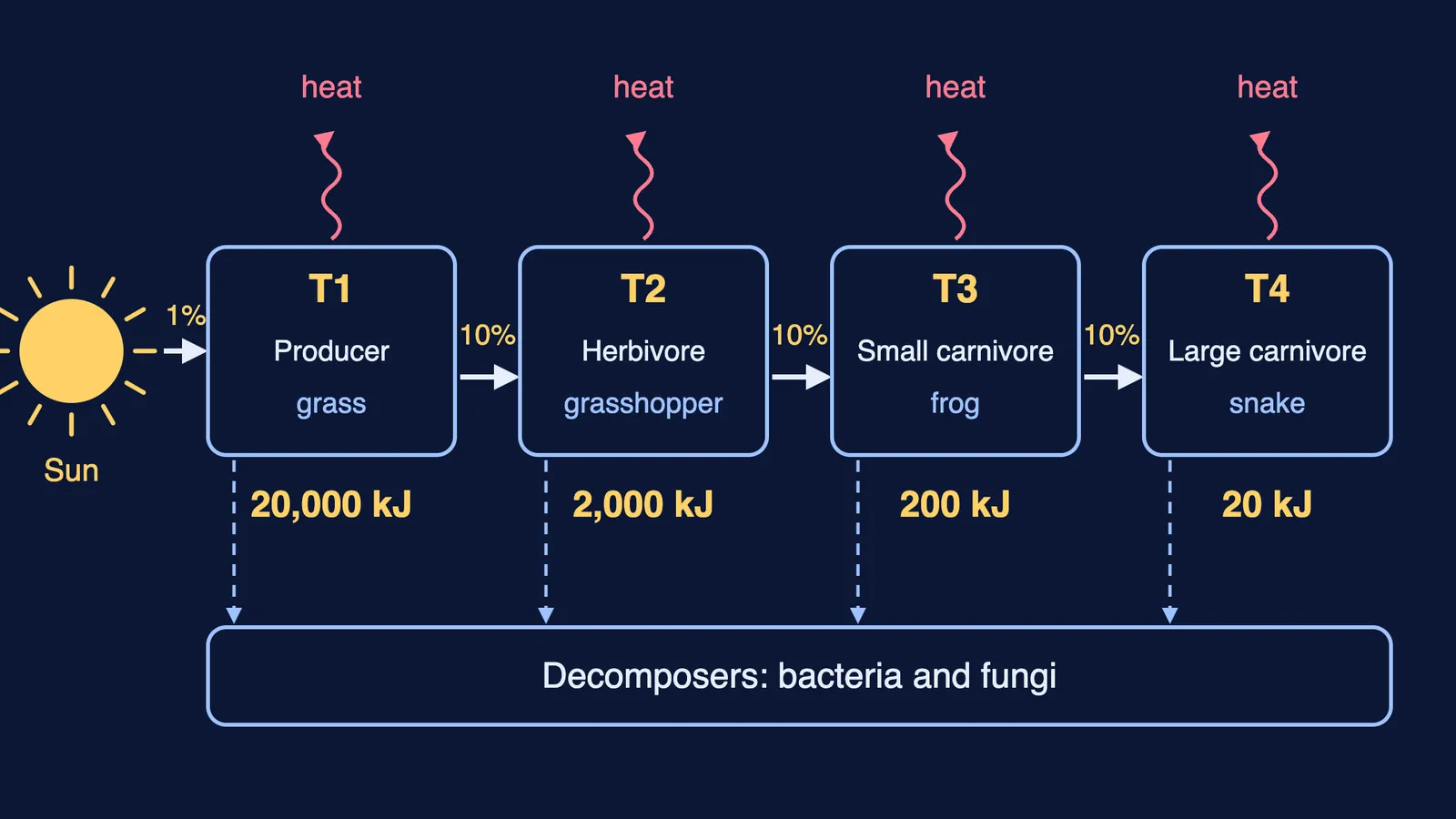
Food chain: a series of organisms in which each one eats the one before it. Example: grass → grasshopper → frog → snake.
Trophic level: each step of a food chain. Producers are always the first trophic level.
Primary consumers: herbivores, at the second trophic level.
Secondary consumers: small carnivores, at the third trophic level.
Tertiary consumers: larger carnivores, at the fourth trophic level.
Food web: many food chains joined together, because most organisms are eaten by two or more kinds of organisms. Don't confuse with: a food chain, which is one straight line.
How does energy flow through an ecosystem?
Unidirectional energy flow: energy moves one way only, from the Sun to producers, consumers and decomposers; it never returns from herbivores to plants or from plants to the Sun.
Energy capture by plants: NCERT says green plants in a land ecosystem capture about 1% of the sunlight falling on their leaves.
10 per cent transfer: on average about 10% of the food eaten becomes the eater's body and is available to the next level, per NCERT. The rest is used up, much of it lost as heat and some in digestion and daily work.
Worked example: if the grass in a field stores 20,000 kJ, the grasshoppers get about 2,000 kJ, the frogs 200 kJ and the snakes only 20 kJ. This loss is why food chains usually stop at three or four steps.
Pesticides: chemicals sprayed to protect crops from pests and diseases. They wash into soil and water and enter plants and aquatic organisms.
Biological magnification: the build-up of non-degradable chemicals at each higher trophic level, so organisms at the top, including humans, carry the highest concentration. Example: pesticide residues in grain, vegetables, fruit and meat. Our biological magnification explainer goes deeper.
What is the ozone layer and why is it thinning?
Ozone (O₃): a molecule of three oxygen atoms. Near the ground it is poisonous to breathe. Don't confuse with: oxygen (O₂), which aerobic life needs.
Ozone layer: ozone high in the atmosphere that shields the Earth's surface from the Sun's ultraviolet rays.
Ultraviolet (UV) radiation: high-energy radiation from the Sun that damages living things; NCERT notes it can cause skin cancer in humans.
Ozone formation: UV splits O₂ into two free oxygen atoms (O₂ → O + O), and each atom joins another O₂ to make ozone (O + O₂ → O₃).
Chlorofluorocarbons (CFCs): human-made chemicals used as refrigerants and in fire extinguishers, linked to the sharp drop in ozone from the 1980s.
Ozone depletion: the thinning of the ozone layer, letting more UV reach the ground.
UNEP agreement (1987): in 1987 the United Nations Environment Programme got countries to agree to freeze CFC production at 1986 levels, per NCERT. Companies everywhere must now make CFC-free refrigerators.
How do we manage the waste we make?
Biodegradable substances: materials broken down by biological processes such as bacteria and fungi. Example: fruit peels, cake, grass, wood.
Non-biodegradable substances: materials that biological processes cannot break down, so they stay in the environment for a long time and may harm living things. Example: plastics. Don't confuse with: biodegradable.
Enzyme specificity: each enzyme breaks down only particular substances, which is why microbes cannot digest most plastics.
Saprophytes: organisms that feed on dead and decaying matter. Example: many fungi.
The textbook's "Think it over" box on disposable cups is useful reading, but the syllabus says "the information in these boxes would not be assessed in the year-end examination" (CBSE 2026-27). Water and air pollution from Class IX is only recalled here, not taught again.
How to learn these terms
Learn in pairs: biotic vs abiotic, producer vs consumer, food chain vs food web, ozone vs oxygen, biodegradable vs non-biodegradable.
Draw one food chain with T1 to T4 labels and write the 10% numbers under each level.
Write the two ozone equations from memory, then say what each step does.
Sort your own day's waste into biodegradable and non-biodegradable piles.
If a term stays fuzzy, the Fermi Concept Library covers every concept in biology, so you can read it in context.