On this page
This chapter's terms come in tight pairs: two hand rules, three wires, two kinds of fault. Every definition below is in our own words and checked against NCERT Class 10 Science Chapter 12 (Reprint 2026-27). The CBSE Class 10 Science syllabus for 2026-27 lists the motor, electromagnetic induction and the electric generator as "assessed only formatively", so they are left out.
For the full chapter walk-through, see our Class 10 guide to magnetic effects of electric current.
What are magnetic field and field lines?
Compass needle: a small bar magnet free to turn, so it lines up with the field around it.
North and south poles: the end of a freely turning magnet that points roughly north is its north pole; the other is its south pole. Like poles repel, unlike poles attract.
Magnetic field: the space around a magnet where another magnet or a compass feels its pull or push. It has both a size and a direction. Example: iron filings form a pattern around a bar magnet.
Magnetic field lines: lines we draw to show a field's shape and direction. A tiny north pole, if it were free, would move along one. Example: trace one by moving a compass step by step from N to S.
Direction of the field: the way a compass's north pole points at that spot. Field lines run N to S outside a magnet and S to N inside, so they are closed curves.
Field strength: shown by how crowded the lines are; strongest near the poles.
Field lines never cross: at a crossing, a compass would have to point two ways at once.
What field does a current produce?
Magnetic effect of current: a current-carrying wire produces a magnetic field. Oersted noticed this in 1820 when a compass near such a wire was deflected.
Field around a straight wire: circles that all have the wire at their centre (concentric circles). It is stronger for more current, weaker farther away, and reverses when the current reverses.
Right-hand thumb rule: hold the wire in your right hand, thumb along the current; your fingers curl the way the field lines go. Also called Maxwell's corkscrew rule. Example: for current flowing east to west in a power line, the field circles clockwise seen from the east end.
Circular loop: near the wire the lines are small circles; at the centre they are nearly straight, and every part of the loop adds to the field in the same direction.
Coil of n turns: gives n times the field of one turn, since the current circulates the same way in each.
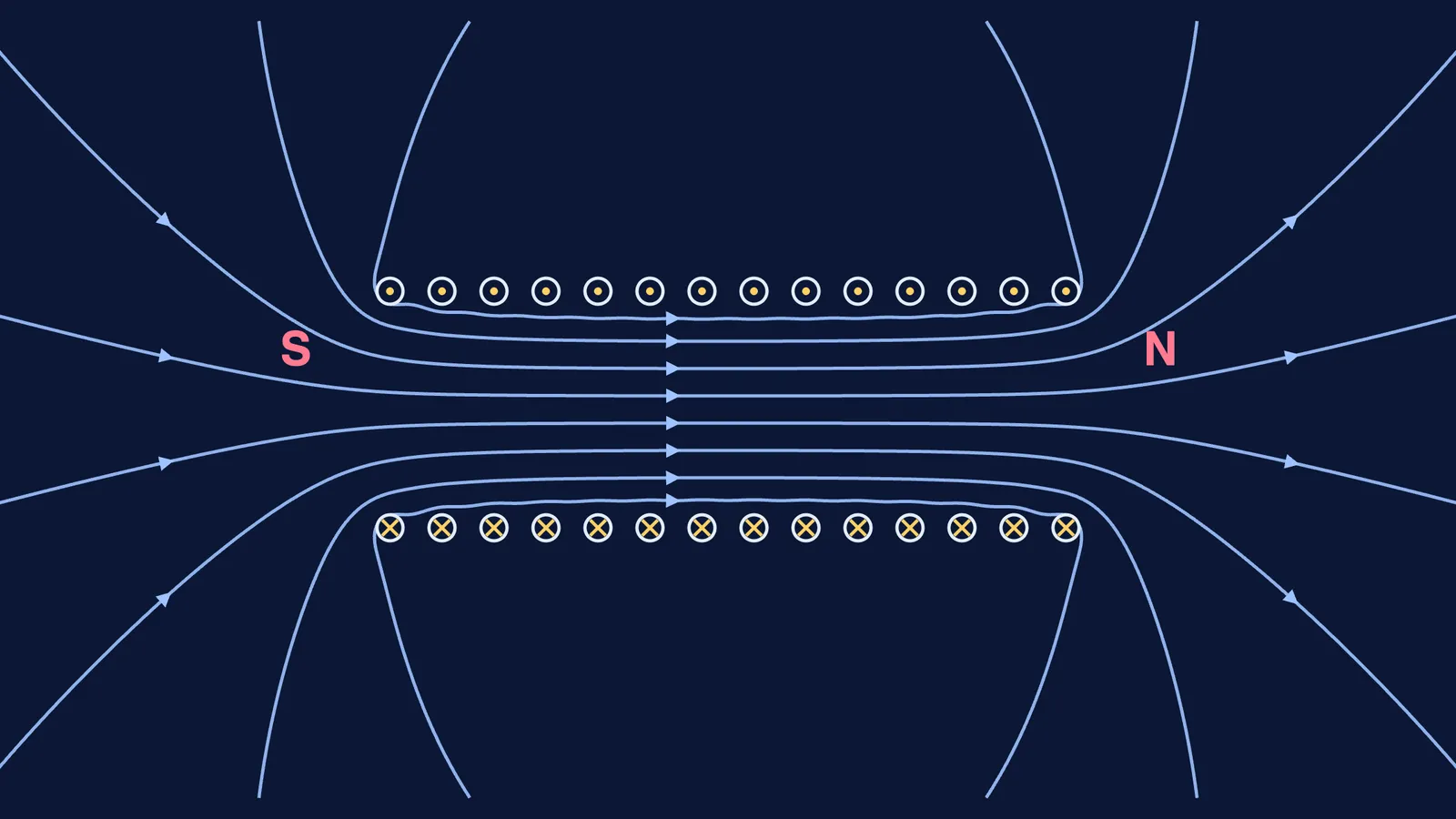
Solenoid: insulated copper wire wound tightly into many turns, like a long spring. Its field looks like a bar magnet's, with N at one end and S at the other.
Uniform magnetic field: the same at every point, drawn as parallel, evenly spaced lines. Example: the field inside a long solenoid.
Electromagnet: soft iron magnetised by the field inside a current-carrying solenoid. Don't confuse with: a permanent magnet, which needs no current.
What force acts on a current in a magnetic field?
Force on a current-carrying conductor: a current in a magnetic field is pushed sideways. Example: an aluminium rod hung between a horseshoe magnet's poles moves when current flows. Ampère suggested the magnet and conductor push on each other with equal and opposite forces.
Direction and size of the force: reverse the current or the field and the force reverses. The force is largest when current and field are at right angles.
Fleming's left-hand rule: hold thumb, forefinger and middle finger of your left hand at right angles. Forefinger along the field, middle finger along the current: the thumb gives the force.
Conventional current: taken opposite to the motion of electrons. Example: for electrons moving right, point your middle finger left.
What are the key terms in domestic electric circuits?
Mains: the main supply bringing power into a home. NCERT gives India's supply as 220 V AC at 50 Hz (NCERT Chapter 12).
Alternating current (AC): current that keeps reversing direction; its frequency is the number of full cycles per second. Don't confuse with: direct current (DC), which flows one way only, as from a cell. See our explainer on AC, DC and India's 50 Hz supply.
Live wire: the supply wire, red in NCERT's colour scheme.
Neutral wire: the return wire, black. Live and neutral differ by 220 V.
Earth wire: a green wire joined to a metal plate buried deep in the ground. If current leaks to an appliance's metal body, it flows away to the ground through this easy path, so the body stays safe to touch and the user avoids a severe shock. Example: an iron or a refrigerator.
Current rating: the largest current a circuit is meant to carry. Example: NCERT describes a 15 A circuit for geysers and a 5 A circuit for bulbs and fans.
Parallel connection: each appliance sits across live and neutral, so each gets the same potential difference and its own switch.
Electric fuse: a thin wire that heats up and melts when the current gets too high (Joule heating), breaking the circuit.
Short-circuiting: live and neutral touch directly, often through damaged insulation, and the current jumps sharply.
Overloading: too much current, from a short circuit, a sudden voltage rise or too many appliances on one socket. Don't confuse with: short-circuiting, which is one cause of overloading.
To revise current, voltage and resistance, see our Class 10 guide to electricity.
How to learn these terms
Draw from memory the field lines of a bar magnet, the circles round a straight wire and a solenoid with N and S marked. Most terms above sit on these three pictures.
Act out both hand rules with a pen as the wire, saying what each finger means.
Learn the pairs together: the two hand rules, solenoid and bar magnet, live and neutral, short-circuiting and overloading, AC and DC.
Explain the earth wire and fuse to someone at home using a real appliance.
If one idea keeps slipping, the Fermi Concept Library gives every concept in physics its own lesson and its place in the map.