On this page
Aldehydes, Ketones and Carboxylic Acids is Unit 8 of the NCERT Class 12 Chemistry textbook, Part II (reprint 2026-27). In the CBSE Chemistry syllabus for 2026-27, the unit carries 8 of the 70 theory marks and runs from naming and structure to preparation, reactions and uses. The terms below follow that order. For answer-writing, see our Aldehydes, ketones and carboxylic acids Class 12 board exam guide.
What is a carbonyl group, and how do the three families differ?
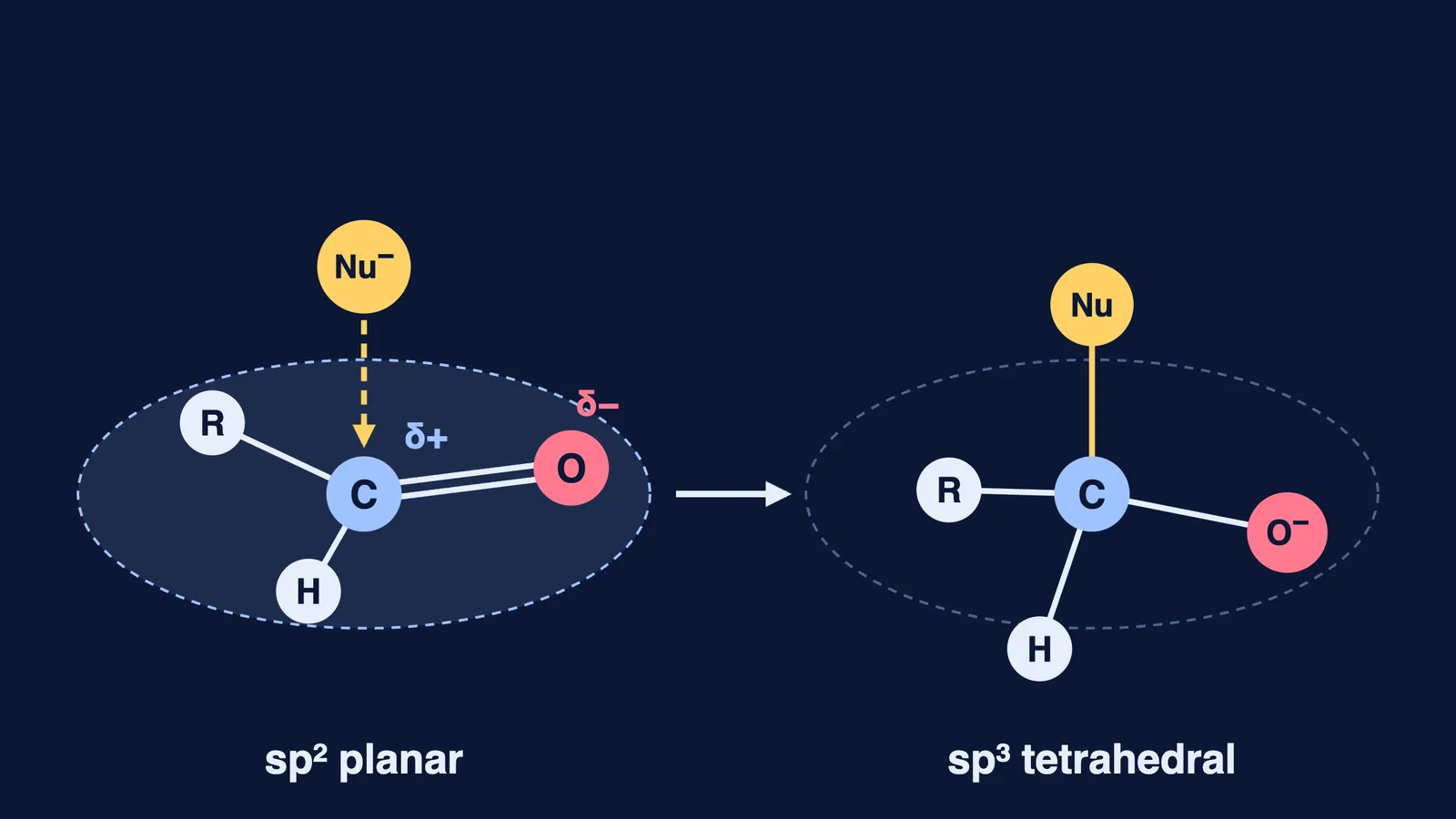
Carbonyl group: a carbon double-bonded to an oxygen, >C=O. The sp2 carbon and its three neighbours lie in one plane, about 120° apart (NCERT Figure 8.1).
Polar C=O bond: oxygen is more electronegative, so the carbonyl carbon is an electrophile (Lewis acid) and the oxygen a nucleophilic centre (Lewis base).
Aldehyde: the carbonyl carbon carries a hydrogen and a carbon group (methanal has two hydrogens). Example: ethanal, CH3CHO.
Ketone: the carbonyl carbon is bonded to two carbon groups. Example: propanone (acetone). Don't confuse with: propanal, an aldehyde with the same formula, C3H6O.
Carboxylic acid: a compound with the carboxyl group, –COOH, a carbonyl joined to an –OH. Example: ethanoic acid.
α-carbon: the carbon right next to the carbonyl carbon; its hydrogens are α-hydrogens.
IUPAC endings: -al for aldehydes, -one for ketones, -oic acid for acids.
Which named reactions make aldehydes and ketones?
Rosenmund reduction: an acyl chloride plus H2 over a Pd–BaSO4 catalyst gives an aldehyde.
Stephen reaction: SnCl2 and HCl reduce a nitrile to an imine, which hydrolyses to an aldehyde. Don't confuse with: DIBAL-H, which reduces nitriles and esters to aldehydes.
Etard reaction: chromyl chloride (CrO2Cl2) turns toluene's methyl group into a chromium complex that hydrolyses to benzaldehyde, stopping short of benzoic acid. See our Etard reaction explainer.
Gatterman-Koch reaction: benzene, carbon monoxide and HCl with anhydrous AlCl3 or CuCl give benzaldehyde.
Friedel-Crafts acylation: benzene and an acyl chloride with anhydrous AlCl3 give an aromatic ketone.
What happens when a nucleophile adds to C=O?
Nucleophilic addition: a nucleophile attacks the carbonyl carbon roughly perpendicular to its plane; the carbon goes from sp2 to sp3, forming a tetrahedral alkoxide that takes a proton. Don't confuse with: electrophilic addition, typical of alkenes.
Reactivity of aldehydes vs ketones: aldehydes add faster: a ketone's two groups crowd the carbon and reduce its positive character more. Example: benzaldehyde is less reactive than propanal, as ring resonance lowers the carbonyl's polarity.
Cyanohydrin: the product of HCN addition; base helps by supplying CN⁻, the stronger nucleophile.
Bisulphite addition compound: a water-soluble adduct with sodium hydrogensulphite; dilute acid or alkali releases the carbonyl compound, so it purifies aldehydes.
Hemiacetal and acetal: an aldehyde and one alcohol (dry HCl) give a hemiacetal; a second alcohol gives an acetal, a gem-dialkoxy compound. Ketones with ethylene glycol give a cyclic ketal instead.
Imine and Schiff's base: >C=N– products from ammonia and from an amine; the amine product (substituted imine) is the Schiff's base.
Oxime, hydrazone, semicarbazone: products from hydroxylamine, hydrazine and semicarbazide.
2,4-DNP derivative: the 2,4-dinitrophenylhydrazone; its coloured (yellow to red) solid confirms an aldehyde or ketone.
How do you tell aldehydes and ketones apart?
Tollens' test: an aldehyde reduces freshly made ammoniacal silver nitrate to silver metal, which coats the tube as a mirror.
Fehling's test: solution A (copper sulphate) and solution B (alkaline Rochelle salt), heated with an aliphatic aldehyde, give a reddish-brown precipitate. Aromatic aldehydes fail it.
Haloform reaction: sodium hypohalite turns a methyl ketone (or aldehyde with CH3 on the carbonyl) into a haloform and the salt of an acid one carbon shorter.
Iodoform test: the hypoiodite version; a yellow precipitate detects CH3CO–, or CH3CH(OH)–, which oxidises to it.
Clemmensen reduction: zinc amalgam and concentrated HCl reduce C=O to CH2. Don't confuse with: Wolff-Kishner reduction, which does the same with hydrazine, then KOH or NaOH heated in ethylene glycol.
What does the α-hydrogen do?
Acidic α-hydrogen: the carbonyl group withdraws electrons and the conjugate base is resonance stabilised, so α-hydrogens are acidic.
Aldol reaction: two molecules with α-hydrogens join under dilute alkali to give a β-hydroxy aldehyde (aldol) or β-hydroxy ketone (ketol). Losing water then gives an α,β-unsaturated carbonyl compound (aldol condensation).
Cross aldol condensation: aldol between two different carbonyl compounds; ethanal and propanal give four products.
Cannizzaro reaction: an aldehyde with no α-hydrogen, heated with concentrated alkali, disproportionates into an alcohol and a carboxylate salt.
Why are carboxylic acids acidic, and how do they react?
Carboxylate ion: the conjugate base, RCOO⁻, its charge shared equally by two oxygens through two equivalent resonance structures. Don't confuse with: phenoxide, whose charge spreads onto ring carbons, so phenols are weaker acids.
pKa: –log Ka; a smaller pKa means a stronger acid. Example: NCERT gives 4.76 for acetic acid and 4.19 for benzoic acid.
Electron-withdrawing group (EWG): stabilises the carboxylate and strengthens the acid; an electron-donating group weakens it. Example: 4-nitrobenzoic acid (pKa 3.41) vs 4-methoxybenzoic acid (pKa 4.46).
Esterification: an acid and an alcohol or phenol give an ester, catalysed by concentrated H2SO4 or HCl gas.
Thionyl chloride: SOCl2 turns –COOH into –COCl; preferred over PCl5 because the by-products are gases.
Decarboxylation: heating a sodium carboxylate with sodalime (NaOH and CaO) removes CO2, giving a hydrocarbon. Don't confuse with: Kolbe electrolysis, which electrolyses the salt solution to a hydrocarbon with twice the alkyl carbons.
Hell-Volhard-Zelinsky (HVZ) reaction: chlorine or bromine with a little red phosphorus replaces an α-hydrogen of an acid to give an α-halo acid.
Reducing –COOH: LiAlH4, or better diborane, gives a primary alcohol. Don't confuse with: NaBH4, which does not reduce the carboxyl group.
How to learn these terms
Sort reagents by where they stop: Rosenmund, Stephen and Etard stop at the aldehyde; KMnO4 goes on to the acid.
Learn the H2N–Z products as one grid: reagent to product name.
Drill the pairs: Clemmensen (acid) vs Wolff-Kishner (base), Tollens' vs Fehling's, aldol vs Cannizzaro, decarboxylation vs Kolbe.
Redraw the diagram above from memory: flat sp2 carbon, attack from above, tetrahedral alkoxide.
Apply the terms in our aldehydes, ketones and acids case study questions.
If a reaction feels abstract, the Fermi Concept Library covers every concept in chemistry, each with its own lesson and its place in the map.