On this page
Amines is Unit 9 of the CBSE Class 12 Chemistry syllabus for 2026-27. Most of it turns on a few words: lone pair, pKb, diazotisation. Here are the key terms from the current NCERT chapter on amines, grouped by topic. For a revision plan, see our Amines Class 12 board exam guide.
What is an amine, and how are amines classified?
Amine: ammonia with one, two or all three hydrogens swapped for alkyl or aryl groups. Example: CH3NH2, methylamine.
Pyramidal shape: nitrogen is sp3 hybridised, with three bonds and a lone pair, so the molecule is pyramidal. The NCERT chapter gives the C–N–C angle in trimethylamine as 108°, under 109.5° because of the lone pair.
Primary, secondary, tertiary (1°, 2°, 3°): how many hydrogens of ammonia are replaced: one (RNH2), two (R2NH) or three (R3N). Don't confuse with: 1°, 2°, 3° alcohols, which count carbons on the carbon holding –OH. (CH3)3CNH2 is a primary amine.
Simple and mixed amines: simple when all groups on nitrogen are the same, mixed when they differ. Example: CH3NHC2H5 is mixed.
Quaternary ammonium salt: nitrogen carrying four carbon groups and a positive charge, with an anion (R4N+ X−). Ammonolysis ends here.
Alkanamine: IUPAC name of an aliphatic primary amine, replacing the final "e" of the alkane with "amine". Example: CH3CH2NH2 is ethanamine.
N locant: an "N" in a name means that group sits on nitrogen. Example: CH3NHCH2CH3 is N-methylethanamine.
Arylamine: –NH2 bonded straight to a benzene ring. Example: aniline (benzenamine). Don't confuse with: benzylamine, C6H5CH2NH2, where a CH2 sits between ring and nitrogen, so it behaves like an alkylamine.
How are amines prepared?
Reduction of nitro compounds: –NO2 to –NH2 with hydrogen over Ni, Pd or Pt, or a metal and acid.
Ammonolysis: breaking a C–X bond with ammonia, so an alkyl halide becomes an amine. The amine keeps reacting, giving a mixture up to the quaternary salt; excess ammonia favours the primary amine.
Reduction of nitriles: R–C≡N reduced by LiAlH4 or catalytic hydrogenation to R–CH2NH2, used to climb the amine series by one carbon.
Gabriel phthalimide synthesis: potassium phthalimide heated with an alkyl halide, then alkaline hydrolysis, gives a primary amine only. It cannot make aniline, as aryl halides do not substitute with the phthalimide anion.
Hoffmann bromamide degradation: an amide with bromine and NaOH gives a primary amine with one carbon fewer, as the alkyl or aryl group moves from carbonyl carbon to nitrogen. Example: benzamide gives aniline. Don't confuse with: nitrile reduction, which keeps every carbon.
Why are amines basic, and why is aniline weaker?
Lewis base: an electron-pair donor. The lone pair lets amines take a proton from acids and form salts.
Kb and pKb: Kb measures how far an amine pulls a proton from water; pKb = −log Kb, so smaller pKb means stronger base. Table 9.3 of the NCERT chapter lists pKb 3.38 for methanamine and 9.38 for benzenamine, against 4.75 for ammonia.
+I effect: alkyl groups pushing electron density toward nitrogen, making the lone pair more available. It gives the gas-phase order 3° > 2° > 1° > NH3.
Solvation effect: water stabilising the ammonium cation by hydrogen bonding; more N–H bonds, better solvation.
Steric hindrance: bulky groups crowding nitrogen and blocking hydrogen bonding. With the other two effects it gives (C2H5)2NH > (C2H5)3N > C2H5NH2 > NH3 in water. We work through the methyl case in why secondary amines win in water.
Resonance in aniline: the lone pair spreads into the ring, giving five resonating structures; the anilinium ion has only two. So aniline is a weaker base than ammonia. Don't confuse with: the +I effect, which raises basicity.
Which properties, reactions and tests define amines?
Intermolecular hydrogen bonding: N–H of one amine bonding to the nitrogen of another. Primary amines have two N–H, tertiary none, so isomers boil 1° > 2° > 3°. Table 9.2 of the NCERT chapter puts butan-1-amine at 350.8 K and butan-1-ol at 390.3 K.
Acylation: swapping an N–H hydrogen of a 1° or 2° amine for an acyl group using an acid chloride, anhydride or ester, giving an amide. With benzoyl chloride it is benzoylation.
Carbylamine reaction (isocyanide test): a primary amine heated with chloroform and ethanolic KOH gives a foul-smelling isocyanide; 2° and 3° amines do not.
Hinsberg's reagent: benzenesulphonyl chloride. A 1° amine gives a sulphonamide that dissolves in alkali, a 2° amine one that does not, a 3° amine no reaction.
Protection by acetylation: turning –NH2 into –NHCOCH3 with acetic anhydride to weaken its strong activating effect, then hydrolysing back.
Anilinium ion: C6H5NH3+, aniline protonated in strong acid. It is meta directing, so direct nitration gives a significant amount of m-nitroaniline. Don't confuse with: –NH2, which is ortho/para directing and strongly activating.
What are diazonium salts used for?
Diazonium salt: ArN2+ X−, where –N2+ is the diazonium group. Example: benzenediazonium chloride. Aromatic ones survive briefly in cold solution thanks to resonance; aliphatic ones break down at once.
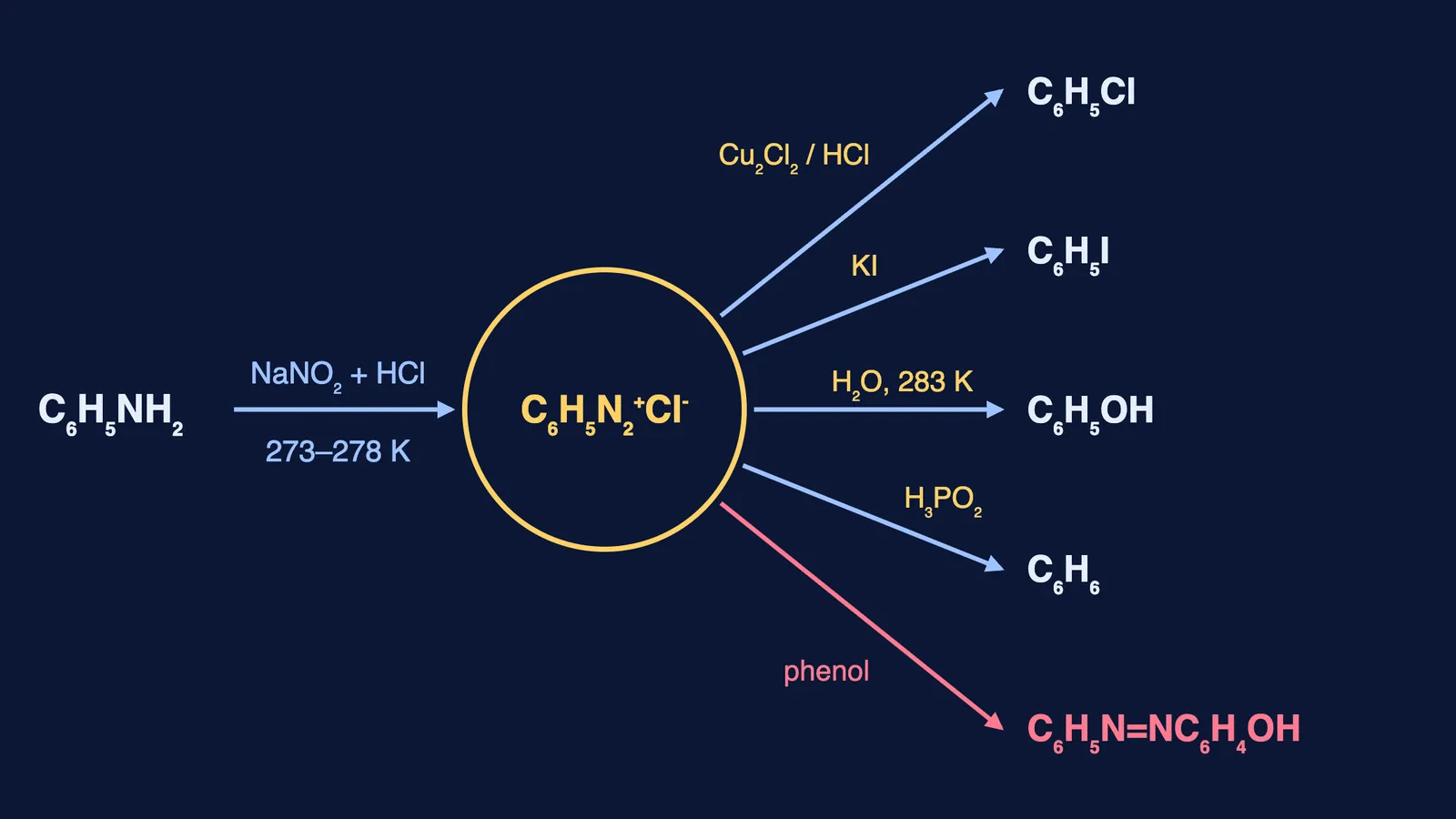
Diazotisation: turning a primary aromatic amine into its diazonium salt with NaNO2 and HCl at 273–278 K, per the NCERT chapter.
Sandmeyer reaction: replacing the diazonium group with Cl, Br or CN using a copper(I) salt. Don't confuse with: the Gattermann reaction, copper powder plus halogen acid, with a lower yield.
Other replacements: KI gives iodobenzene; fluoroboric acid then heat gives fluorobenzene; hypophosphorous acid gives benzene; warming to 283 K gives phenol.
Coupling reaction: the diazonium ion attacks the para position of phenol or aniline, keeping the –N=N– link; with phenol it gives p-hydroxyazobenzene. It is electrophilic substitution.
Azo dye: a coloured compound with two aromatic rings joined by –N=N–.
How to learn these terms
Learn look-alikes in pairs: aniline and benzylamine, Sandmeyer and Gattermann.
Keep a carbon-count card: Hoffmann loses one carbon, nitrile reduction keeps them all.
Draw the diazonium wheel from memory: the salt in the middle, each spoke a reagent and product.
Tie each basicity term to an order: +I to the gas phase, solvation and sterics to water, resonance to aniline at the bottom.
Use the terms in context with our Amines case study questions for Class 12. If an idea such as solvation feels shaky, the Fermi Concept Library has its own lesson for every concept in chemistry.