On this page
Chemical kinetics is Unit 3 of the CBSE Class 12 Chemistry syllabus for 2026-27, covering reaction rate, the factors that change it, integrated rate equations, temperature dependence and collision theory. The terms below follow the NCERT Class 12 Chemistry chapter on chemical kinetics (reprint 2026-27), rewritten in plain words. For solved board answers and a revision plan, read our chemical kinetics Class 12 board exam guide.
What is the rate of a reaction?
Chemical kinetics: the study of how fast reactions go, what changes their speed, and the steps they follow.
Rate of a reaction: how much the concentration of a reactant falls, or of a product rises, per unit time, usually in mol L⁻¹ s⁻¹. Example: precipitation of silver chloride is very fast; rusting of iron is very slow.
Average rate: the change in concentration divided by a finite time interval. Don't confuse with: instantaneous rate.
Instantaneous rate: the rate at one moment, found from the slope of the tangent to the concentration-time curve at that time.
Factors influencing rate: concentration (pressure for gases), temperature and a catalyst.
What is the difference between order and molecularity?
Rate law (rate expression): an equation giving the rate in terms of reactant concentrations, each raised to some power, such as Rate = k[A]ˣ[B]ʸ. It is found by experiment, not from the balanced equation.
Differential rate equation: the rate law written with the derivative, −d[R]/dt = k[R]ˣ.
Rate constant (k): the proportionality constant in the rate law; it is fixed for a reaction at a given temperature, and its unit depends on the order. Example: s⁻¹ for first order, mol L⁻¹ s⁻¹ for zero order.
Order with respect to a reactant: the power of that reactant's concentration in the rate law.
Overall order: the sum of those powers; it can be 0, 1, 2, 3 or a fraction, according to NCERT. Example: Rate = k[A]^(1/2)[B]^(3/2) is second order overall.
Elementary reaction: a reaction that happens in a single step.
Complex reaction: a reaction that happens through a sequence of elementary steps; that sequence is the mechanism.
Molecularity: how many atoms, ions or molecules must meet in one simultaneous collision in an elementary step; it is 1, 2 or 3, never zero or a fraction. Example: 2HI → H₂ + I₂ is bimolecular. Don't confuse with: order, which is measured by experiment and applies to complex reactions too.
Rate-determining step: the slowest step of a mechanism, which sets the overall rate, like the slowest runner in a relay team.
Intermediate: a species made in one step and used up in a later one, so it is absent from the overall equation. Example: IO⁻ in the iodide-catalysed decomposition of H₂O₂.
Integrated rate equations and half-life
Integrated rate equation: the rate law integrated so it links concentration directly to time.
Zero order reaction: the rate does not depend on reactant concentration. Example: decomposition of ammonia on a hot platinum surface at high pressure, where the surface is saturated.
First order reaction: the rate is proportional to the first power of one reactant's concentration.
Half-life (t½): the time for a reactant's concentration to fall to half its starting value. For first order it is 0.693/k and independent of the starting concentration; for zero order it is [R]₀/2k, per the NCERT chapter.
Pseudo first order reaction: a higher order reaction that behaves as first order because one reactant is in large excess. Example: acid hydrolysis of ethyl acetate in excess water; inversion of cane sugar.
Worked numbers for each of these are in our chemical kinetics Class 12 formulas post.
How does temperature change the rate of a reaction?
The NCERT chapter gives a rule of thumb: a 10° rise in temperature nearly doubles the rate constant.
Arrhenius equation: k = A e^(−Ea/RT), which links the rate constant to temperature; a plot of ln k against 1/T is a straight line with slope −Ea/R.
Arrhenius factor (A): the constant in front, also called the frequency factor or pre-exponential factor, specific to each reaction.
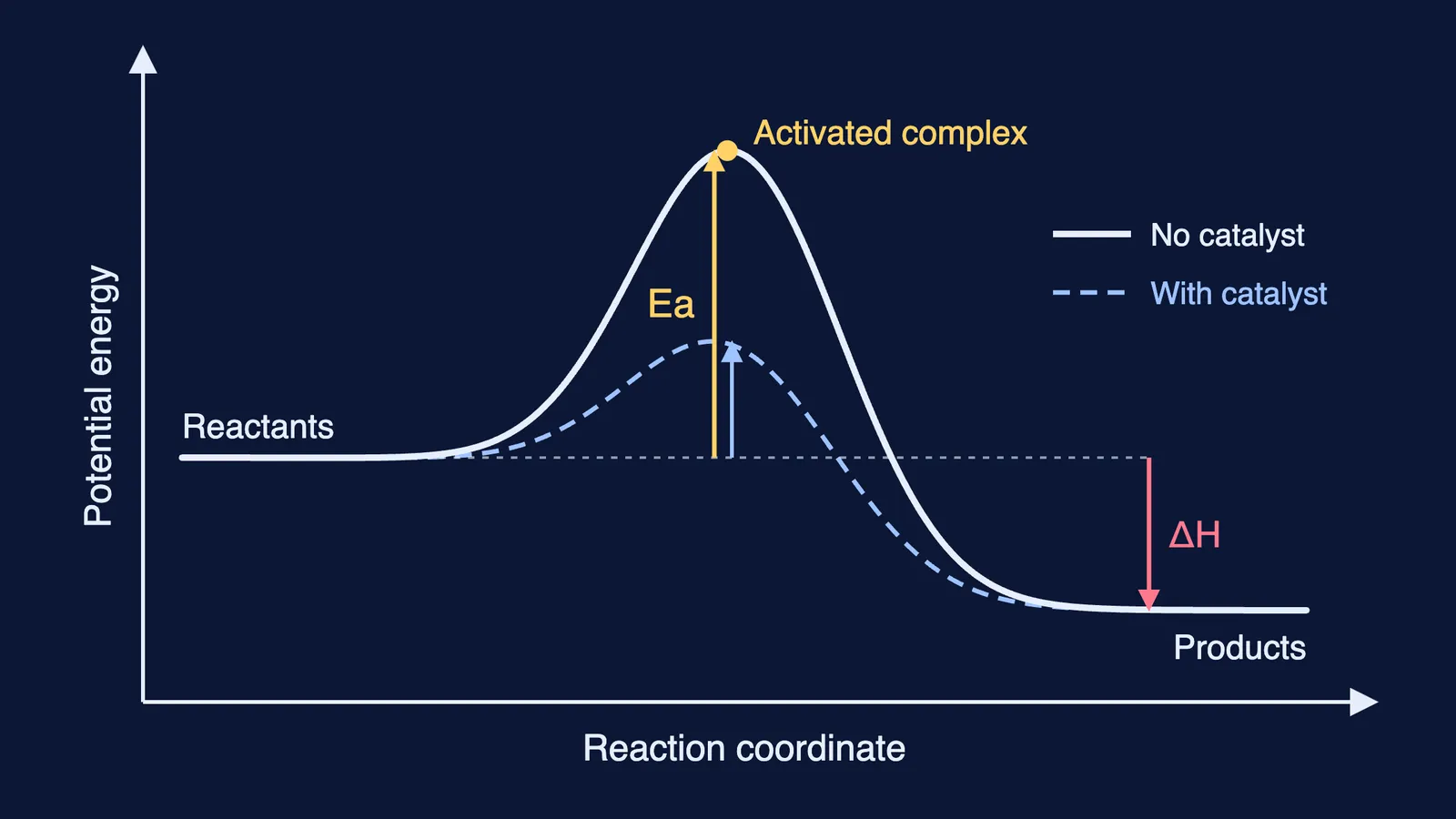
Activation energy (Ea): the energy needed to form the activated complex from the reactants. Lower Ea means a faster reaction.
Activated complex: the short-lived, high-energy arrangement at the top of the energy barrier. Example: H₂ and I₂ forming it before splitting into two HI. Don't confuse with: a reaction intermediate such as IO⁻, formed in one step and used up later.
Reaction coordinate: the horizontal axis of an energy profile, from reactants to products.
Maxwell-Boltzmann distribution: the curve of the fraction of molecules against kinetic energy. Heating moves its peak to higher energy and widens it, so more molecules have energy above Ea.
Catalyst: a substance that speeds up a reaction without being permanently changed, by giving a path with lower Ea. It does not change ΔG or the equilibrium constant. Example: MnO₂ in the decomposition of KClO₃.
Inhibitor: a substance that slows a reaction. Don't confuse with: catalyst, a word used only for speeding up.
What does collision theory say?
Collision theory was developed by Max Trautz and William Lewis in 1916-18, as the NCERT chapter records.
Collision frequency (Z_AB): how often reactant molecules collide, counted per second in each unit volume.
Threshold energy: the minimum energy colliding molecules need to react; it equals activation energy plus the energy the molecules already have.
Effective collision: a collision with enough energy and the right orientation to break and form bonds.
Steric (probability) factor (P): the factor added to the rate expression to allow for the need for proper orientation.
How to learn these terms
Learn them in pairs: average and instantaneous rate, order and molecularity, intermediate and activated complex, catalyst and inhibitor.
Draw one energy profile and label reactants, products, activated complex, Ea and ΔH, then add a lower dashed curve for a catalyst.
Write a rate law with units beside k for zero, first and second order, and say each order aloud.
Test yourself with the chemical kinetics case study questions for Class 12.
If a term still feels abstract, the Fermi Concept Library gives every concept in chemistry its own lesson and its place in the map.