On this page
These are the formulas of Unit 3, Chemical Kinetics, in the rationalised NCERT Class 12 Chemistry Part I textbook (Reprint 2026-27), grouped as the chapter builds them, each with one worked example. The CBSE 2026-27 Chemistry curriculum lists Chemical Kinetics as Unit 3 with 7 of the 70 theory marks in Class XII.
NCERT derives integrated equations only for zero and first order, so second order integrated forms are left out. Concentrations are in mol L⁻¹, time in s, R = 8.314 J K⁻¹ mol⁻¹ (as NCERT uses) and log means log₁₀.
How is the rate of a reaction written?
Symbols: [R] and [P] are molar concentrations of a reactant and a product (mol L⁻¹); t is time (s). Assumes constant volume.
Average rate: r_av = −Δ[R]/Δt = +Δ[P]/Δt (mol L⁻¹ s⁻¹)
Instantaneous rate: r_inst = −d[R]/dt = +d[P]/dt (mol L⁻¹ s⁻¹), the tangent's slope
For aA + bB → cC + dD: Rate = −(1/a) Δ[A]/Δt = −(1/b) Δ[B]/Δt = +(1/c) Δ[C]/Δt = +(1/d) Δ[D]/Δt (mol L⁻¹ s⁻¹)
Gases followed by partial pressure: rate in atm s⁻¹
Worked example: in 4NH₃ + 5O₂ → 4NO + 6H₂O, [O₂] falls by 0.015 mol L⁻¹ in 10 s. Rate of reaction = (1/5)(0.015 mol L⁻¹ / 10 s) = 3.0 × 10⁻⁴ mol L⁻¹ s⁻¹. NO forms at 4 × 3.0 × 10⁻⁴ = 1.2 × 10⁻³ mol L⁻¹ s⁻¹.
Watch for: divide by the coefficient to get the rate of reaction, multiply to get one species' rate.
How do you find the order and the units of k?
Symbols: k is the rate constant; x and y are orders found by experiment, not from the balanced equation.
Rate law: Rate = k[A]ˣ[B]ʸ (mol L⁻¹ s⁻¹)
Overall order: n = x + y (no unit; zero, whole or fractional)
Units of k: (mol L⁻¹)^(1−n) s⁻¹, so zero order mol L⁻¹ s⁻¹, first order s⁻¹, second order L mol⁻¹ s⁻¹
Pseudo first order: with water in large excess (ethyl acetate hydrolysis, cane sugar inversion), Rate = k′[ester] (mol L⁻¹ s⁻¹), where k′ = k[H₂O] in s⁻¹ (k in L mol⁻¹ s⁻¹)
Molecularity (species colliding in one elementary step) is 1, 2 or 3, never zero or a fraction.
Worked example: initial rates for A + B → products are 2.4 × 10⁻³ mol L⁻¹ s⁻¹ at [A] = 0.20, [B] = 0.10; 9.6 × 10⁻³ at [A] = 0.40, [B] = 0.10; and 2.4 × 10⁻³ at [A] = 0.20, [B] = 0.20 mol L⁻¹. Doubling [A] multiplies the rate by 4, so x = 2; doubling [B] changes nothing, so y = 0. Rate = k[A]², and k = 2.4 × 10⁻³ / (0.20)² = 0.060 L mol⁻¹ s⁻¹.
Watch for: the unit of k gives the order; L mol⁻¹ s⁻¹ means second order.
What are the integrated rate equations for zero and first order?
Symbols: [R]₀ initial and [R] current concentration; t₁/₂ half-life; pᵢ initial and p_t total pressure.
Zero order (Rate = k; special conditions, such as NH₃ on hot platinum at high pressure):
[R] = [R]₀ − kt; k = ([R]₀ − [R])/t (k in mol L⁻¹ s⁻¹)
Straight line: [R] (mol L⁻¹) against t (s), slope −k, intercept [R]₀
t₁/₂ = [R]₀ / 2k (s), proportional to [R]₀
First order (Rate = k[R]):
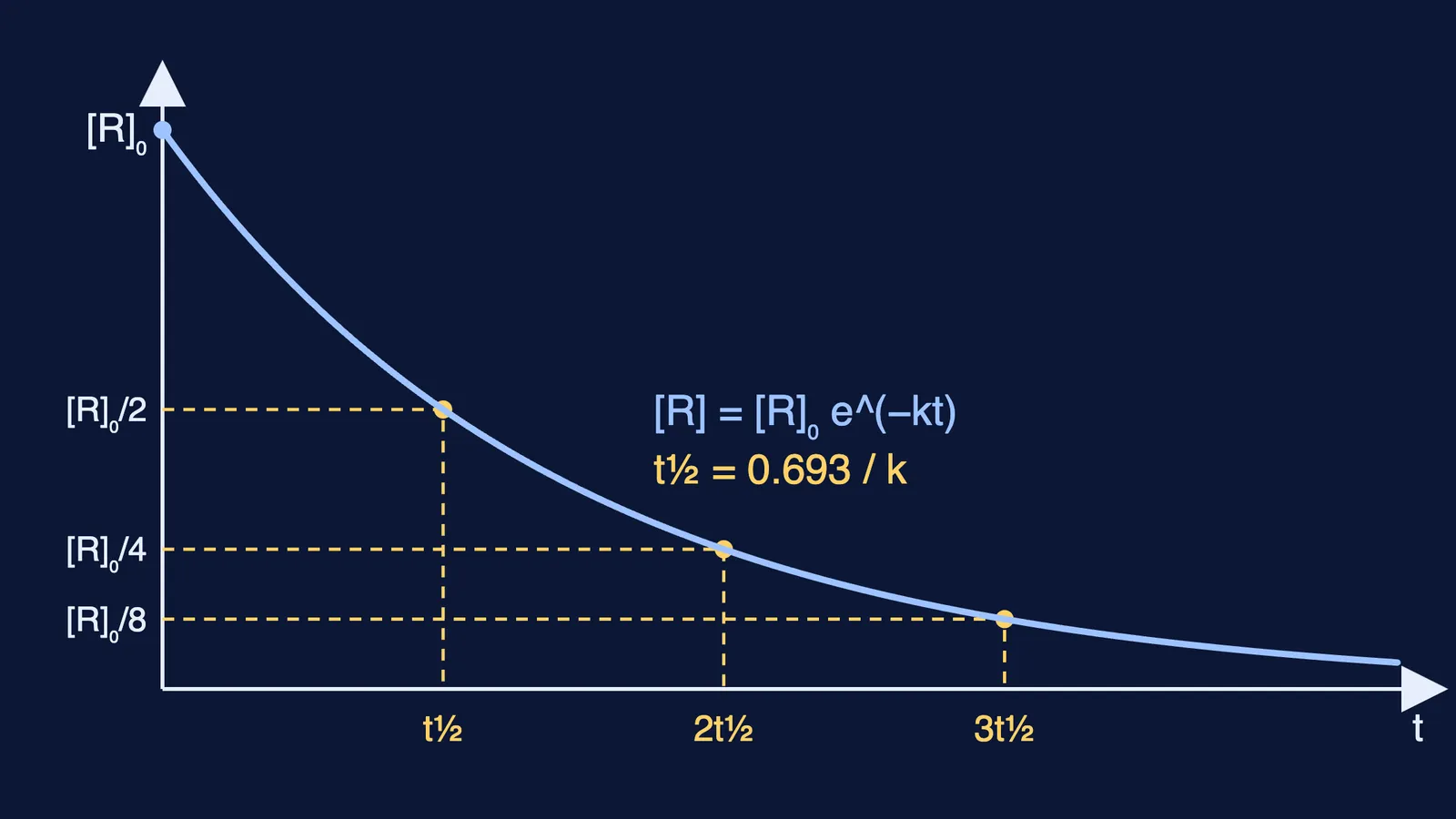
[R] = [R]₀ e^(−kt); ln[R] = ln[R]₀ − kt (k in s⁻¹)
k = (2.303/t) log([R]₀/[R]) (s⁻¹)
Between two times: k = [2.303/(t₂ − t₁)] log([R]₁/[R]₂) (s⁻¹)
Straight line: ln[R] against t (s), slope −k (s⁻¹)
t₁/₂ = 0.693/k (s), independent of [R]₀
Time for 99.9% completion ≈ 10 t₁/₂ in s (exactly ln 1000 / ln 2 ≈ 9.97 half-lives)
Gas phase A(g) → B(g) + C(g) at constant volume: p_A = 2pᵢ − p_t, and k = (2.303/t) log[pᵢ/(2pᵢ − p_t)] (pressures in atm, k in s⁻¹)
Worked example: a first order reaction has k = 4.0 × 10⁻³ s⁻¹. How long does [R] take to fall from 0.80 to 0.10 mol L⁻¹? t = (2.303 / 4.0 × 10⁻³ s⁻¹) × log 8 = 575.75 × 0.903 ≈ 520 s. Check: 0.80 → 0.10 is three half-lives of 173 s.
Watch for: the pressure formula is for one gas giving two; for 2N₂O₅ → 2N₂O₄ + O₂, rebuild the pressure table as NCERT Example 3.6 does.
How does temperature change the rate constant?
Symbols: A is the Arrhenius factor (units of k); Eₐ activation energy (J mol⁻¹); T in K.
Arrhenius equation: k = A e^(−Eₐ/RT) (k and A in the same units, e.g. s⁻¹ for first order)
Log form: ln k = ln A − Eₐ/RT; ln k against 1/T (K⁻¹) has slope −Eₐ/R (K)
Two temperatures: log(k₂/k₁) = [Eₐ / (2.303R)] × (T₂ − T₁)/(T₁T₂), Eₐ in J mol⁻¹, T in K (ratio has no unit); assumes Eₐ and A stay constant
e^(−Eₐ/RT): fraction of molecules with energy ≥ Eₐ (no unit)
Collision theory, bimolecular elementary reaction A + B: Rate = P Z_AB e^(−Eₐ/RT) (mol L⁻¹ s⁻¹, with Z_AB, the collision frequency, in the same units; P, the probability or steric factor, has no unit)
Worked example: k = 2.0 × 10⁻³ s⁻¹ at 300 K and Eₐ = 60 kJ mol⁻¹. Find k at 320 K. log(k₂/k₁) = [60 000 / (2.303 × 8.314)] × 20/(300 × 320) = 3134 × 2.083 × 10⁻⁴ ≈ 0.653, so k₂/k₁ ≈ 4.5 and k₂ ≈ 9.0 × 10⁻³ s⁻¹.
Watch for: convert kJ to J and °C to K first; 60 instead of 60 000 gives a ratio near 1.
How to revise this formula sheet
Write the first order equation three ways from memory and derive t₁/₂ = 0.693/k from one.
Read the order off the unit of k before calculating.
Build the pressure table for one new gas reaction a week.
Memorise log 2 = 0.301, log 3 = 0.477 and log 5 = 0.699 for quick 2.303 log steps.
Work the long-answer versions in our Class 12 chemical kinetics board exam guide, then try the chemical kinetics case study questions for Class 12.
If a numerical keeps going wrong at the same step, the Fermi Problem Library has worked problems with a step-by-step solver that explains the reasoning rather than printing an answer.