

On this page
Three original Chemical Kinetics cases for the CBSE Class 12 board exam, easy to hard. Try each on paper before reading the answers.
What do kinetics case-study questions test?
The CBSE Chemistry sample paper for 2026-27 has Section D with 2 case-based questions carrying 4 marks each. It also says log tables and calculators are not allowed, so every log you need is given in the passages below.
Chemical Kinetics is Unit 3 of the CBSE 2026-27 Chemistry curriculum. All three cases stay inside the rationalised NCERT Unit 3, Reprint 2026-27. For the full chapter, read our Chemical Kinetics Class 12 board exam guide.
Case 1: How do you find the order from initial rates?
Students at a school lab in Jaipur study a reaction P + 2Q → products at 298 K. They measure the initial rate three times. With [P] = 0.05 mol L⁻¹ and [Q] = 0.10 mol L⁻¹, the rate is 1.5 × 10⁻⁵ mol L⁻¹ s⁻¹. When they triple [P] to 0.15 mol L⁻¹ and keep [Q] at 0.10 mol L⁻¹, the rate becomes 1.35 × 10⁻⁴ mol L⁻¹ s⁻¹. When they go back to [P] = 0.05 mol L⁻¹ and double [Q] to 0.20 mol L⁻¹, the rate stays at 1.5 × 10⁻⁵ mol L⁻¹ s⁻¹. One student says Q must be second order because of its coefficient 2.
(i) The order with respect to Q is: (a) 2 (b) 1 (c) 0 (d) ½
(ii) What is the order with respect to P?
(iii) Write the units of the rate constant for this reaction.
(iv) Calculate k, and the initial rate when [P] = 0.10 mol L⁻¹ and [Q] = 0.30 mol L⁻¹. (2 marks)
Answers.
(i) (c) 0. Doubling [Q] leaves the rate unchanged. The student is wrong: NCERT says the rate law must be found by experiment, not read from the balanced equation.
(ii) 2. Tripling [P] multiplies the rate by 1.35 × 10⁻⁴ / 1.5 × 10⁻⁵ = 9 = 3².
(iii) Rate = k[P]², overall order 2, so k has units L mol⁻¹ s⁻¹.
(iv) k = 1.5 × 10⁻⁵ / (0.05)² = 1.5 × 10⁻⁵ / 2.5 × 10⁻³ = 6.0 × 10⁻³ L mol⁻¹ s⁻¹. New rate = 6.0 × 10⁻³ × (0.10)² = 6.0 × 10⁻⁵ mol L⁻¹ s⁻¹. [Q] does not enter.
Case 2: How long does a first-order drug last?
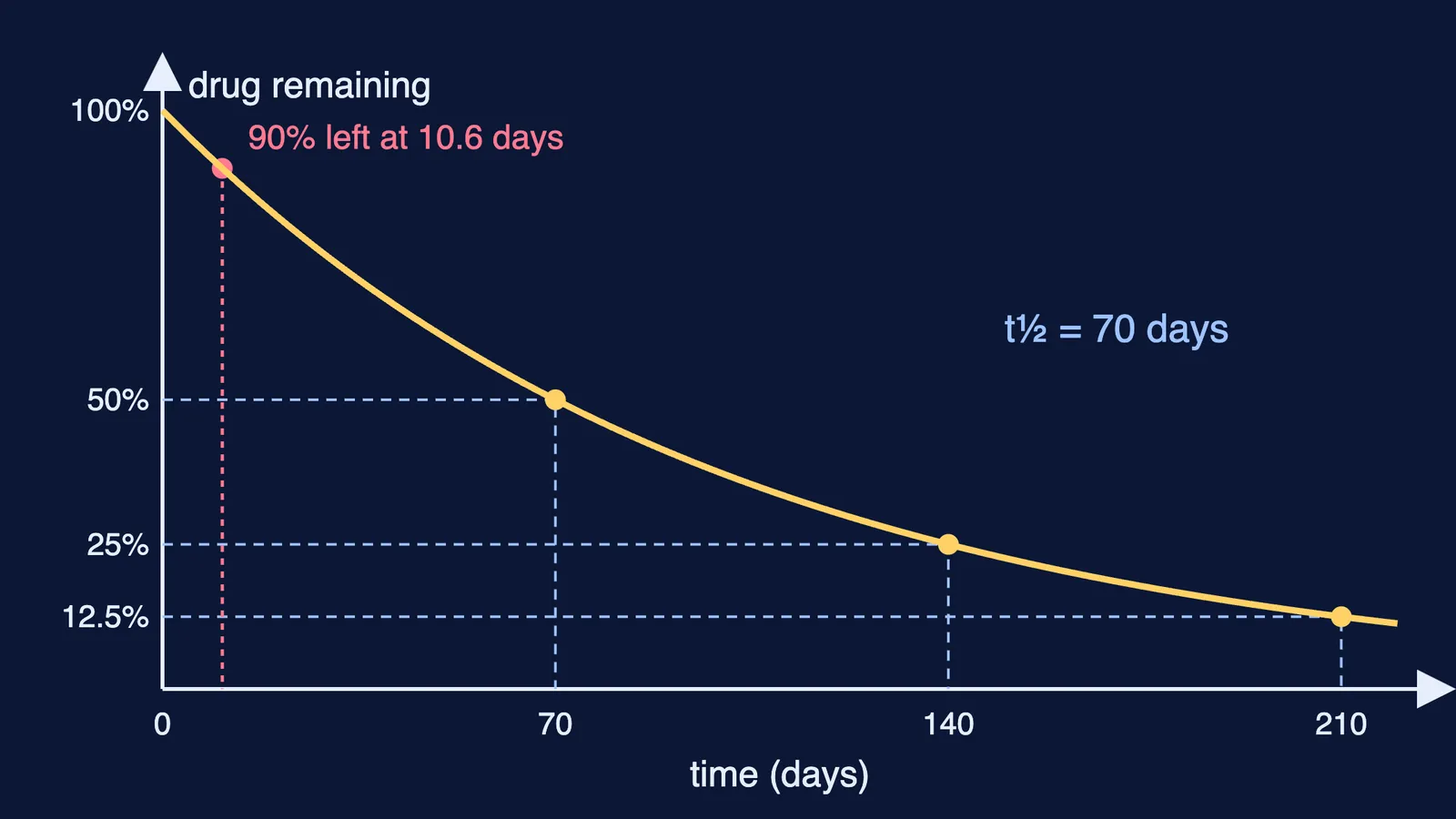
A hospital pharmacy in Kochi tests a liquid medicine whose active ingredient breaks down by first-order kinetics at room temperature. A fresh bottle holds 250 mg of the ingredient per 5 mL. The quality team finds that the content falls to 125 mg per 5 mL in 70 days. Their rule is simple: a batch must be discarded once it has lost 10% of its active ingredient. The pharmacist wants a discard date on each label. (Given: log 2 = 0.3010, log (10/9) = 0.0458.)
(i) How long does the content take to fall from 125 to 62.5 mg per 5 mL? (a) 35 days (b) 70 days (c) 140 days (d) 105 days
(ii) Calculate the rate constant.
(iii) How long until 87.5% of the ingredient has broken down?
(iv) After how many days must a batch be discarded? (2 marks)
Answers.
(i) (b) 70 days. For a first-order reaction the half-life is independent of the starting concentration, so each halving takes the same time.
(ii) k = 0.693 / t½ = 0.693 / 70 = 9.9 × 10⁻³ day⁻¹.
(iii) 87.5% gone means 12.5% = 1/8 left, which is three half-lives: 3 × 70 = 210 days.
(iv) 10% lost means [R]₀/[R] = 100/90 = 10/9. t = (2.303/k) log(10/9) = (2.303 / 9.9 × 10⁻³) × 0.0458 = 232.6 × 0.0458 ≈ 10.7 days. (Exact logs give 10.6 days, as graphed above.)
Case 3: Why does dal cook faster in a pressure cooker?
A food-science student in Hyderabad treats the softening of dal as a single first-order process, so that for the same degree of softening, cooking time is inversely proportional to the rate constant. In an open pan at 100 °C (373 K) her dal needs 48 minutes. In a pressure cooker that she holds at 120 °C (393 K), the same dal softens in 12 minutes. (Given: log 2 = 0.3010, R = 8.314 J K⁻¹ mol⁻¹, 373 × 393 = 146589.)
(i) The main reason the rate rises with temperature is that: (a) activation energy falls (b) the fraction of molecules with energy ≥ Ea rises (c) ΔG becomes more negative (d) the order of reaction changes
(ii) Find k(393 K)/k(373 K).
(iii) For the Arrhenius equation, which plot gives a straight line, and what is its slope?
(iv) Calculate Ea. (2 marks)
Answers.
(i) (b). NCERT explains that a rise in temperature increases the fraction of molecules with energy equal to or greater than Ea, the e^(−Ea/RT) factor. Ea itself does not change with temperature.
(ii) k₂/k₁ = t₁/t₂ = 48/12 = 4.
(iii) log k against 1/T is a straight line with slope −Ea/2.303R (or ln k against 1/T, slope −Ea/R).
(iv) log(k₂/k₁) = (Ea/2.303R) × (T₂ − T₁)/(T₁T₂). log 4 = 2 × 0.3010 = 0.6021. Ea = 2.303 × 8.314 × 0.6021 × 146589 / 20 = 19.147 × 0.6021 × 7329.45 ≈ 8.45 × 10⁴ J mol⁻¹ ≈ 84.5 kJ mol⁻¹.
How to attack case-study questions
Underline what changes and what stays fixed. Each pair of readings in Case 1 changes one concentration, so each pair gives one order.
Don't trust coefficients. An opinion about order based on the equation is usually the trap.
Convert words to ratios first. "10% lost" becomes [R]₀/[R] = 10/9; "87.5% gone" becomes 1/8 left, or three half-lives.
Check against rules of thumb. NCERT notes that the rate constant nearly doubles for a 10° rise. Case 3 gives 4 times over 20°, which fits, so 84.5 kJ mol⁻¹ is plausible.
Write units on every line. Units of k change with order; Ea comes out in J mol⁻¹.
For more practice in other formats, try our assertion-reason questions on Chemical Kinetics and the general guide to case-based questions in board exams. If a method keeps going wrong, the Fermi Problem Library has worked problems with a step-by-step solver that explains the reasoning rather than printing an answer.


