On this page
Chemical Kinetics is Unit 8 of Physical Chemistry in the NEET (UG) syllabus notified by the National Medical Commission: rate laws, order and molecularity, zero and first-order half-lives, the Arrhenius equation and collision theory. Every statement below was checked against NCERT Class 12 Chemistry, Unit 3 Chemical Kinetics (Reprint 2026-27).
How do you answer assertion-reason questions?
Mark each line true or false on its own. Only if both are true, ask whether R is the direct reason for A.
Use these keys for Q1 to Q6:
(A) Both A and R are true and R is the correct explanation of A.
(B) Both A and R are true but R is NOT the correct explanation of A.
(C) A is true but R is false.
(D) A is false but R is true.
More on the method: our assertion-reason question strategy.
Assertion-reason questions on chemical kinetics
Each answer below follows the NCERT Chemical Kinetics chapter.
Q1 (easy). Assertion (A): For 2NO(g) + O2(g) → 2NO2(g), NO disappears at the same rate as NO2 appears. Reason (R): NO and NO2 have the same stoichiometric coefficient in the balanced equation.
Answer: (A). Both are true and R explains A. The rate of reaction divides each species' rate of change by its coefficient; both coefficients are 2, so the two rates are equal.
Trap: comparing NO with O2, whose rate is half as large.
Q2 (easy). Assertion (A): A complex reaction has a molecularity equal to the sum of the molecularities of its steps. Reason (R): Molecularity is defined only for elementary reactions.
Answer: (D). A is false: NCERT says molecularity has no meaning for a complex reaction. R is true, and is why A fails.
Trap: confusing molecularity with order, which a complex reaction does have.
Q3 (medium). Assertion (A): In acidic solution, the inversion of cane sugar follows first-order kinetics even though water is also a reactant. Reason (R): Water is present in such large excess that its concentration hardly changes during the reaction.
Answer: (A). Both are true and R is the cause. With [H2O] almost constant, it folds into k, so rate = k[C12H22O11], a pseudo first order reaction.
Trap: thinking water "does not take part".
Q4 (medium). Assertion (A): Raising the temperature of a reaction increases its rate constant. Reason (R): A higher temperature lowers the activation energy of the reaction.
Answer: (C). A is true. R is false: Ea stays the same. Heating raises the fraction of molecules that collide with energy greater than Ea.
Trap: confusing heating with adding a catalyst.
Q5 (medium). Assertion (A): For a zero-order reaction, doubling the initial concentration doubles the half-life. Reason (R): The rate constant of a zero-order reaction has units of mol L−1 s−1.
Answer: (B). Both are true, but R is not the reason. The integrated law [R] = [R]0 − kt gives t½ = [R]0/2k, so t½ is proportional to [R]0. The units of k are a separate fact.
Trap: accepting a true, related fact as the cause.
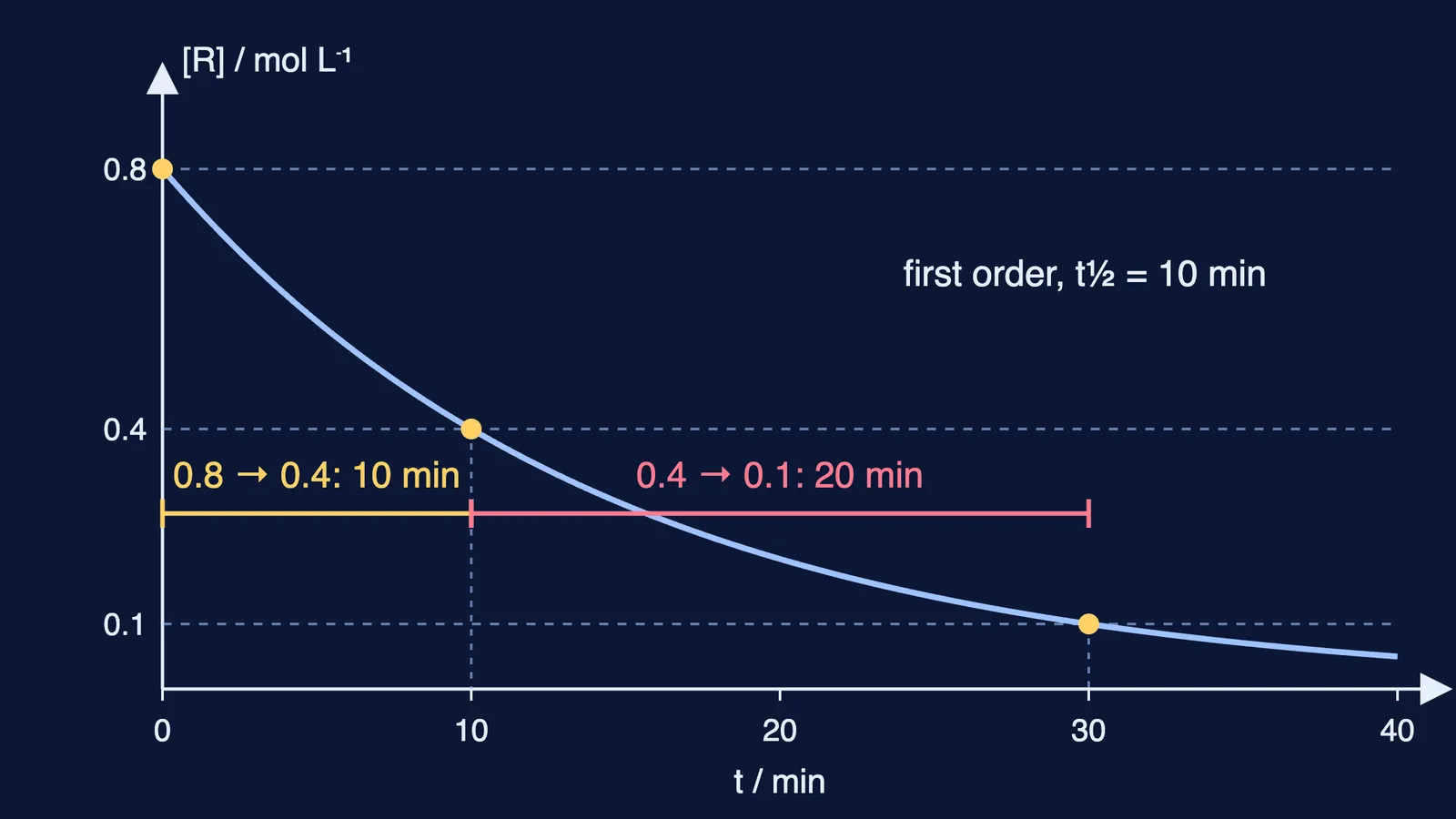
Q6 (hard). Assertion (A): For a first-order reaction, [R] takes as long to fall from 0.8 M to 0.4 M as from 0.4 M to 0.1 M. Reason (R): The half-life of a first-order reaction does not depend on the initial concentration.
Answer: (D). A is false: 0.8 to 0.4 M is one half-life, but 0.4 to 0.1 M is two. With t½ = 10 min, that is 10 min against 20 min. R is true.
Trap: zero-order thinking, assuming equal drops take equal times.
Statement I and Statement II questions
These also follow the NCERT Chemical Kinetics chapter. Use these keys for Q7 to Q10:
(A) Both statements are correct.
(B) Both statements are incorrect.
(C) Statement I is correct, Statement II is incorrect.
(D) Statement I is incorrect, Statement II is correct.
Q7 (medium). Statement I: Adding a catalyst leaves the ΔG of a reaction unchanged. Statement II: A suitable catalyst can make a non-spontaneous reaction take place.
Answer: (C). Statement I is correct. Statement II is wrong: NCERT states that a catalyst speeds up spontaneous reactions but does not catalyse non-spontaneous ones.
Trap: treating a catalyst as an energy source.
Q8 (medium). Statement I: In k = A e^(−Ea/RT), e^(−Ea/RT) gives the fraction of molecules whose kinetic energy exceeds Ea. Statement II: A plot of ln k against 1/T is a straight line with slope −Ea/R.
Answer: (A). Both are correct. Taking logs gives ln k = ln A − Ea/RT, a straight line in 1/T with slope −Ea/R and intercept ln A.
Trap: using −Ea/2.303R, which is the slope of log k, not ln k.
Q9 (hard). Statement I: The order of a reaction can always be read from the stoichiometric coefficients of the reactants in its balanced equation. Statement II: A rate constant of 2.0 × 10⁻³ L mol−1 s−1 shows that a reaction is first order.
Answer: (B). Both are wrong. Order is found by experiment and may differ from the coefficients. Units of L mol−1 s−1 mean second order; first order has s−1 only.
Trap: seeing s−1 and stopping there.
Q10 (hard). Statement I: For a first-order reaction, a plot of [R] against time is a straight line with slope −k. Statement II: A zero-order reaction with k = 0.020 mol L−1 min−1 and [R]0 = 0.50 mol L−1 has a half-life of 12.5 min.
Answer: (D). Statement I is wrong: for first order, ln [R] against t is the straight line with slope −k; [R] itself decays exponentially. Statement II is correct: t½ = [R]0/2k = 0.50/0.040 = 12.5 min.
Trap: swapping the straight-line plots of zero and first order.
How should you use this set?
Attempt all ten without notes, marking each line T or F before choosing a key.
For every miss, write what you misjudged: A, R, or the link.
Redo the misses after three days, then try our Chemical Kinetics NEET practice questions with solutions.
If order and molecularity still blur together, the Fermi Concept Library gives every concept in chemistry its own lesson and its place in the map. For a full plan for the chapter, read Chemical Kinetics for NEET: how to prepare, with worked examples.