On this page
The d- and f-Block Elements is Unit 4 of the NCERT Class 12 Chemistry textbook, Part I (reprint 2026-27). The CBSE Chemistry syllabus for 2026-27 lists its topics, from electronic configuration and general properties to important compounds, lanthanoids, actinoids and applications. Below are its key terms in our own words. For answers and a revision plan, see our d- and f-block elements Class 12 chapter guide.
What makes an element a transition element?
All facts in this section are from the NCERT chapter.
d-block elements: groups 3 to 12, where electrons fill the d orbitals of the second-last shell. There are four series: 3d (Sc to Zn), 4d (Y to Cd), 5d (La, Hf to Hg) and 6d.
Transition metal: by the IUPAC definition, a metal with an incomplete d subshell in the neutral atom or in its ions. Example: scandium (3d¹). Don't confuse with: zinc, cadmium and mercury, which keep a full d¹⁰ set in the atom and their common ions, so they are not transition metals, though the chapter studies them alongside.
Inner transition elements (f-block): elements in which 4f or 5f orbitals fill, shown in a separate panel below the main table.
General outer configuration: (n−1)d¹⁻¹⁰ ns¹⁻², with exceptions. Example: chromium is 3d⁵4s¹ and copper 3d¹⁰4s¹, because half-filled and full d sets are extra stable and the 3d–4s gap is small.
Which properties of transition metals should you know?
Values here come from Tables 4.2 to 4.8 of the NCERT chapter.
Enthalpy of atomisation: the energy needed to break a metal into separate gaseous atoms. It is high for transition metals because many unpaired electrons make metallic bonding strong. Example: zinc has the lowest value in the 3d series, 126 kJ/mol.
Exchange energy: extra stability that grows with the number of electron pairs with parallel spins in orbitals of equal energy. It explains why d⁵ ions such as Mn²⁺ resist losing another electron.
Variable oxidation states: one metal forming compounds in several oxidation states that usually differ by one. Example: manganese shows every state from +2 to +7. Don't confuse with: p-block elements, whose states usually differ by two.
Disproportionation: one species turning into a higher and a lower oxidation state of the same element. Example: in acid, manganate(VI) gives permanganate(VII) and MnO₂ (IV); Cu⁺ in water gives Cu and Cu²⁺.
Standard electrode potential, E°(M²⁺/M): the reduction potential of the M²⁺/M couple; the more negative it is, the more readily the metal forms M²⁺ in water. Example: copper's is +0.34 V, so it cannot release hydrogen from non-oxidising acids.
Paramagnetism: weak attraction into a magnetic field, caused by unpaired electrons. Don't confuse with: diamagnetism (repelled, all electrons paired) and ferromagnetism (very strong attraction, an extreme form of paramagnetism).
Spin-only magnetic moment: μ = √(n(n+2)) Bohr magnetons (BM), with n the count of unpaired electrons. Example: Mn²⁺ has five, giving 5.92 BM; one unpaired electron gives 1.73 BM.
d–d transition and colour: a d electron jumps to a higher d orbital by absorbing visible light, and we see the complementary colour. Example: Cu²⁺(aq) is blue, while Sc³⁺ (d⁰) and Zn²⁺ (d¹⁰) are colourless.
Complex compound: a central metal ion holding a set of ions or neutral molecules around it. Example: [Cu(NH₃)₄]²⁺.
Catalytic property: speeding up reactions by changing oxidation state or binding reactants on a surface. Example: V₂O₅ in the Contact process, iron in the Haber process, nickel in hydrogenation.
Interstitial compound: small atoms such as H, C or N trapped in the gaps of a metal lattice, usually non-stoichiometric. Example: TiC, Fe₃H.
Alloy: a blend of metals; atoms with radii within about 15 percent mix easily. Example: brass (copper and zinc). Don't confuse with: interstitial compounds, where non-metal atoms sit in the gaps.
Which compounds does the chapter cover?
From section 4.4 of the NCERT chapter.
Potassium dichromate (K₂Cr₂O₇): orange oxidant made from chromite ore (FeCr₂O₄) and used as a primary standard in titrations. In acid, dichromate is reduced to Cr³⁺.
Chromate–dichromate change: yellow chromate turns into orange dichromate when acid is added, and back with alkali. Don't confuse with: a redox reaction; chromium stays +6 in both.
Potassium permanganate (KMnO₄): dark purple oxidant made by fusing MnO₂ with KOH and an oxidising agent, then converting green manganate to permanganate. In acid it is reduced to Mn²⁺, in neutral solution to MnO₂.
Manganate vs permanganate: manganate (MnO₄²⁻) is green and paramagnetic with one unpaired electron; permanganate (MnO₄⁻) is purple and diamagnetic.
Amphoteric oxide: an oxide that reacts with both acids and bases. Example: V₂O₅ and Cr₂O₃. Higher oxides such as Mn₂O₇ and CrO₃ are acidic.
How are lanthanoids and actinoids different?
From sections 4.5 and 4.6 of the NCERT chapter.
Lanthanoids: the 14 elements after lanthanum (Ce to Lu), filling 4f; +3 is the usual oxidation state. Symbol Ln.
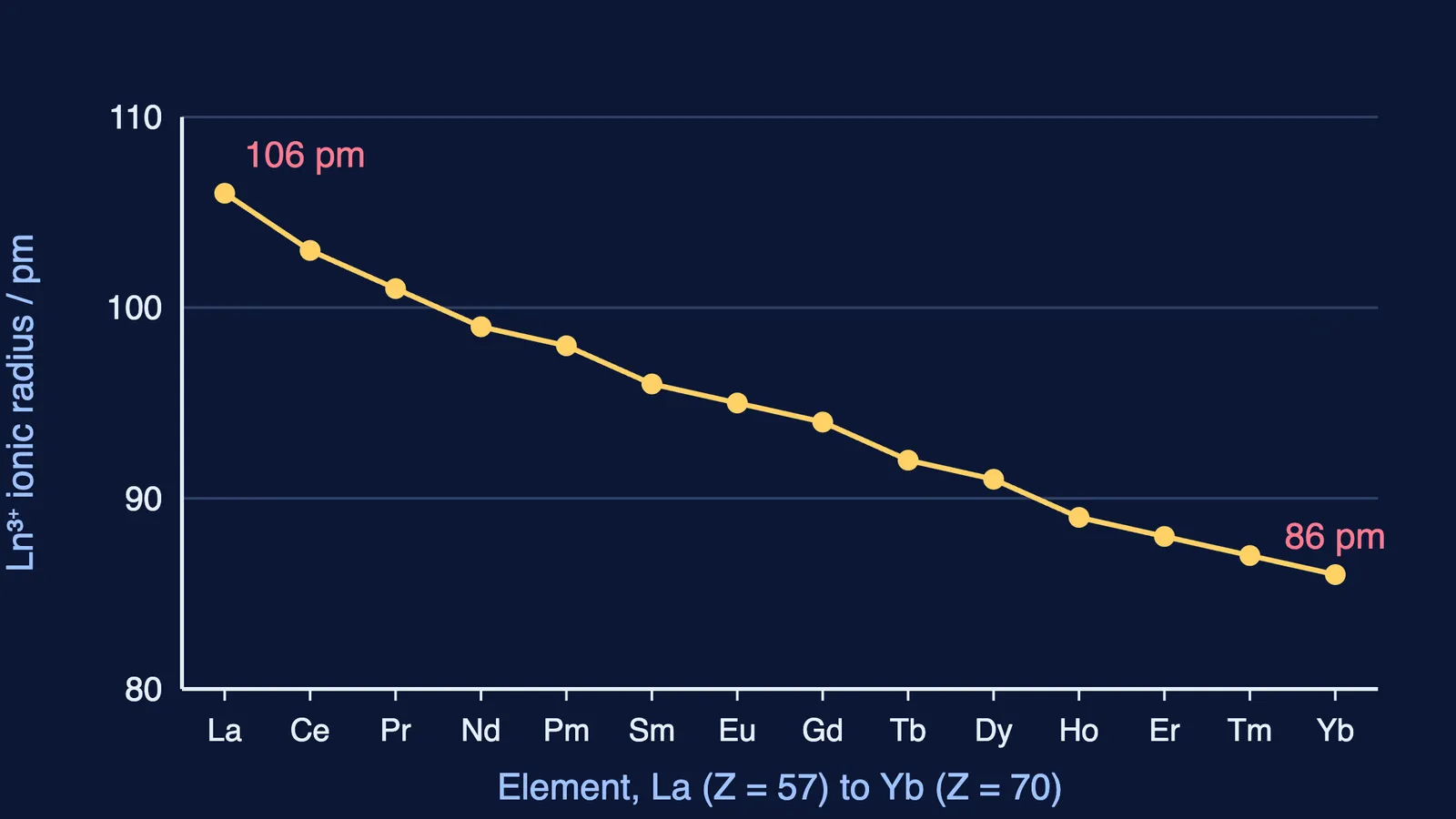
Lanthanoid contraction: the overall shrinking of atoms and Ln³⁺ ions from La to Lu (smooth for the ions, uneven for the atoms), because 4f electrons shield each other poorly. Example: it makes zirconium (160 pm) and hafnium (159 pm) almost the same size and hard to separate.
Unusual lanthanoid states: Ce⁴⁺ is a strong oxidant and Eu²⁺ a strong reducing agent, because both drift back to +3.
Actinoids: the 14 elements from thorium to lawrencium, filling 5f; all radioactive. They show more oxidation states because 5f, 6d and 7s energies are close. Example: neptunium reaches +7.
Actinoid contraction: the matching shrink across the actinoids, larger from one element to the next because 5f electrons shield even more poorly. Don't confuse with: lanthanoid contraction, the smaller step per element.
Mischmetall: an alloy of about 95 percent lanthanoid metal and 5 percent iron, used in lighter flints.
How to learn these terms
Pair opposites: paramagnetic and diamagnetic, chromate and dichromate, manganate and permanganate, lanthanoid and actinoid contraction.
Write the 3d series with each ion's d count, then work out colour and magnetic moment for five ions. Check against Tables 4.7 and 4.8 of NCERT.
Sketch the falling Ln³⁺ radius curve and note zirconium and hafnium beside it.
Practise using the terms in full answers with our d- and f-block case study questions for Class 12 and d- and f-block assertion-reason questions.
If a term still feels shaky, the Fermi Concept Library has every concept in chemistry, each with its own lesson.