

On this page
d- and f-block assertion-reason questions test whether a true reason is the real cause or just a true fact standing beside the assertion. Here are 10 original items (6 assertion-reason, 4 Statement I/II pairs), easy to hard, each built on a common slip.
Every item stays inside Unit 11, d- and f-Block Elements, of the NMC's NEET (UG)-2026 syllabus, and every statement is checked against Unit 4 of NCERT Class 12 Chemistry Part I, Reprint 2026-27. New to the chapter? Start with our guide on how to prepare d- and f-Block Elements for NEET.
How do you answer assertion-reason questions on d- and f-block elements?
Judge A and R separately first. Then ask: if R were all you knew, would A follow? Write the configuration before reading R.
The keys are the same for every assertion-reason item below:
(A) Both A and R are true and R is the correct explanation of A.
(B) Both A and R are true but R is NOT the correct explanation of A.
(C) A is true but R is false.
(D) A is false but R is true.
Assertion-reason questions on d- and f-block elements
Q1 (easy). Assertion (A): Zinc is not regarded as a transition metal. Reason (R): Zinc has a completely filled 3d subshell both in its ground state and in its common +2 oxidation state.
Answer: (A). Both are true. NCERT excludes Zn, Cd and Hg from the transition metals for exactly R's reason: no incomplete d subshell.
Trap: picking (D) because zinc sits in the d-block.
Q2 (easy). Assertion (A): In the first transition series, manganese shows the highest oxidation state, +7. Reason (R): Manganese has the largest number of 3d electrons in the series.
Answer: (C). A is true. R is false: manganese has five 3d electrons, and iron to zinc have more. The +7 state uses all of manganese's 4s and 3d electrons.
Trap: thinking more d electrons means higher oxidation states.
Q3 (medium). Assertion (A): In aqueous solution, Cu⁺ tends to convert into Cu²⁺ and copper metal. Reason (R): Cu⁺ has a 3d¹⁰ configuration.
Answer: (B). Both are true, but R is not the cause. NCERT explains it by the much more negative hydration enthalpy of Cu²⁺(aq), which more than compensates for copper's second ionisation enthalpy.
Trap: treating any stable configuration as the explanation.
Q4 (medium). Assertion (A): In group 6, Cr(VI) is more stable than Mo(VI) and W(VI). Reason (R): In the p-block, heavier members of a group favour lower oxidation states because of the inert pair effect.
Answer: (D). R is true, but NCERT notes the d-block does the opposite: Mo(VI) and W(VI) are more stable than Cr(VI).
Trap: carrying a p-block trend into the d-block.
Q5 (hard). Assertion (A): Zirconium and hafnium occur together in nature and are hard to separate. Reason (R): Because of the lanthanoid contraction, their atomic radii are almost identical.
Answer: (A). NCERT gives Zr 160 pm and Hf 159 pm, calls this a consequence of the lanthanoid contraction, and says it accounts for both facts in A.
Trap: choosing (B); here NCERT names the radii as the cause.
Q6 (hard). Assertion (A): Ce⁴⁺ is a strong oxidising agent. Reason (R): Ce⁴⁺ has a noble gas configuration.
Answer: (B). Both are true. The noble gas configuration explains why Ce⁴⁺ forms; it oxidises because it reverts to the common +3 state, with E°(Ce⁴⁺/Ce³⁺) = +1.74 V in NCERT.
Trap: reading a stable configuration as the reason for oxidising power.
Statement I and Statement II questions on d- and f-block elements
The keys for every statement pair:
(A) Both statements are correct.
(B) Both statements are incorrect.
(C) Statement I is correct, Statement II is incorrect.
(D) Statement I is incorrect, Statement II is correct.
Q7 (easy). Statement I: Adding acid to a yellow chromate solution turns it orange as dichromate forms, and adding alkali reverses the change. Statement II: Chromium is +6 in chromate and +7 in dichromate.
Answer: (C). Statement I matches NCERT: acid turns CrO₄²⁻ into Cr₂O₇²⁻ and alkali reverses it. In Cr₂O₇²⁻, 2x − 14 = −2 gives x = +6, the same as in chromate.
Trap: assuming the yellow-to-orange change means a new oxidation state.
Q8 (medium). Statement I: Eu²⁺ has a half-filled 4f⁷ configuration, yet it is readily oxidised to Eu³⁺, which makes it a strong reductant. Statement II: Apart from La³⁺ and Lu³⁺, which are colourless, trivalent lanthanoid ions are coloured, and the colour is linked to their f electrons.
Answer: (A). Both match NCERT. Eu²⁺ (4f⁷) forms by losing the two 6s electrons yet reverts to the common +3 state, and NCERT attributes the colour of Ln³⁺ ions to f electrons; La³⁺ (4f⁰) and Lu³⁺ (4f¹⁴) show none.
Trap: deciding Eu²⁺ must be stable, and so not reducing, because 4f⁷ is half-filled.
Q9 (medium). Statement I: The intense purple colour of KMnO₄ comes from d-d transitions in manganese(VII). Statement II: MnO₄²⁻ has one unpaired electron, but MnO₄⁻ has none.
Answer: (D). Mn(VII) is 3d⁰, so no d-d transition is possible; NCERT says molecular orbital theory explains the colour. Statement II is correct: manganate (Mn(VI), 3d¹) is paramagnetic and permanganate (3d⁰) is diamagnetic.
Trap: using "coloured ion means d-d transition" without counting d electrons.
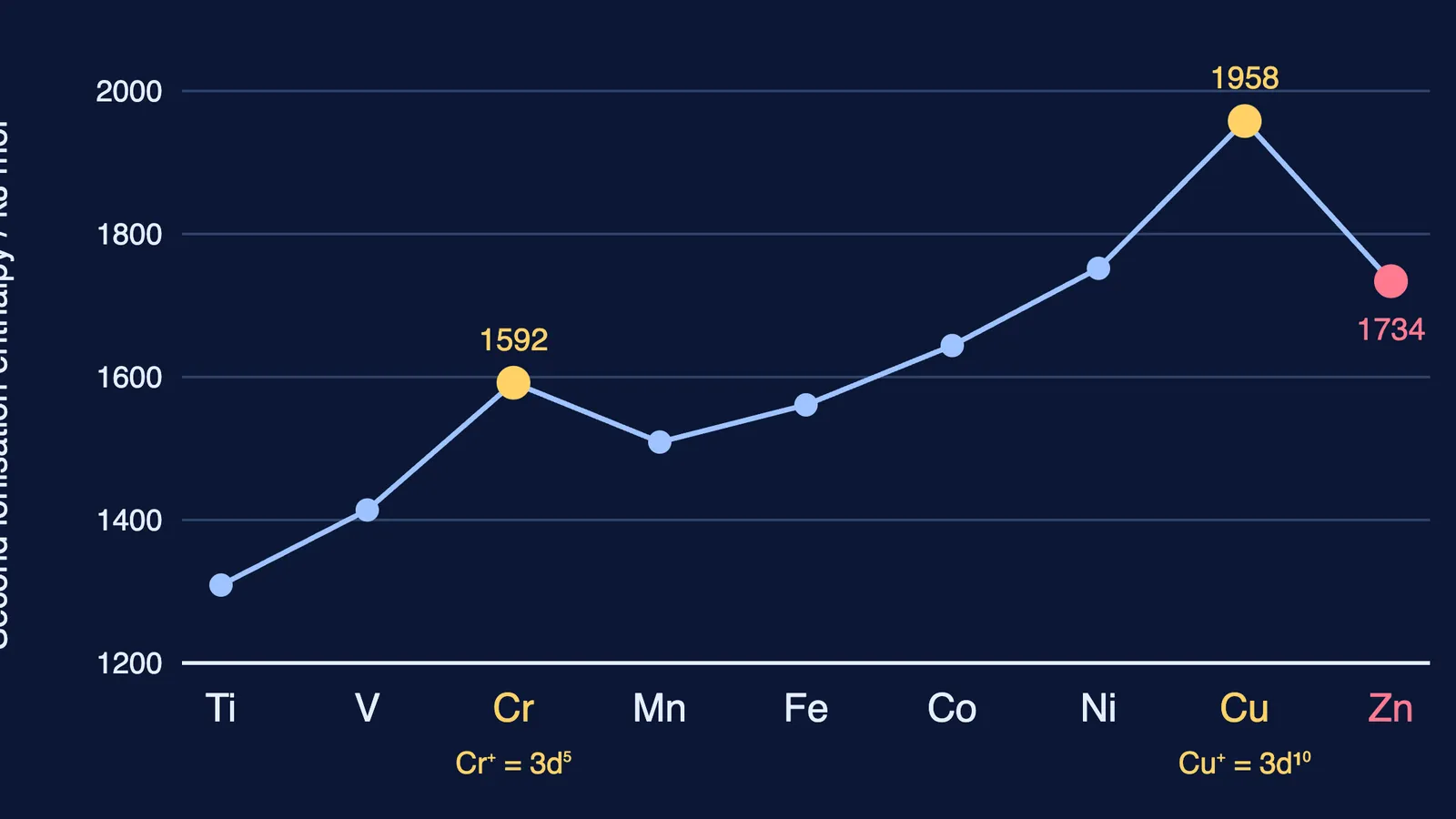
Q10 (hard). Statement I: Zinc's second ionisation enthalpy is unusually high, because removing a second electron breaks the stable 3d¹⁰ configuration. Statement II: The third ionisation enthalpies of Mn and Zn are unusually low.
Answer: (B). NCERT's Table 4.4 gives zinc 1734 kJ mol⁻¹, below copper's 1958, because zinc's second electron comes from 4s and leaves 3d¹⁰ intact. Mn and Zn have high third ionisation enthalpies, since that electron must come from a d⁵ (Mn²⁺) or d¹⁰ (Zn²⁺) ion.
Trap: copying copper's reasoning; Zn⁺ still has a 4s electron to lose.
How should you use this set?
Write a key for all ten before checking.
For each miss, note whether you misjudged a statement or the link.
Redo every miss after three days.
If link calls slip, our assertion-reason strategy guide walks through the method, and the d- and f-block NEET practice questions add single-correct practice. When the gap is a concept, such as why lanthanoid contraction happens, the Fermi Concept Library has a lesson on every concept in chemistry, each placed in its map.


